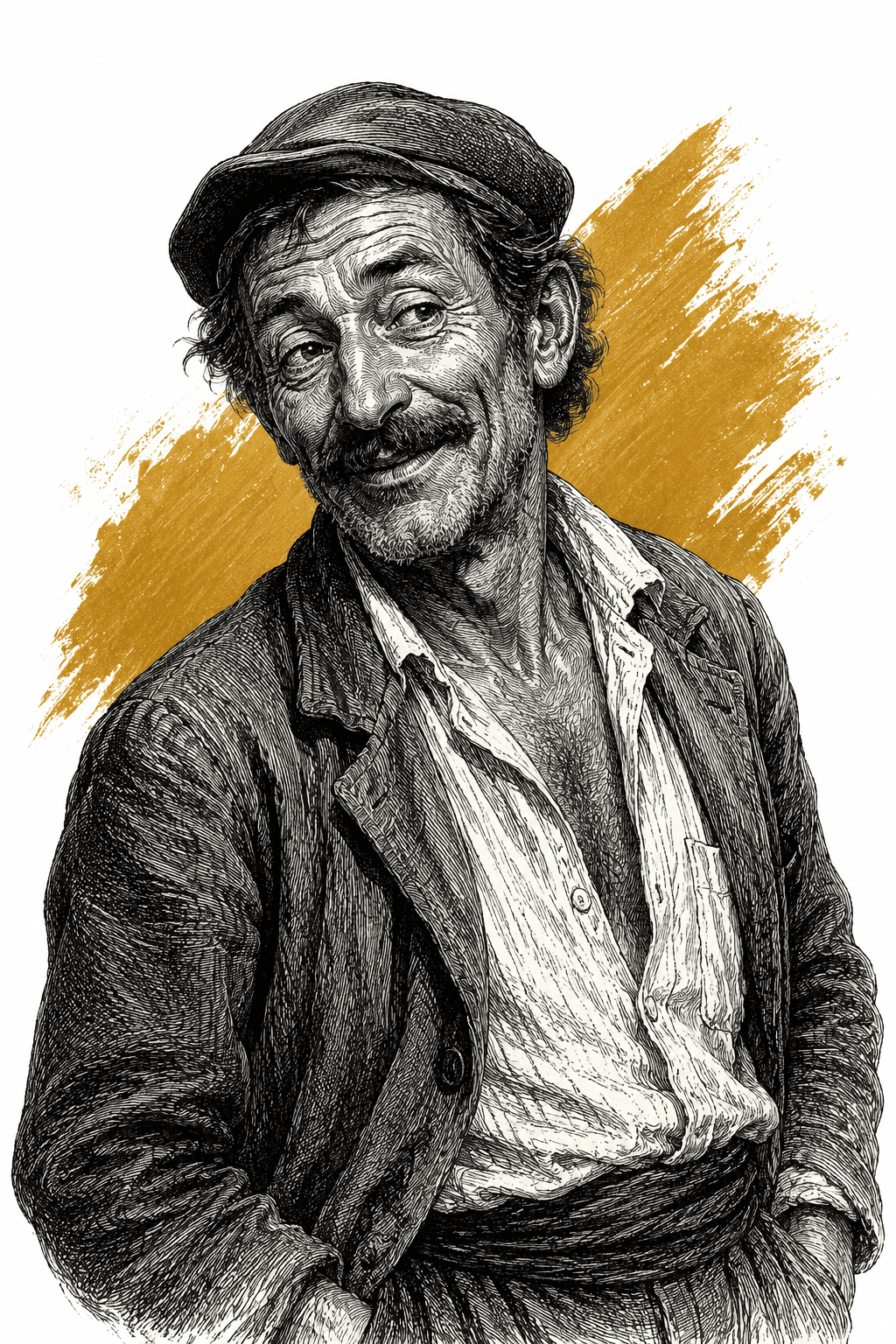
Peduzzi
An elderly odd-job man in an Italian mountain town who talks a visiting couple into an afternoon's illegal fishing, and drinks their marsala.
To be walking down the main street of Cortina in company, as somebody worth hiring. He calls the wife up from behind to walk abreast of them, greets everyone he passes by name, and afterwards insists on the same again tomorrow at seven, with bread, salami, cheese, minnows for bait, and perhaps some marsala.
The book

At a glance
- "Out of Season" only
- Cortina d'Ampezzo, in the Italian Dolomites, in the early spring
- Hotel gardening, odd jobs, and selling frogs; a former soldier, in an old military coat
- A young English-speaking man and his wife, whom he calls Signorina, Signora, and eventually caro
- Fishing is out of season and forbidden — a fact he dismisses each time it is raised
- Ten lire for the wine, and four more borrowed against tomorrow
Who they are in the book
Spoiler-freePeduzzi is an old man in Cortina d'Ampezzo, in the Italian Dolomites, who spades the hotel garden and breaks up frozen manure with a dung fork for a few lire a day. He carries "Out of Season," a story in which he offers to guide a young English-speaking couple to the trout and the afternoon comes apart in his hands.
He is drunk before the party sets off, having spent his four lire and got three more grappas on credit. Fishing is out of season and forbidden, which he waves away. Nothing that follows works: nobody in the town returns his greetings, the wine shop is shut, the wife walks back to the hotel, and the fishing cannot happen because nobody has brought any lead for the line. He treats every step of it as a triumph.
How Peduzzi Is Portrayed
- What he does for a livingOdd jobs at the hotel — a day's spading is worth four lire, and by the end of the story he is glad to think he is through with breaking up frozen manure with a dung fork. He also mentions that he sells frogs. He wears an old military coat and says he has been a soldier.
- Drunk from the start"On the four lire Peduzzi had earned by spading the hotel garden he got quite drunk." At the cantina by the bridge they let him have three more grappas on credit, because he is so confident and mysterious about the job he has that afternoon.
- The walk through townHe greets everyone elaborately and tips his hat. The bank clerk stares at him from the door of the Fascist café; groups outside the shops stare; the workmen on the new hotel's foundations look up. "Nobody spoke or gave any sign to them except the town beggar, lean and old, with a spittle-thickened beard, who lifted his hat as they passed."
- The languagesHe talks fast, with a great deal of winking, part of the time in the d'Ampezzo dialect and part in Tyroler German. Unable to work out which the couple follows better, he tries being bilingual, then settles on Tyroler. Neither of them understands a word of it.
- Money, asked for sidewaysHe takes hold of the young man's sleeve and says "Geld" and then "Lire," embarrassed but needing to get things moving. Handed a bottle of marsala on the riverbank, he passes it back twice, insists it is not his, and then drinks the whole thing, the grey hairs in the folds of his neck moving as he swallows. Afterwards he asks to borrow five lire for a favour and is given four.
- Two things go wrong at the waterHe has said the good stretch is half an hour further down; standing at a brown, muddy river beside a dump heap he says it is good here too. Then it turns out nobody has any lead for the line, without which the bait will float. He searches the linings of his military pockets and finds none. The young man reels in and says they will fish tomorrow.
- "My daughter"Passing a house on the way down the hill he points to a girl in the doorway and says she is his daughter. The wife, who cannot follow the Italian, hears something else entirely and asks whether he has to show them his doctor. The girl goes inside.
The couple's own quarrel runs underneath the whole afternoon: he apologises for the way he talked at lunch, she says none of it makes any difference, and she walks back to the hotel alone. Hemingway never says what the quarrel was about. The title is doing more work than the fishing licence.
If you like In Our Time


If you like Ernest Hemingway
Explore authors with a similar voice, perspective, and influence.

Louis-Ferdinand Céline
The other great stylist the Great War produced — where Hemingway cut the language down, Céline set it on fire. The same wound, opposite treatments.
View author
Henry Miller
Paris on no money a decade later, with the restraint removed. Miller called Hemingway's Paris a tourist's Paris; readers get to referee.
View author
Martha Gellhorn
War correspondent who covered the Spanish Civil War, D-Day, and conflicts across five more decades; Hemingway's third wife, 1940–1945.
View author