Paris Salons, Cafés, Studios quotes
16 passages from Paris Salons, Cafés, Studios by Sisley Huddleston, each quoted verbatim from the text and placed at the address in Paris where the scene happens.

About Sisley Huddleston
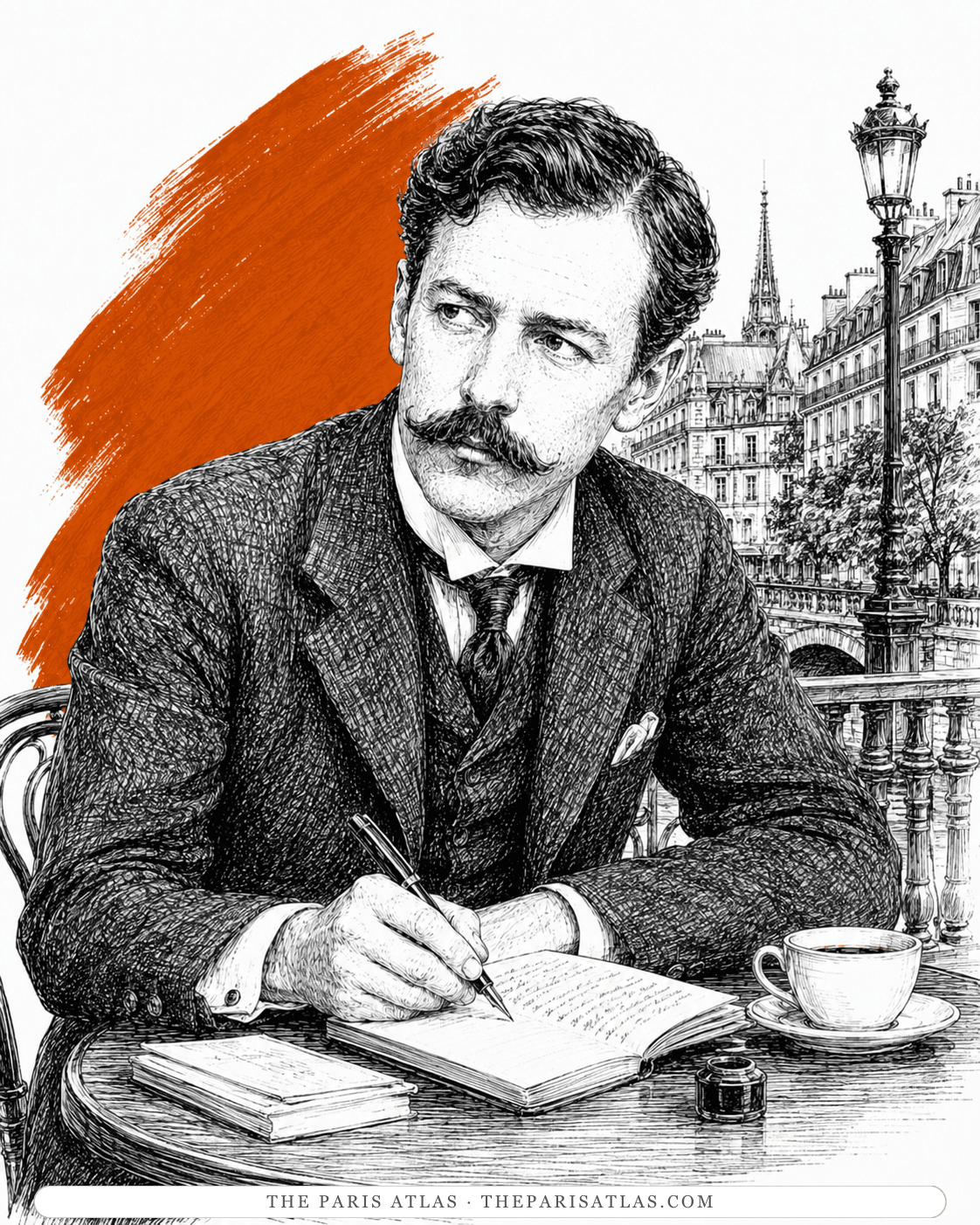
The evenings of the Closerie des Lilas come back to me vividly. The Prince of Poets sat in state on an upholstered bench of the café; while around him was his court of writers … To the drinking of coffee and of bocks, poetry was recited, analysed, and appraised.
Once upon a time the Closerie des Lilas at the corner of the Boulevard du Montparnasse was a guinguette — a country-inn on the route to Fontainebleau. Baudelaire frequented it.
My attention was first called to them by a tremendous row one evening at the Closerie des Lilas. Chairs hurtled through the air, crockery crashed through the window.
At the Closerie des Lilas you will mostly find Poles. At the Rotonde you will find Italians, Spaniards, and Balkanics — with a sprinkling of French. At the Dome there are Scandinavians, British, and Americans.
Their photographs were pinned on the walls above the bowl of goldfish. In the back parlour there were manuscripts of Walt Whitman — poems scribbled on the backs of envelopes — which had been presented by the good grey poet to the aunt of Sylvia Beach …
‘It is impossible,’ said Joyce. ‘You will lose money.’ ‘Nothing is impossible,’ replied Sylvia Beach with American determination. ‘It will not interest the public,’ returned Joyce. ‘It is a masterpiece,’ declared Miss Beach, ‘and come what may it must appear.’
He could hardly set foot out of doors without entering the great gates of the Luxembourg Gardens with its old world terrace, its ancient trees, its Seventeenth Century palace.
It is, of course, easy to parody Hemingway: — ‘What are you doing?’ ‘Nothing particular.’ ‘Well, let’s go over to the Select.’ ‘Righto!’ We went over to the Select. I was feeling rather bad. He looked pretty sick too. We sat down. The waiter came — the fat one.
Occasionally they roll up in beautiful automobiles dressed as for the Opera, swallow-tail coats and white ties, gorgeous evening robes and cloaks; and they make a fine display of pearls and diamonds at the Rotonde. But this is exceptional. Generally they are content to put on rakish clothes as though they were Haroun al-Raschid descending in disguise to the lower town.
So the parties were transferred to a Bal Musette behind the Pantheon. It was in a working-class district, and the habitual dancers were astonished at this strange apparition of artists and writers and hangers-on.
There was to be an orchestra of pianos not played by hand but by machinery. Sixteen pianolas connected and synchronised, their sound magnified by loud speakers and a large buzzing electric fan adding to the uproar, were promised us if we would attend the Théâtre des Champs-Elysées. The torrent of sound was to be unimaginable.
People turned up their coat collars, put on their hats, opened their umbrellas, yelled and hooted against the buzzers. Ezra Pound, in a flowing blue shirt, stood up and raised his voice above the hubbub. One could distinguish such words as ‘Idiot! Imbecile! Ignoramus! Philistine!’ But there were louder roars of laughter.
That evening — though it is but one of many — we — that is to say Ford Madox Ford, Pierre Loving, Pound, and myself — gaily played with ideas for hours, in the upper room on the Boulevard Saint-Michel, next to the mock Oriental building of the Bal Bullier.
What a vivacious evening we spent for example in an upper room chez Emile! Emile is a picturesque Alsatian restaurant keeper, perpetually dressed in white twill clothes, and a high cook's bonnet.
Astonished we were when Pound suddenly announced that he had turned musician. He had set to music some of the songs from the Testament of François Villon, one of the earliest and most poignant of French poets. We were bidden to the home of Mrs. Christian Gross in the Avenue Charles Floquet, to hear ‘Quatre Chansons du Testament, Paroles de Villon, Musique d’Ezra Pound.’
‘Critics who were most appreciative of “Ulysses,”’ he told me as we talked together one afternoon in his cool quiet study by the Champ de Mars, ‘are complaining about my new work. They cannot understand it. Therefore they say it is meaningless. Now if it were meaningless it could be written quickly, without thought, without pains, without erudition; but I assure you that these twenty pages now before us cost me twelve hundred hours and an enormous expense of spirit.’
Newsletter
Join our newsletter
New stories about art, literature and famous places around the world.