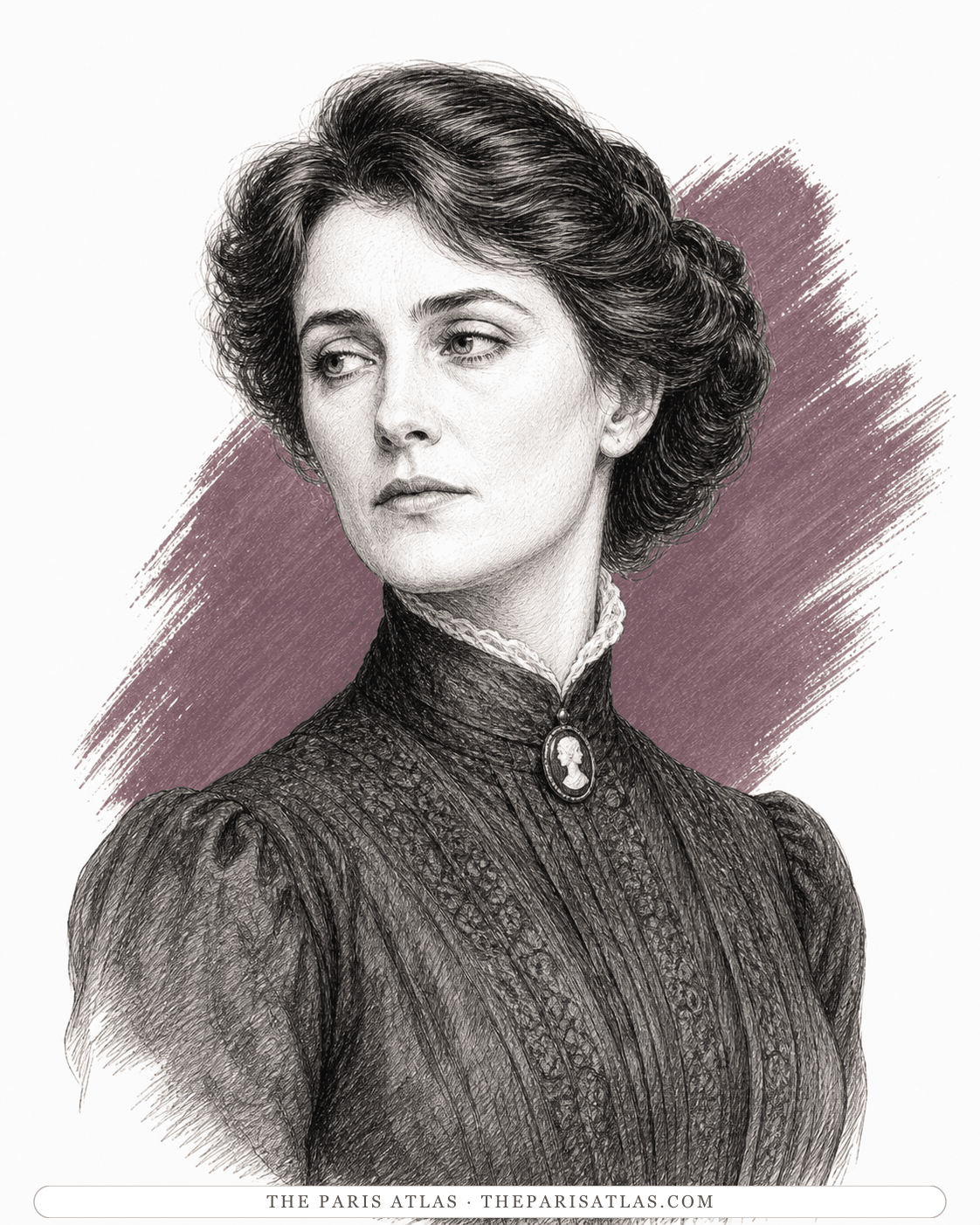
Anna Gordon
Stephen's mother: an Irishwoman who adored her husband, could not make herself touch her daughter, and did not know why until she was shown a letter.
To love her daughter, and to keep her husband. She prays in so many words to be given peace and enlightenment so that she may learn how to love her own child, and she goes on failing.
The book

At a glance
- Book One and Book Two; appears once more, briefly, before Stephen goes to France
- Anna Molloy, in County Clare
- Sir Philip Gordon, at just over twenty; widowed after roughly a quarter-century
- Morton, which she never leaves
- Stephen, and no others
Who they are in the book
Spoiler-freeLady Anna Gordon is Stephen's mother in The Well of Loneliness, the 1928 novel by the English writer Radclyffe Hall. She is fictional. She was Anna Molloy of County Clare, and came to Morton as a bride of just over twenty; the novel introduces her as lovely in the way only an Irishwoman can be, and the phrase it uses for her is the archetype of the very perfect woman.
She waited ten years for a child and expected a son, having been talked into the certainty by her husband. What she got was a narrow-hipped, wide-shouldered baby who grew up looking exactly like Sir Philip. From the time Stephen is about seven, Anna finds she cannot fondle the child without effort, and she knows the child can feel the effort.
The novel is careful about her. It gives her the language of a woman scourging herself: she prays for enlightenment, calls herself an unnatural mother, and asks God to teach her how to love her own child. It also gives her, in one scene near the end of Book Two, the cruellest speech in the book.
How Anna Gordon Is Portrayed
- The likenessWhat she cannot get past. Looking at the plentiful auburn hair and the brave hazel eyes that are her husband's, she is filled with an antagonism that comes near to anger, and privately experiences the resemblance as an outrage — as though the child were a blemished, maimed reproduction of the man she loves.
- The hand that will not fondleHall stages it twice. Anna's voice is gentle and her eyes are cold, and the hand making an effort to stroke Stephen's hair is unwilling, and the child knows it. Later, standing over her sleeping daughter with a candle, she kisses her lightly and quickly on the forehead so that the girl will not wake and kiss back.
- The one afternoon that nearly worksIn a meadow full of meadow-sweet, Stephen tugs her sleeve and says the scent is a white smell and reminds her of her mother. They stand looking at each other as though each were asking the other for something. Then the moment passes and they walk on, no nearer in spirit than before.
- What she says to her husband about itAfter the disastrous tea party at the Antrims' she tells him it is time he realised that if he is Stephen's father she is Stephen's mother, that he has treated the child as a boy, and that at times it frightens her. It is the first quarrel of their marriage and it breeds all the others.
- The letterTwo days after Ralph Crossby posts it she sends for Stephen, tells her to lock the door and come and stand in front of her, and hands over first Crossby's covering note and then a copy of Stephen's own letter to his wife.
- The speechSlow and quiet, which the novel says is more dreadful than anger. She tells Stephen that she has felt a physical repulsion towards her all her life, that she now knows the instinct was right, and that what Stephen is is a sin against creation and an insult to her father's memory: "It is you who are unnatural, not I." She would rather, she says, see her daughter dead at her feet.
- The arrangement afterwardsHaving said all of it, she sits her daughter down and works out the logistics: London or abroad, on the pretext that Stephen wants to study; Puddle to go with her; occasional visits home so that the two of them can be seen together. Every clause is justified for the sake of Sir Philip's honourable name.
If you like The Well of Loneliness


If you like Radclyffe Hall
Explore authors with a similar voice, perspective, and influence.
George Eliot
Mary Ann Evans, who wrote Middlemarch under a man's name because she was living openly with another woman's husband and knew what English readers would do with that. Her mind was formed in French and German: she translated Strauss and Feuerbach before she wrote a line of fiction, and the sight she most wanted in Paris was not a monument but the flat where Auguste Comte had lived.
View author
Claude McKay
Jamaican-born poet and novelist, and one of the essential writers of the Harlem Renaissance. He arrived in Paris from Moscow in 1923 and stayed in France until 1928, writing Home to Harlem there — and forming a low opinion of the rich, white expatriate scene that dominates most accounts of the period. His Paris is the same years as Hemingway's and almost nothing like it.
View author
Mark Twain
The Missouri newspaperman who became America's most famous writer, and whose first book made its reputation partly out of Paris: in 1867 he arrived with a shipload of American tourists, renamed his guide Ferguson, watched the high-kicking can-can through his fingers and wrote it all down. He kept coming back — and was living in Paris in the mid-1890s, broke, while finishing the novel he considered his best, Personal Recollections of Joan of Arc.
View author