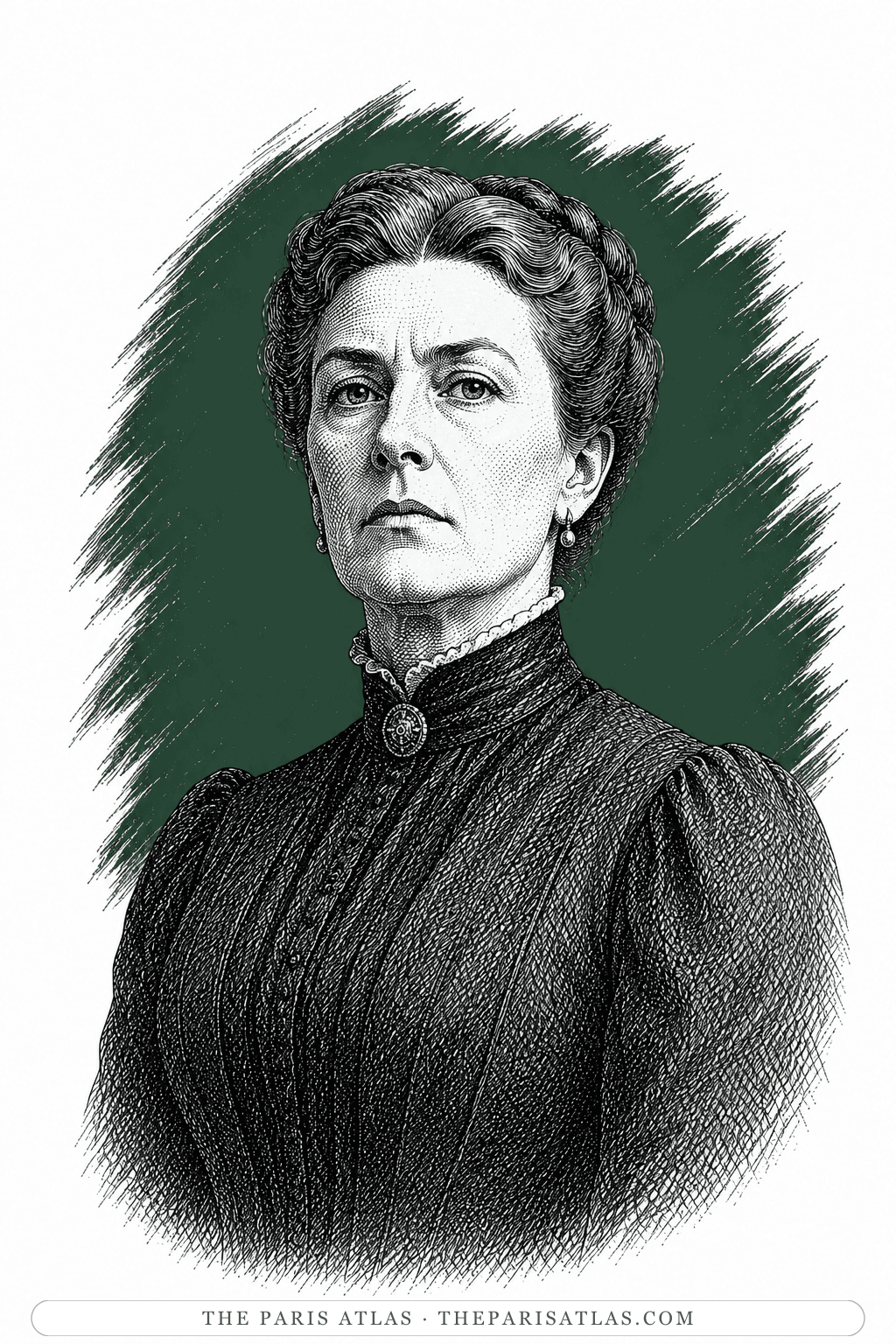
Dante Riordan
The devout widow who lives with the Dedalus family and teaches Stephen his geography. She keeps two hairbrushes for two Irish politicians, and destroys the Christmas dinner defending the priests who abandoned Parnell.
The church defended, whatever it costs the room. She says it twice at the top of her voice across the Christmas table: "—God and religion before everything! Dante cried. God and religion before the world."
The book

At a glance
- Mrs Riordan, called Dante by the children — a devout older woman living with the Dedalus family
- Geography — the Mozambique Channel, the longest river in America, the highest mountain in the moon
- Maroon velvet for Michael Davitt, green velvet for Parnell, until she tears the green one off
- A spoiled nun who came out of a convent in the Alleghanies, and a clever, wellread woman
- Chapter one only — the nursery, the fireside, and the Christmas dinner
Who they are in the book
Spoiler-freeDante is the older woman living with the family of Stephen Dedalus, the boy A Portrait of the Artist as a Young Man follows, in the first chapter of that 1916 novel by the Irish writer James Joyce. Her real name is Mrs Riordan; Dante is what the children call her, and the book never explains why. She is a governess in effect rather than in title — she teaches Stephen where the Mozambique Channel is and the name of the highest mountain on the moon — and she is fiercely, unnegotiably Catholic.
She matters because she supplies the novel's first lesson in politics, and it is a lesson delivered as violence at a dinner table. The subject is Charles Stewart Parnell, the leader of the Irish parliamentary party, who was ruined in 1890 when he was named in a divorce case and whose own supporters, urged on by the Catholic bishops, turned him out. He died the following year. Stephen's father and his father's friend are Parnell men. Dante is with the bishops.
Everything the reader knows about her comes from a small boy's observation, and it is unsparing. He notices the heartburn after dinner, the cachou sweets she hands out, the two hairbrushes in her press, and the fact that his father says she is a spoiled nun who left a convent in the Alleghanies when her brother came into money from selling trinkets to native people. He also notices that his father calls her a clever, well-read woman.
How Dante Riordan Is Portrayed
- The two hairbrushesShe keeps two brushes in her press. The one with the maroon velvet back is for Michael Davitt, who founded the Land League; the one with the green velvet back is for Parnell. It is the first political fact in the novel, and it is delivered as an item of nursery furniture. Then Parnell falls, and she rips the green velvet off the back of his brush with a scissors and tells the child that Parnell was a bad man.
- Pull out his eyesOn the first page, the boy hides under a table after some unnamed offence and his mother says he will apologise. Dante's contribution is a threat: "—O, if not, the eagles will come and pull out his eyes." He turns it into a rhyme and sings it to himself — "Pull out his eyes, / Apologise, / Apologise, / Pull out his eyes." — which is either a child processing fear or a writer showing you how a child converts everything into language.
- The teacherShe taught him where the Mozambique Channel was, what the longest river in America was, and the name of the highest mountain in the moon, and she gave him a cachou sweet every time he brought her a piece of tissue paper. Small Stephen ranks her carefully: Father Arnall knows more than Dante because he is a priest, but both his father and his uncle say she is a clever woman and a wellread woman.
- The Christmas tableShe refuses sauce, sits with her hands in her lap going red in the face, and answers every attack on the bishops with an escalation. "—The bishops and priests of Ireland have spoken, said Dante, and they must be obeyed." When the men call the clergy names she calls them renegade catholics, and when one of them tells a story about spitting tobacco juice into a woman's eye she repeats "—Very nice! Ha! Very nice!" while everyone else laughs.
- How she leaves the roomShe shoves her chair aside, upsetting her napkin ring, and gets as far as the door before turning round and shouting the length of the room with her cheeks quivering: "—Devil out of hell! We won! We crushed him to death! Fiend!" The door slams. The man she was shouting at puts his head in his hands and sobs for Parnell, and Stephen looks up and sees that his father is crying.
- The umbrellaShe is not simply a clerical mouthpiece, and the boy knows it. One night at a band concert on the esplanade she hit a gentleman over the head with her umbrella because he took his hat off when the band played God Save the Queen. She was for Ireland too, until the church told her which side of it to be on.
- How she endsShe does not. After the first chapter she disappears from the book entirely, surviving only as a name in a list Stephen recites to himself in Cork when he finds he can no longer remember his own childhood: Dante, Parnell, Clane, Clongowes.
If you like A Portrait of the Artist as a Young Man


If you like James Joyce
Explore authors with a similar voice, perspective, and influence.
Ezra Pound
The impresario who dragged Joyce's early books into print, brought him to Paris, and championed Ulysses until the world caught up.
View author
Sylvia Beach
His publisher of last resort and first devotion — the bookseller who printed Ulysses when no one else would.
View author
Louis-Ferdinand Céline
The doctor of the Paris slums who wrote the century's blackest, funniest novel — and changed the sound of French prose.
View author