The dean of studies
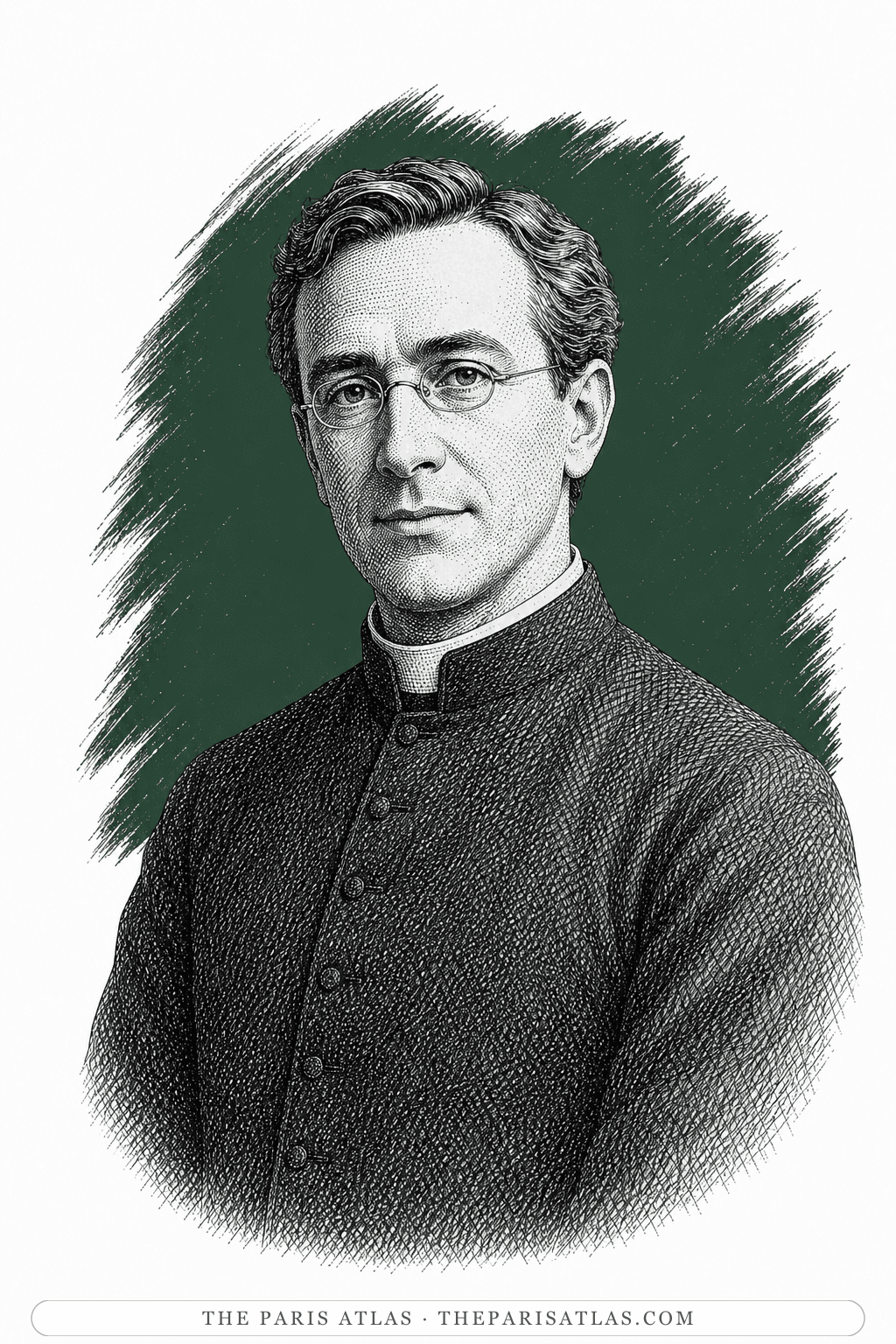
An elderly English Jesuit teaching at Stephen's Dublin university, met on his knees lighting a classroom fire. Their five minutes of small talk produce the exchange the whole book is remembered for.
To be useful, and to see the young man in front of him finish his degree. He says so at the end of the conversation, having enjoyed it: "—In pursuing these speculations, said the dean conclusively, there is, however, the danger of perishing of inanition. First you must take your degree. Set that before you as your first aim."
The book

At a glance
- An elderly English Jesuit priest, dean of studies at Stephen's Dublin university; never named
- Mr Dedalus
- Stephen's word for a funnel, which the Englishman has never heard — and which turns out to be good old English after all
- One scene in the physics theatre in chapter five, two glimpses on the stairs, and one diary entry dated 13 April
Who they are in the book
Spoiler-freeThe dean of studies is an elderly English Jesuit priest teaching at the Dublin university Stephen Dedalus attends in the last chapter of A Portrait of the Artist as a Young Man, the 1916 novel by the Irish writer James Joyce. The book never gives him a name. It gives him a nationality, and the whole scene turns on it: he is English, a convert to Catholicism who came to the order late, working in a country that is not his, teaching in a language that is his and not Stephen's.
Stephen finds him crouched in front of a cold grate in the physics theatre, lean and grey, lighting the fire himself with four candle-ends taken out of the pockets of his cassock. They talk for perhaps five minutes — about the art of lighting fires, about what beauty is, about Aristotle and Aquinas, about a lamp belonging to a Greek philosopher — and the priest is courteous and dry and entirely unbothered by any of it.
Then they get stuck on a word. Stephen's private verdict is severe and a little unfair: a humble follower in the wake of clamorous conversions, a poor Englishman in Ireland, a latecomer to a history that was nearly over by the time he arrived. He is also the only person in the novel who asks Stephen a serious question about art and then waits for the answer.
How The dean of studies Is Portrayed
- The fireHe is doing a servant's job and doing it expertly, on his knees on the flagstone with four candle-butts and twisted paper among the coals. Offered help, he declines: "—One moment now, Mr Dedalus, and you will see. There is an art in lighting a fire. We have the liberal arts and we have the useful arts. This is one of the useful arts." Then he adds the secret — "—Not too much coal, said the dean, working briskly at his task, that is one of the secrets." — and opens the door a crack, because a draught is said to be a help in these matters.
- The questionHe asks it looking up from the coals, blinking: "—You are an artist, are you not, Mr Dedalus? said the dean, glancing up and blinking his pale eyes. The object of the artist is the creation of the beautiful. What the beautiful is is another question." Stephen answers with Aquinas, and the priest immediately produces a counter-example out of the grate in front of them: this fire will be pleasing to the eye — will it therefore be beautiful?
- The wordTalking about pouring oil into a lamp, the priest uses the word funnel. Stephen offers the word he grew up with instead — a tundish, which is the same object, the cone you pour liquid through — and the Englishman has never heard it. "—Is that called a tundish in Ireland? asked the dean. I never heard the word in my life." Stephen, laughing, says it is called a tundish in Lower Drumcondra, where they speak the best English. The priest turns it over twice with real pleasure: "—A tundish, said the dean reflectively. That is a most interesting word. I must look that word up. Upon my word I must."
- What it does to StephenIt stops him cold, and produces the passage this novel is most quoted for after its last line. Watching the priest enjoy the curiosity, he thinks: "—The language in which we are speaking is his before it is mine. How different are the words home, Christ, ale, master, on his lips and on mine! I cannot speak or write these words without unrest of spirit. His language, so familiar and so foreign, will always be for me an acquired speech. I have not made or accepted its words. My voice holds them at bay. My soul frets in the shadow of his language."
- The lamp, and the thiefHis way of teaching is to tell small stories and let them sit there. He offers the Greek philosopher Epictetus, whose lamp was sold for a fancy price after his death, and then the story of the thief who stole it: the philosopher reflected that it was in the character of a thief to steal, and bought a cheaper earthenware lamp the next day. Stephen finds the priest's voice hard and jingling while he tells it, and his face like an unlit lamp or a reflector hung in a false focus.
- The adviceIt is ordinary, kind, and beside the point, which is what makes it land. Take your degree first; then, little by little, you will see your way, in life and in thinking; it may be uphill pedalling at first. He offers a former student as proof — a long time getting to the top, but he got there. Stephen says he may not have that man's talent, and the priest will not have it: "—You never know, said the dean brightly. We never can say what is in us. I most certainly should not be despondent. Per aspera ad astra."
- What Stephen decides about himA desolating pity, which is not the same as liking. He sees a man whose body and soul have both grown old in service without ever being lit by it — obedient, unresentful, loving neither the master nor the work — and he thinks of him as one whom he would never call his ghostly father. It is the harshest thing in the book about a priest, and the priest in question has just lit a fire for him and paid him a compliment.
- The last word, weeks laterStephen looks the word up, and the diary at the end of the novel records what he found: "That tundish has been on my mind for a long time. I looked it up and find it English and good old blunt English too. Damn the dean of studies and his funnel! What did he come here for to teach us his own language or to learn it from us. Damn him one way or the other!" The Irishman had the older English word and the Englishman did not, and the discovery makes Stephen angrier rather than less.
If you like A Portrait of the Artist as a Young Man


If you like James Joyce
Explore authors with a similar voice, perspective, and influence.
Ezra Pound
The impresario who dragged Joyce's early books into print, brought him to Paris, and championed Ulysses until the world caught up.
View author
Sylvia Beach
His publisher of last resort and first devotion — the bookseller who printed Ulysses when no one else would.
View author
Louis-Ferdinand Céline
The doctor of the Paris slums who wrote the century's blackest, funniest novel — and changed the sound of French prose.
View author