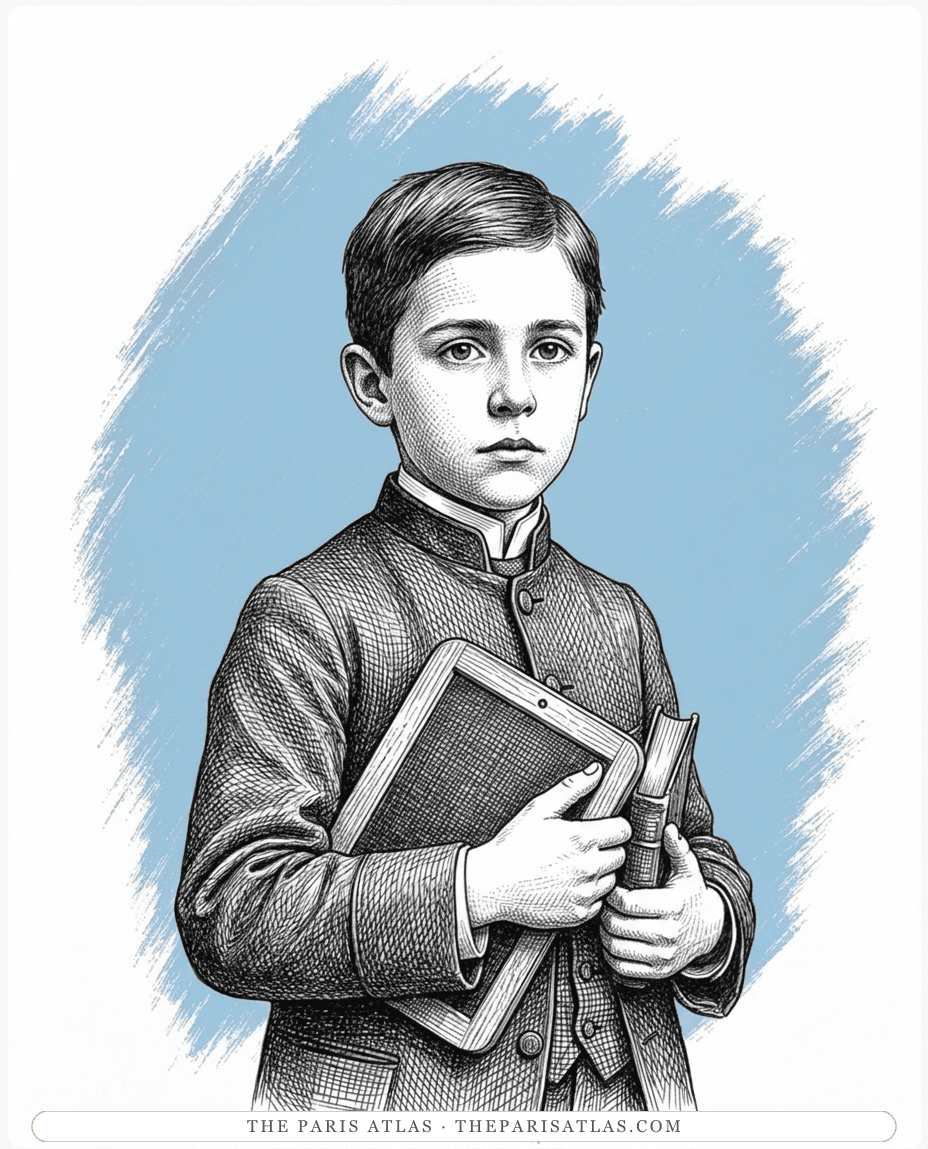
Stephen Dedalus
The boy the novel follows from infancy to about twenty — a short-sighted, watchful, proud Dublin schoolboy who loses his religion and decides to leave Ireland and write. He turns up again, older, in Joyce's Ulysses.
To get out from under everything that owns him and to make something of his own. He states it to his friend Cranly near the end: "I will not serve that in which I no longer believe, whether it call itself my home, my fatherland, or my church: and I will try to express myself in some mode of life or art as freely as I can and as wholly as I can, using for my defence the only arms I allow myself to use—silence, exile and cunning."
The book

At a glance
- Follows him from infancy to roughly twenty; the eldest of nine or ten children
- Clongowes Wood College in County Kildare, then Belvedere College in Dublin, then university
- Ulysses (1922), Joyce's next novel, where he is twenty-two, back in Dublin, and one of its two central figures
- Simon Dedalus, his father, a talker and a drinker; his mother, who wants him back in the church; brothers and sisters raised on watered tea
- An ashplant walking stick in the last chapter — the same one he has in Ulysses
- One poem to a girl at sixteen, one villanelle to the same girl ten years later, and a notebook of questions about art
- A diary, kept over about five weeks in spring, as he arranges to leave Ireland
- James Joyce — the author as a young man · 1882–1941 · Rathgar, Dublin
Who they are in the book
Spoiler-freeStephen Dedalus is the central figure of A Portrait of the Artist as a Young Man, the 1916 novel by the Irish writer James Joyce. The book follows him from earliest childhood to somewhere around his twentieth year, in five chapters that each skip forward several years, and it is written throughout in the language he would have had at the time — so the first pages are a small child's and the last are a university student's.
The facts of his life are ordinary and the book gives them in order. He is the eldest of nine or ten children. He is sent at six to Clongowes Wood College, a Jesuit boarding school in County Kildare, where he is homesick, physically slight, bad at games and short-sighted, and where he is beaten by a priest for something he did not do. His father's money runs out; he is taken out of school, the family moves to a poorer address in Dublin, and he finishes his schooling as a day boy at Belvedere College. At about sixteen he begins visiting the brothel quarter. At seventeen he sits through a retreat sermon on hell and is frightened into a period of extreme religious observance. He is then invited to become a priest, and refuses. He goes to university, argues about art, writes very little, and prepares to leave the country.
What makes him hard to like is also what makes the book work. He is arrogant, cold to his mother, ungenerous about his friends, and entirely certain that he is destined for something the people around him could not understand. Joyce is not asking the reader to agree with him. The narration stays inside Stephen's head and lets his self-regard show, which is why arguments about whether the book admires him or is quietly laughing at him have gone on since 1916.
How Stephen Dedalus Is Portrayed
- The first page, in his own vocabularyThe book opens in baby talk, mid-story: "Once upon a time and a very good time it was there was a moocow coming down along the road and this moocow that was coming down along the road met a nicens little boy named baby tuckoo...." Within two pages the reader has his father's hairy face, his mother's better smell, the oilsheet on the wet bed, and a song he sings wrong. Nothing is explained because nothing is explained to a child.
- The nameDedalus is not an Irish name and every boy who hears it says so. Asked what kind of a name it is on his first day at school, he cannot answer. Years later, hearing schoolmates shout a Greek-sounding version of it across the water at the seaside, he thinks of Daedalus, the craftsman of the myth who made wings for himself and his son and got out of Crete by air. The book takes his name seriously well before he does.
- What his father isAlso on the first day, a boy called Nasty Roche asks what his father is. Stephen answers: "—A gentleman." The follow-up question is whether he is a magistrate, and the answer to that is no. By the end of the book Stephen can list the whole career flatly: "—A medical student, an oarsman, a tenor, an amateur actor, a shouting politician, a small landlord, a small investor, a drinker, a good fellow, a storyteller, somebody's secretary, something in a distillery, a taxgatherer, a bankrupt and at present a praiser of his own past."
- The handsThe prefect of studies at Clongowes beats him with a pandybat — a stiffened leather strap — for not writing, although the reason he is not writing is that his glasses are broken and a priest has excused him. Six blows on each hand. What the book fixes on is not the pain but the touch beforehand: the priest steadies his shaking fingers gently before hitting them, and Stephen keeps returning to the gentleness. He walks up to the rector afterwards and complains, and the school treats him as a hero for a day.
- The Christmas dinnerHome from school at six or seven, he sits at his first grown-up Christmas dinner and watches it destroyed by an argument about Charles Stewart Parnell, the Irish nationalist leader who had died after a divorce scandal turned the Catholic clergy against him. His governess screams that the priests were right and leaves the table; his father's friend sobs "—Poor Parnell! he cried loudly. My dead king!"; and Stephen, terrified, sees that his father is crying too. He is too young to follow the politics and old enough to understand that something has broken.
- The months of pietyAfter the hell sermon and the confession, he sets about being good with the same intensity he brought to being bad. He counts prayers up for the souls in purgatory as if they were money, prays for a different gift of the Holy Ghost on each day of the week, walks the street with his eyes down to mortify his sight, and deliberately seeks out a smell he dislikes in order to mortify his nose. It works and it does not last. What defeats him is not temptation but boredom, and the discovery that he cannot stop being irritated by the sound of his mother sneezing.
- Nothing on the pageFor a novel about becoming an artist, remarkably little art gets made. He writes a poem to a girl after a tram ride and never sends it; ten years later he writes another about the same girl, a villanelle, on the back of a torn cigarette packet in bed. Both are reproduced in full. He talks about aesthetics for pages, brilliantly and at unbearable length, to a friend who keeps asking for another cigarette.
- How he ends conversationsBy refusing. He will not sign the peace petition, will not learn Irish, will not be one of the boys, and will not take communion at Easter to please his mother. Pressed by his friend Davin to be an Irishman first and a poet afterwards, he answers: "When the soul of a man is born in this country there are nets flung at it to hold it back from flight." Asked in the same conversation what Ireland is, he says: "Ireland is the old sow that eats her farrow."
Stephen is Joyce with the facts kept and the sympathy withheld. Joyce went to Clongowes at six and was taken away at nine when his father was declared bankrupt; he had a spell at a Christian Brothers school, which the novel leaves out and which his fictional father refuses in advance; he went on to Belvedere College and University College Dublin, lost his faith, refused to make his Easter duty, and left Ireland in 1904, at twenty-two, with Nora Barnacle. His father, John Stanislaus Joyce, went through the same slide from property to pawn tickets. The distance between the two men is the eighteen years Joyce spent turning the story over — long enough that the book records the young man's certainty exactly and declines to endorse it.
If you like A Portrait of the Artist as a Young Man


If you like James Joyce
Explore authors with a similar voice, perspective, and influence.
Ezra Pound
The impresario who dragged Joyce's early books into print, brought him to Paris, and championed Ulysses until the world caught up.
View author
Sylvia Beach
His publisher of last resort and first devotion — the bookseller who printed Ulysses when no one else would.
View author
Louis-Ferdinand Céline
The doctor of the Paris slums who wrote the century's blackest, funniest novel — and changed the sound of French prose.
View author