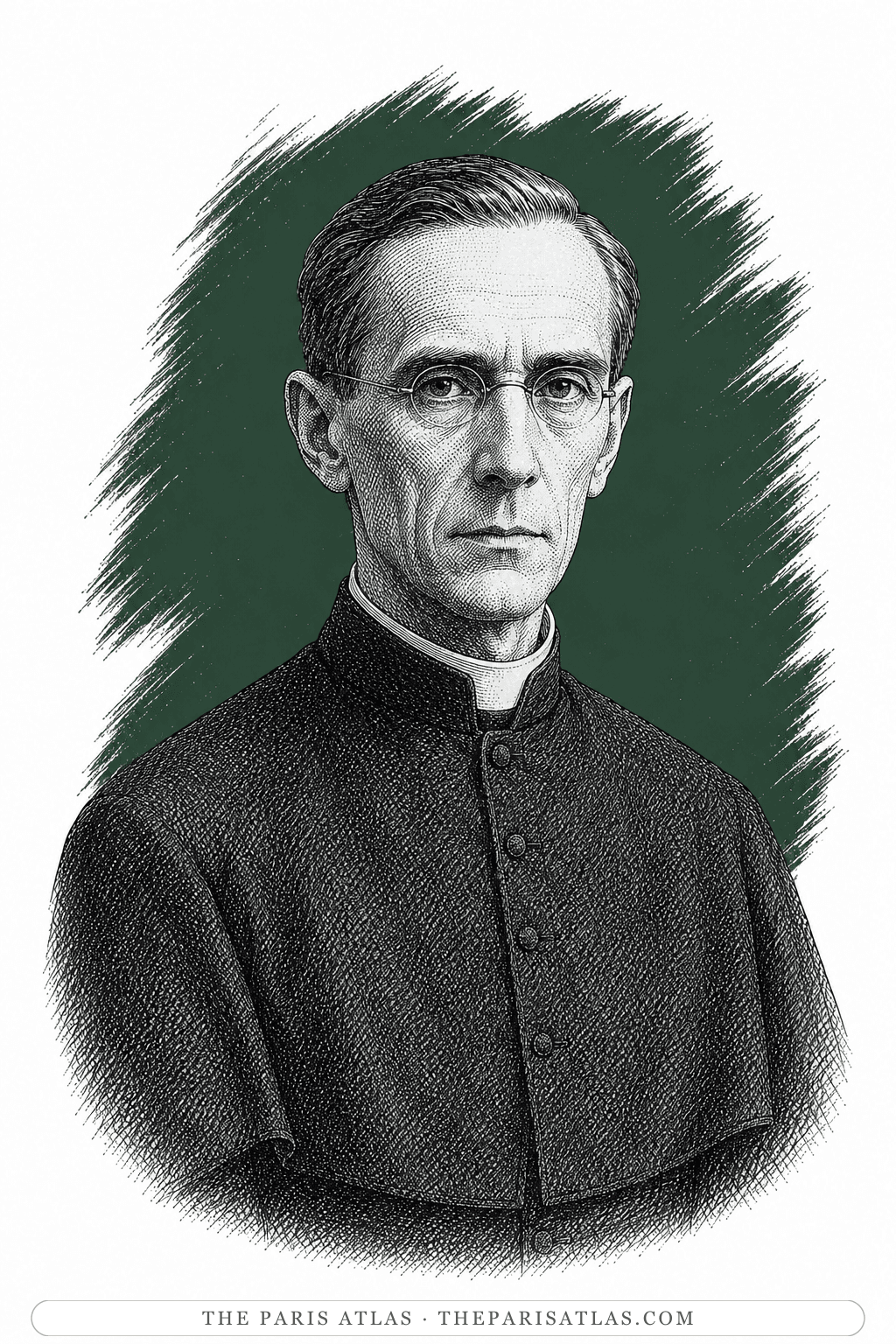
Father Arnall
The Jesuit who teaches Stephen Latin at boarding school and, years later, turns up as the preacher of the retreat — the man who delivers the long sermon on hell that frightens Stephen into months of piety.
To frighten the boys in front of him into saving their souls, and to be sure at least one of them hears it. He says so at the start: "And remember, my dear boys, that we have been sent into this world for one thing and for one thing alone: to do God's holy will and to save our immortal souls."
The book

At a glance
- A Jesuit priest — Stephen's Latin master at Clongowes, and years later the preacher of the retreat at his Dublin school
- Three days of sermons before the feast of St Francis Xavier, on the four last things: death, judgement, hell and heaven
- The two sermons on hell run to roughly twenty-five pages, printed almost whole
- The Clongowes classroom in chapter one, and the chapel in chapter three
Who they are in the book
Spoiler-freeFather Arnall is a Jesuit priest in A Portrait of the Artist as a Young Man, the 1916 novel by the Irish writer James Joyce, and the character who does the most damage in it without meaning any harm at all.
He appears first as a Latin master at Clongowes Wood College, the boarding school Stephen Dedalus is sent to at six. He runs the class as a game between two teams named after the sides in the Wars of the Roses, gets into rages and out of them, makes a boy kneel on the floor for a bad exercise and then corrects the same boy's work gently ten minutes later. He is also the priest who excuses Stephen from work because his glasses are broken — which is why the beating that follows is unjust.
Then he is gone for two chapters and comes back transformed. At about seventeen, at his day school in Dublin, Stephen files into the chapel for the annual retreat and finds his old master sitting by the altar in a heavy cloak, pale and hoarse, about to preach. Over three days he preaches on death, judgement, hell and heaven, and the middle section — the two sermons on hell — runs to roughly twenty-five pages of the novel. Joyce prints them nearly whole. Stephen goes home, is physically sick, and confesses.
How Father Arnall Is Portrayed
- The war of the rosesHis Clongowes sums are a contest between two teams, York and Lancaster, with the boys wearing little silk badges — a white rose or a red one — pinned to their jackets. Stephen is on the York side and no good at sums, and watches his white badge flutter while he fails to get the answer. His mind goes off to the colours of the winners' cards, pink and cream and lavender, and to whether there could be a green rose anywhere in the world.
- The temper, and after itHe shuts a book and shouts at a boy called Fleming to kneel out in the middle of the class for a bad Latin exercise, his face going red. Twenty minutes later, after another priest has come in and beaten the same boy's hands and Stephen's, he goes quietly among the desks helping the class with their mistakes in a low gentle voice, and tells the two of them they may return to their places. Stephen notices that he makes no difference between them.
- The reappearanceSeeing his old schoolmaster sitting by the altar in a heavy cloak — face drawn, voice broken with a cold — does something to Stephen before a word is spoken. All of Clongowes comes back with him: the playgrounds, the ditch of cold water, the little cemetery, the firelight in the infirmary. "His soul, as these memories came back to him, became again a child's soul." Whatever the sermon then does, it is done to a child.
- The watch on the tableBefore the first sermon on hell he takes a watch with no chain out of a pocket inside his soutane, looks at the dial for a moment in silence, and places it in front of him on the table. Then he begins quietly. It is the only stage direction the sermon gets, and it tells the boys exactly how long this is going to take.
- The room he buildsThe hell of the sermon is a physical place with measurements. The walls are said to be four thousand miles thick. The fire gives heat but no light, so the damned lie in darkness. The stench is described at length, as the smell of one rotting corpse multiplied by millions. "The blood seethes and boils in the veins, the brains are boiling in the skull, the heart in the breast glowing and bursting, the bowels a redhot mass of burning pulp, the tender eyes flaming like molten balls."
- How he explains for everBy arithmetic. Imagine a mountain of sand a million miles high and a million miles broad, and a bird that comes once every million years and carries away a single grain. When the whole mountain is gone, eternity has not begun. He then adds that if the mountain rose again and the bird returned as many times as there are stars in the sky and hairs on animals, eternity still would not have begun. Elsewhere he gives it as the ticking of a clock in a dark hall saying two words: ever, never; ever, never.
- What it does to the boy in the front benchStephen sits through it certain that every word is aimed at him. Walking down the aisle afterwards his legs shake and he is afraid he has already died on the way. In his bedroom that night he hallucinates a field of thistles and dried excrement with goat-faced creatures circling in it, and vomits into the washstand. Then he goes out and finds a church where nobody knows him.
- The other boysThe novel is careful to show what the same sermon does to everybody else. Two of them are heard talking in the classroom straight afterwards: "—I suppose he rubbed it into you well." "—You bet he did. He put us all into a blue funk." Then they discuss whether the rain will clear up enough for a bike ride out to Malahide.
Joyce did not invent the sermon. Scholars have traced almost all of its imagery to a seventeenth-century Italian Jesuit tract by Giovanni Pietro Pinamonti, Hell Opened to Christians, To Caution Them from Entering into It, first published in 1688 and circulating in Ireland in an English translation printed in Dublin in 1868. That is why it reads as period-accurate rather than exaggerated: boys really did sit through this, and the retreat at Belvedere College in 1896 was the one Joyce sat through himself.
If you like A Portrait of the Artist as a Young Man


If you like James Joyce
Explore authors with a similar voice, perspective, and influence.
Ezra Pound
The impresario who dragged Joyce's early books into print, brought him to Paris, and championed Ulysses until the world caught up.
View author
Sylvia Beach
His publisher of last resort and first devotion — the bookseller who printed Ulysses when no one else would.
View author
Louis-Ferdinand Céline
The doctor of the Paris slums who wrote the century's blackest, funniest novel — and changed the sound of French prose.
View author