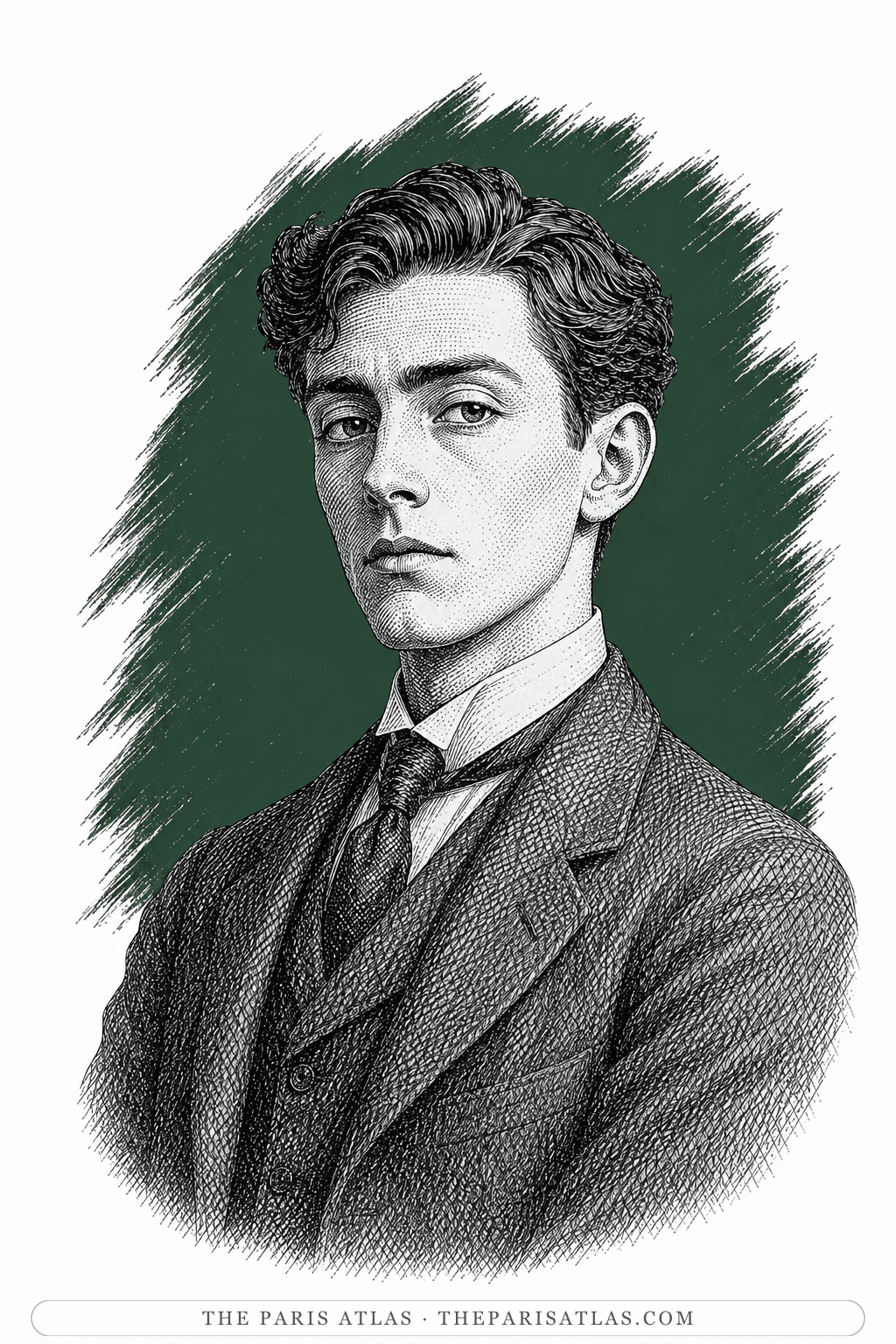
Lynch
The student Stephen explains his theory of art to, at enormous length, in exchange for cigarettes. Sour, broke, filthy-minded and much funnier than his friend — the book's best audience.
Money, and to be left alone by ideas. He is unusually direct about it in the middle of the aesthetics lecture: "I don't care about it. I don't even care about women. Damn you and damn everything. I want a job of five hundred a year. You can't get me one."
The book

At a glance
- A fellow student; the listener for Stephen's theory of art, paid in cigarettes
- A long flattened skull under a long peaked cap, and eyes Stephen thinks reptile-like in glint and gaze
- In yellow
- A job of five hundred a year
- The handball alley, a long walk from the college to the library, and one diary entry
- Vincent Cosgrave · Dublin
Who they are in the book
Spoiler-freeLynch is a fellow student of Stephen Dedalus in the last chapter of A Portrait of the Artist as a Young Man, the 1916 novel by the Irish writer James Joyce. He exists in the book for one purpose, which he is entirely aware of: to be walked around Dublin while Stephen sets out his theory of beauty, and to keep the theory honest by refusing to be impressed by it.
He is poor, hungover, indifferent to art, indifferent to women, and open about all three. He swears in yellow rather than blue, which delights Stephen. He laughs, when he laughs, with a noise the book compares to the whinny of an elephant, and rubs his hands over his groin while doing it. He once wrote his name in pencil on the backside of a museum statue of Venus, and as a schoolboy at a Carmelite school he ate pieces of dried cow dung. He volunteers both facts.
The exchange is straightforwardly commercial and both men know it. Stephen produces cigarettes; Lynch listens to Aquinas. What makes the long aesthetic conversation readable at all is that Lynch keeps puncturing it — asking for the short version, demanding another cigarette, and observing that the whole discussion is happening in a miserable Godforsaken island.
How Lynch Is Portrayed
- Swearing in yellowOffered a cigarette with the remark that Stephen knows he is poor, he answers: "—Damn your yellow insolence, answered Lynch." Yellow, not blue, is his adjective for everything he dislikes — a yellow drunk, a sulphuryellow liar, a yellow pancake-eating excrement — and Stephen tells him it was a great day for European culture when he made up his mind to swear in yellow.
- The laughIt comes from a large frame, is pitched very high, and the book compares it to the whinny of an elephant. He rubs both hands over his groin to ease his mirth, without taking them out of his pockets, which Stephen does not comment on.
- The two confessionsHe tells Stephen, unprompted, that he once wrote his name in pencil on the backside of the Venus of Praxiteles in the museum, and offers it as a counter-example to the claim that art should not excite desire. He has also told him that as a boy at a Carmelite school he ate pieces of dried cow dung. When Stephen brings that up he shouts with laughter: "—O, I did! I did! he cried."
- What he does to the lectureHe heckles it into shape. He asks for definitions, tells Stephen to hurry up and finish the first part, says "—Bull's eye!" when a point lands, and when Stephen finishes a long passage on Aquinas asks whether he is laughing in his sleeve. His single-word instruction to continue is the funniest line in the chapter: "—Proceed!"
- What he thinks of the countryInterrupting the theory as they walk toward the library in the rain: "—What do you mean, Lynch asked surlily, by prating about beauty and the imagination in this miserable Godforsaken island?" He adds that no wonder the artist retired behind his handiwork after perpetrating this country.
- The envyA well-fed student called Donovan stops them, mentions exam results and his sister's pancakes, and leaves. Lynch watches him go with his lip curling: "—To think that that yellow pancake-eating excrement can get a good job, he said at length, and I have to smoke cheap cigarettes!"
- The other side of himHe is not only a grumbler. He knows the Latin hymn Stephen names and sings four lines of it in a deep bass in the street, and pronounces it great music. He also spots the girl Stephen writes poems about before Stephen does, and says so quietly: "—Your beloved is here."
The original was Vincent Cosgrave, a medical student Joyce knew in Dublin. He turns up again in Ulysses, still called Lynch, in the brothel chapter, where he walks away and leaves Stephen to be knocked down in the street. Cosgrave's part in Joyce's real life was worse: in 1909 he told Joyce he had been with Nora Barnacle during the weeks Joyce was courting her, which was not true and which Joyce believed for long enough to write some of the most desperate letters he ever sent.
If you like A Portrait of the Artist as a Young Man


If you like James Joyce
Explore authors with a similar voice, perspective, and influence.
Ezra Pound
The impresario who dragged Joyce's early books into print, brought him to Paris, and championed Ulysses until the world caught up.
View author
Sylvia Beach
His publisher of last resort and first devotion — the bookseller who printed Ulysses when no one else would.
View author
Louis-Ferdinand Céline
The doctor of the Paris slums who wrote the century's blackest, funniest novel — and changed the sound of French prose.
View author