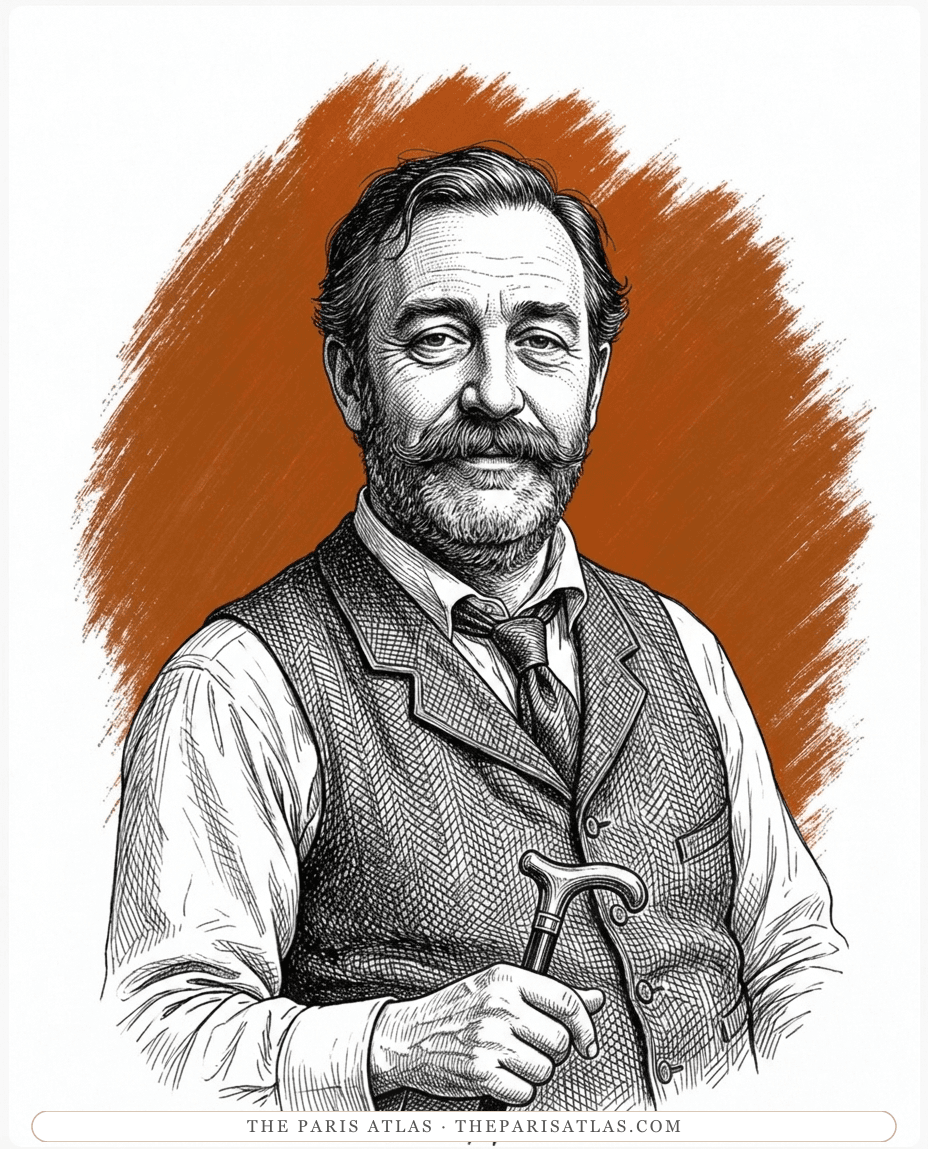
Simon Dedalus
Stephen's father — a Cork man with a good tenor voice, a great many stories, and no money left. He talks his way through the family's fall from a large house to a rented one with pawn tickets on the table.
To be the man he was in Cork thirty years ago, and to be told so. Drinking with two old friends after the property has been sold, he makes the claim outright: "—No, by God! asserted Mr Dedalus. I'll sing a tenor song against him or I'll vault a five-barred gate against him or I'll run with him after the hounds across the country as I did thirty years ago along with the Kerry Boy and the best man for it."
The book

At a glance
- Stephen's father — Corkman, tenor, drinker, and at the end of the book a bankrupt
- Medical student, oarsman, tenor, amateur actor, shouting politician, small landlord, small investor, drinker, good fellow, storyteller, somebody's secretary, something in a distillery, taxgatherer, bankrupt
- Parnell to the end, and the clergy who deserted him never forgiven
- The Christmas dinner, the move to Dublin, the trip to Cork, and, after that, mostly offstage
- John Stanislaus Joyce · 1849–1931 · Cork
Who they are in the book
Spoiler-freeSimon Dedalus is the father of Stephen Dedalus, the boy followed by A Portrait of the Artist as a Young Man, the 1916 novel by the Irish writer James Joyce. He is a Corkman living in Dublin, a good singer, a good talker, a heavy drinker, and by the middle of the book comprehensively broke. The novel never gives a scene of financial collapse; it just shows the family in a worse house each time we look, and eventually a box of pawn tickets sitting on the breakfast table.
He is affectionate towards his son in a loud, teasing way, and useless to him. He gives him two five-shilling pieces on the first day of school and tells him never to inform on a schoolfellow. He gets him into Belvedere College by running into the head of the Jesuit order at a street corner. He takes him to Cork to watch the family property sold at auction, and spends the trip introducing him to elderly men in bars as the son of a fine fellow. Stephen listens to all of it with a coldness the book does not soften.
What he actually was is easier to state than what he became. He had been a medical student, an oarsman and a singer with a future; by the last chapter he is a man whistling upstairs for his son and asking whether the lazy bitch of a brother has gone out yet. He is the funniest character in the novel and the saddest thing in it.
How Simon Dedalus Is Portrayed
- The Christmas dinnerHe carves the turkey, keeps trying to steer the table away from politics, and then goes off like a firework himself. The row is about Parnell and the priests who abandoned him, and Simon's contributions run from mimicry of a fat bishop eating bacon to a flat verdict on the country: "We are an unfortunate priestridden race and always were and always will be till the end of the chapter." By the end of the meal he is in tears.
- The pandybat, retold as a jokeMonths after Stephen is beaten at school and goes to the rector about it, his father comes home with the story from the other side. He had met the priest concerned, who had laughed about it over the Jesuits' dinner table and called Stephen a manly little chap. Simon repeats the whole exchange in a mincing imitation of the priest's voice, delighted, and adds his own moral: "—Shows you the spirit in which they take the boys there. O, a jesuit for your life, for diplomacy!" Stephen says nothing.
- CorkHe brings his son down on the night mail to watch his own property go under the hammer, and spends the visit hunting his initials cut into a desk in the anatomy theatre of Queen's College and asking the porter which of his contemporaries are dead. In a bar afterwards an old man tells Stephen that his father was the boldest flirt in the city of Cork in his day. The auction is never described. The drinking around it is.
- The adviceWalking through Cork he tells his son, at length, to mix with gentlemen, and offers his own father as the model of how a father should behave — the story of being caught smoking at sixteen and handed a cigar the next day. Then his voice goes: "Stephen heard his father's voice break into a laugh which was almost a sob."
- What he says when the money is goneOn the first evening in the bare new house, poking at a fire that will not draw, with the family portraits leaning against the wall and the floor still muddy from the removal men: "—There's a crack of the whip left in me yet, Stephen, old chap, said Mr Dedalus, poking at the dull fire with fierce energy. We're not dead yet, sonny. No, by the Lord Jesus (God forgive me) nor half dead."
- Heard, not seen, in the last chapterBy the time Stephen is at university his father has almost stopped appearing in person and become a whistle from upstairs. The one line of his the reader gets in the opening scene of chapter five is shouted down a staircase: "—Is your lazy bitch of a brother gone out yet?" Stephen's only reply is a joke about grammar made to his sister on the way out the back door.
- The last time he is in the roomIn the diary at the end, Stephen introduces him to his friend Davin outside a cigar shop. Simon is polite, observant, offers the young man a drink, and afterwards says he has a good honest eye. He then asks his son why he does not join a rowing club and says he was cut out for the law. Stephen writes down the exchange and adds one word of his own: crocodiles.
The original was Joyce's own father, John Stanislaus Joyce, a Corkman who came to Dublin with property and an income as a rate collector, lost the job, the property and the money in roughly that order, and moved his large family from address to address ahead of the landlords. Joyce kept the voice almost intact, gave Simon most of his father's songs and sayings, and remained fonder of him than Stephen ever manages to be. He is one of the very few people from Joyce's Dublin who walks straight into Ulysses under the same fictional name, still singing.
If you like A Portrait of the Artist as a Young Man


If you like James Joyce
Explore authors with a similar voice, perspective, and influence.
Ezra Pound
The impresario who dragged Joyce's early books into print, brought him to Paris, and championed Ulysses until the world caught up.
View author
Sylvia Beach
His publisher of last resort and first devotion — the bookseller who printed Ulysses when no one else would.
View author
Louis-Ferdinand Céline
The doctor of the Paris slums who wrote the century's blackest, funniest novel — and changed the sound of French prose.
View author