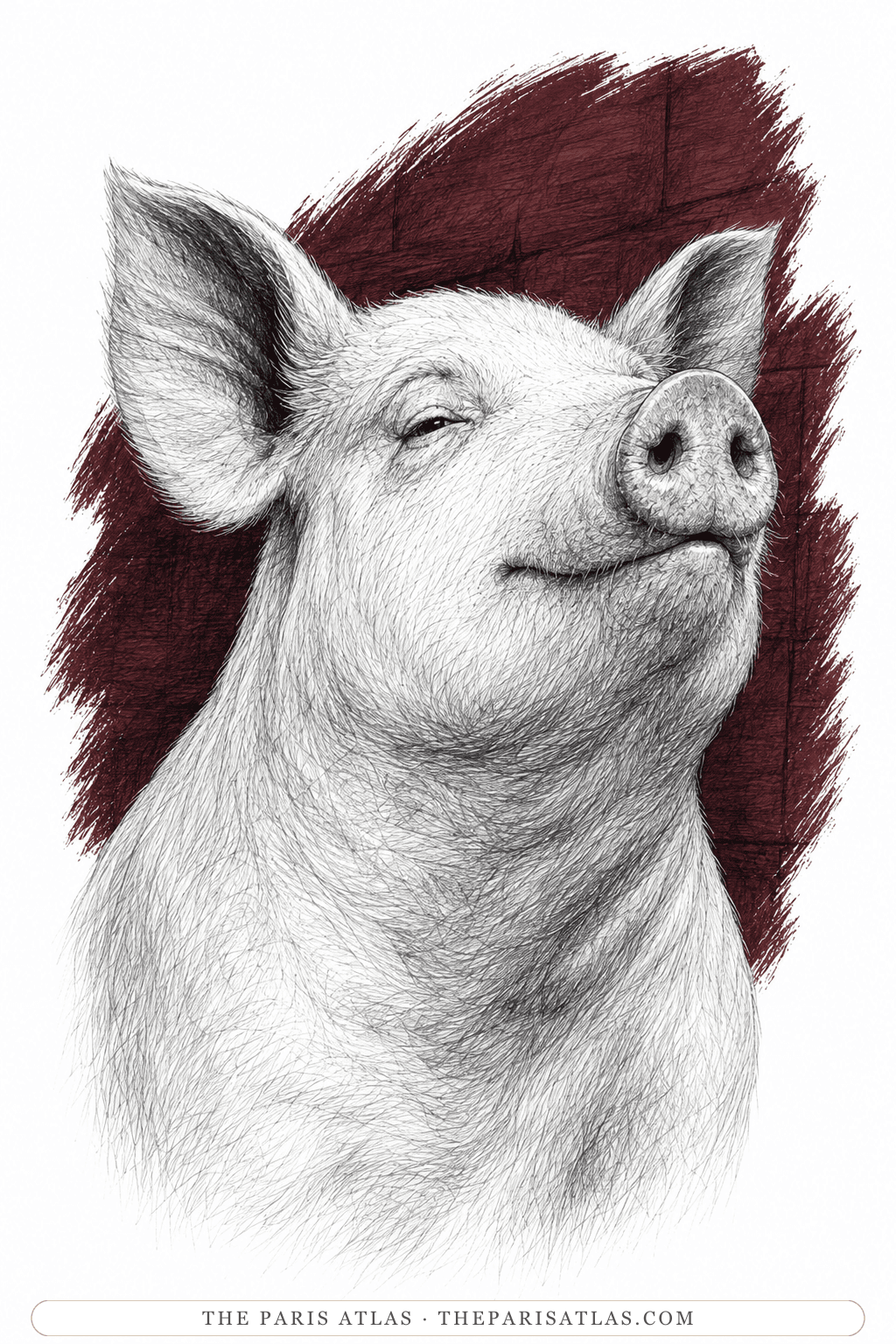
Minimus
A pig with a remarkable gift for composing songs and poems. He sits on the platform beside Napoleon and Squealer, writes the song that replaces "Beasts of England", and composes the ode "Comrade Napoleon", which is painted on the barn wall under a portrait of Napoleon in profile executed by Squealer in white paint.
The book

At a glance
- A pig on Animal Farm, and the only animal in it who writes verse
- A remarkable gift for composing songs and poems
- The front of the raised platform, with Napoleon and Squealer
- The song that replaced "Beasts of England", and the ode "Comrade Napoleon"
- Chapters V, VII and VIII
Who they are in the book
Spoiler-freeMinimus is named in Chapter V, at the point where the Sunday-morning meetings on Animal Farm have stopped being meetings. The debates have been abolished, the animals now file past the skull of Old Major before going into the barn, and they no longer sit all together. Napoleon, the boar who has taken charge of the farm, sits on the front of the raised platform with Squealer, who does his explaining for him, and with a third pig: "another pig named Minimus, who had a remarkable gift for composing songs and poems". The nine dogs form a semicircle round the three of them and the other pigs sit behind.
That sentence is all the description he gets. George Orwell never says how big Minimus is, what colour he is, how old he is or what he sounds like. What the book gives him instead is two pieces of work.
The first is the replacement anthem. On the evening of the executions the animals sing "Beasts of England" three times over, slowly and mournfully, and Squealer comes out with two dogs to announce that Napoleon has abolished it: the song expressed a longing for a better society, that society has now been established, and the song therefore has no purpose. In its place Minimus writes one that begins "Animal Farm, Animal Farm, / Never through me shalt thou come to harm!" It is sung every Sunday morning after the hoisting of the flag. Orwell gives the animals' verdict on it in a single clause: neither the words nor the tune ever seemed to them to come up to the song it replaced.
The second is the ode "Comrade Napoleon", written at the height of the titles and the tears, when the pigs have taken to calling Napoleon Father of All Animals and Protector of the Sheep-fold. It runs to three stanzas and ends with a piglet whose first squeak should be the leader's name. Napoleon approved of it and had it inscribed on the wall of the big barn, at the opposite end from the Seven Commandments, under a portrait of himself in profile executed by Squealer in white paint.
How Minimus Is Portrayed
- The whole of his descriptionChapter V introduces him as another pig with a remarkable gift for composing songs and poems, and Chapter VII calls him Minimus, the poet. The book gives him no size, colour, age or voice at any point. The gift is his only stated attribute.
- Where he sitsOn the front of the raised platform at the Sunday assemblies, with Napoleon and Squealer, the nine dogs in a semicircle round the three of them and the rest of the pigs behind. He is the third pig on the platform, and the only one there who is not either the leader or his spokesman.
- The song that replaced "Beasts of England"Written after the old anthem is banned. It begins "Animal Farm, Animal Farm, / Never through me shalt thou come to harm!" and is sung every Sunday morning once the flag is up. The animals felt that neither the words nor the tune came up to the song it replaced.
- "Comrade Napoleon"Three stanzas addressed to Napoleon as friend of the fatherless, fountain of happiness and lord of the swill-bucket, promising that a sucking-pig of the poet's own would be taught to squeak the leader's name first. Napoleon approved it and had it inscribed on the barn wall opposite the Seven Commandments, under a white-paint portrait of himself in profile by Squealer.
If you like Animal Farm


If you like George Orwell
Explore authors with a similar voice, perspective, and influence.

Henry Miller
The Brooklyn dropout who arrived in Paris broke at thirty-eight and wrote the exuberant, banned books that ended American censorship.
View author
Louis-Ferdinand Céline
The doctor of the Paris slums who wrote the century's blackest, funniest novel — and changed the sound of French prose.
View author
Simone de Beauvoir
French writer and philosopher whose novels, memoirs, and social analysis examined freedom, gender, responsibility, aging, and the material conditions that shape a life.
View author