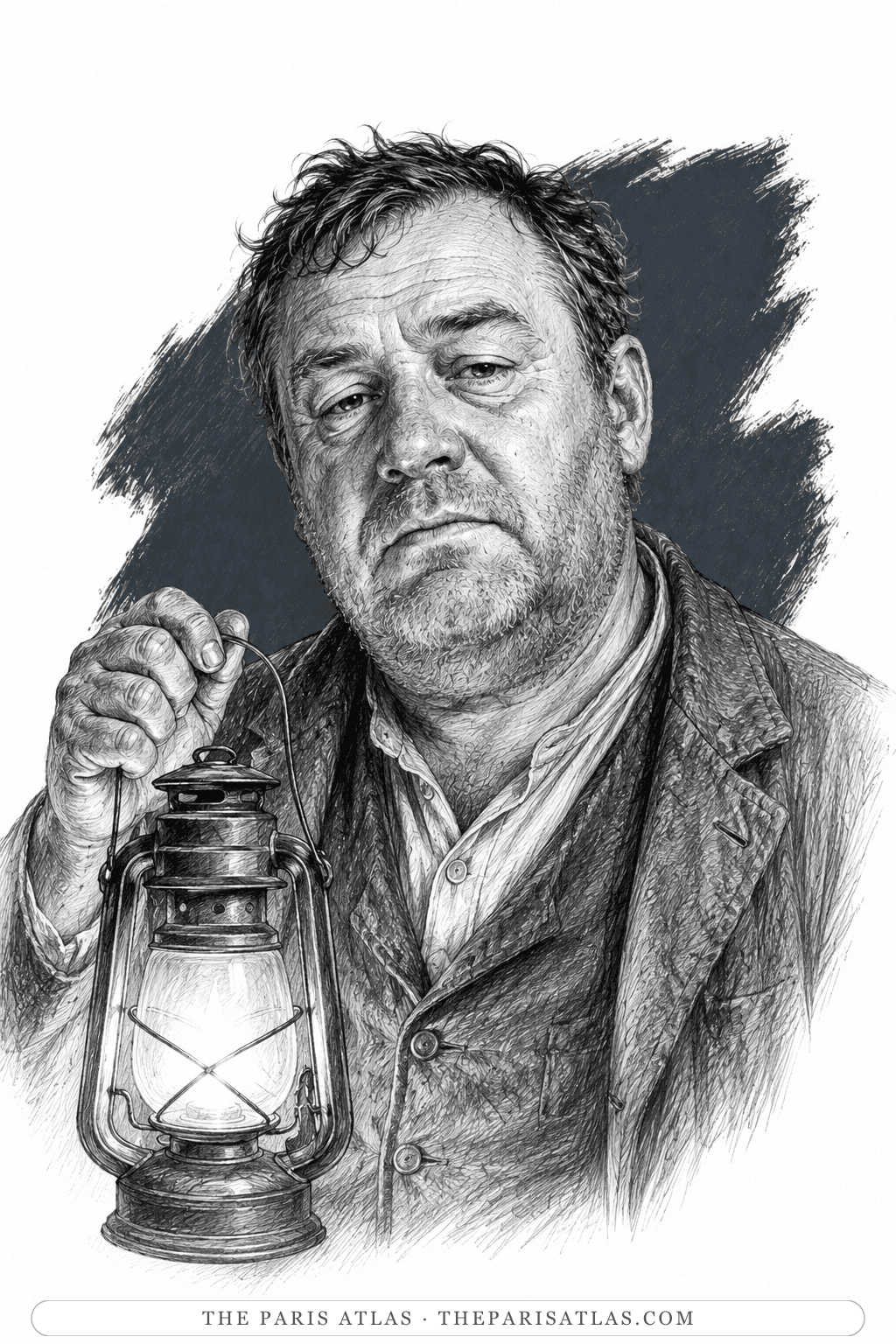
Mr Jones
The farmer the animals drive out. He was a capable farmer once, lost money in a lawsuit and took to drinking; the Rebellion happens on an evening when he has forgotten to feed the stock. His name is used on the farm for years afterwards as the alternative to obedience.
His property back, and an audience for the injustice of it. He spends the months after the Rebellion in the taproom of the Red Lion complaining to anyone who would listen about being turned out by a pack of good-for-nothing animals.
The book

At a glance
- The farmer of the Manor Farm, expelled in the Rebellion
- A wife, four hired men, and children whose old spelling book survives
- Willingdon; he drinks at the Red Lion
- The newspapers, and the News of the World on Sundays
- Joins the attempt to retake the farm, then gives up and moves to another part of the county
- Chapters I, II and IV in person; invoked constantly thereafter
Who they are in the book
Spoiler-freeMr Jones owns the Manor Farm, and George Orwell puts him on the first page in one sentence of action: he had locked the hen-houses for the night but was too drunk to remember to shut the pop-holes, and he lurched across the yard with the ring of light from his lantern dancing from side to side, kicked off his boots, drew himself a last glass of beer from the barrel in the scullery and went up to bed. Everything that follows is possible because of the pop-holes.
He had been a hard master but a capable farmer. He became disheartened after losing money in a lawsuit, took to drinking more than was good for him, and would spend whole days lounging in a Windsor chair in the kitchen reading the newspapers and feeding the tame raven crusts of bread soaked in beer. His men were idle and dishonest, the fields were full of weeds, the buildings wanted roofing, and the animals were underfed. On Midsummer's Eve he went into Willingdon, got drunk at the Red Lion and did not come back until midday on Sunday, then slept on the drawing-room sofa with the News of the World over his face. By evening the animals had gone a day and a half without food. They broke into the store-shed, he and his four men came at them with whips, and within a few minutes all five were running down the cart-track to the main road.
He never gets the farm back, and he does not need to be present to be useful. Every unpopular decision on Animal Farm for the next several years is closed with the same question: surely nobody wants Jones back? The animals are certain of that one thing, and Orwell notes each time that the argument was therefore unanswerable. What is left of him physically is put to work too: his children's old spelling book teaches the pigs to read, three of his household manuals supply the mechanical details of the windmill, and a book of Julius Caesar's campaigns from his shelves supplies the battle plan that beats him.
How Mr Jones Is Portrayed
- The first pageToo drunk to remember to shut the pop-holes after locking the hen-houses. The lantern swinging, the boots kicked off at the back door, a last glass of beer from the barrel in the scullery, and Mrs Jones already snoring upstairs.
- The declineA hard master but once a capable farmer. He lost money in a lawsuit, was much disheartened by it and took to drinking. Whole days in a Windsor chair with the newspapers, while the hedges went neglected and the animals went underfed.
- Midsummer's EveHe drank at the Red Lion in Willingdon until midday Sunday, came home and slept on the sofa with the News of the World over his face, and left the animals unfed for a second day. When they broke into the store-shed he and four men came in with whips, and the animals flung themselves at them with nothing planned beforehand.
- What was in the harness-roomThe bits, the nose-rings, the dog-chains and the knives he used to castrate the pigs and lambs all went down the well. The reins, halters, blinkers and nosebags went on the rubbish fire, and so did the whips, and all the animals capered with joy when they saw them burn.
- The gunHe fired number 6 shot into the barn wall on the night of Old Major's speech, thinking there was a fox in the yard. At the Battle of the Cowshed he fired again, wounding Snowball and killing a sheep, before Snowball knocked him into a pile of dung. The gun was afterwards mounted at the foot of the flagstaff and fired twice a year.
- The stories the neighbours tellHe was pitied in principle and helped very little. The other farmers first said the whole thing would be over in a fortnight, then that the animals were starving, then that they practised cannibalism, tortured one another with red-hot horseshoes and had their females in common.
- The one argument that never failsLong after he has given up and moved away, his name is the closing move in every difficult announcement on the farm. Surely nobody wants Jones back? The animals were certain that they did not, and so the debates stopped, and the trade began, and the milk went to the pigs.
- What he left behindAn old spelling book on the rubbish heap, from which the pigs taught themselves to read and write in three months. Three household manuals — One Thousand Useful Things to Do About the House, Every Man His Own Bricklayer and Electricity for Beginners — from which Snowball worked out the windmill. And a book of Julius Caesar's campaigns, from which Snowball worked out how to beat him.
If you like Animal Farm


If you like George Orwell
Explore authors with a similar voice, perspective, and influence.

Henry Miller
The Brooklyn dropout who arrived in Paris broke at thirty-eight and wrote the exuberant, banned books that ended American censorship.
View author
Louis-Ferdinand Céline
The doctor of the Paris slums who wrote the century's blackest, funniest novel — and changed the sound of French prose.
View author
Simone de Beauvoir
French writer and philosopher whose novels, memoirs, and social analysis examined freedom, gender, responsibility, aging, and the material conditions that shape a life.
View author