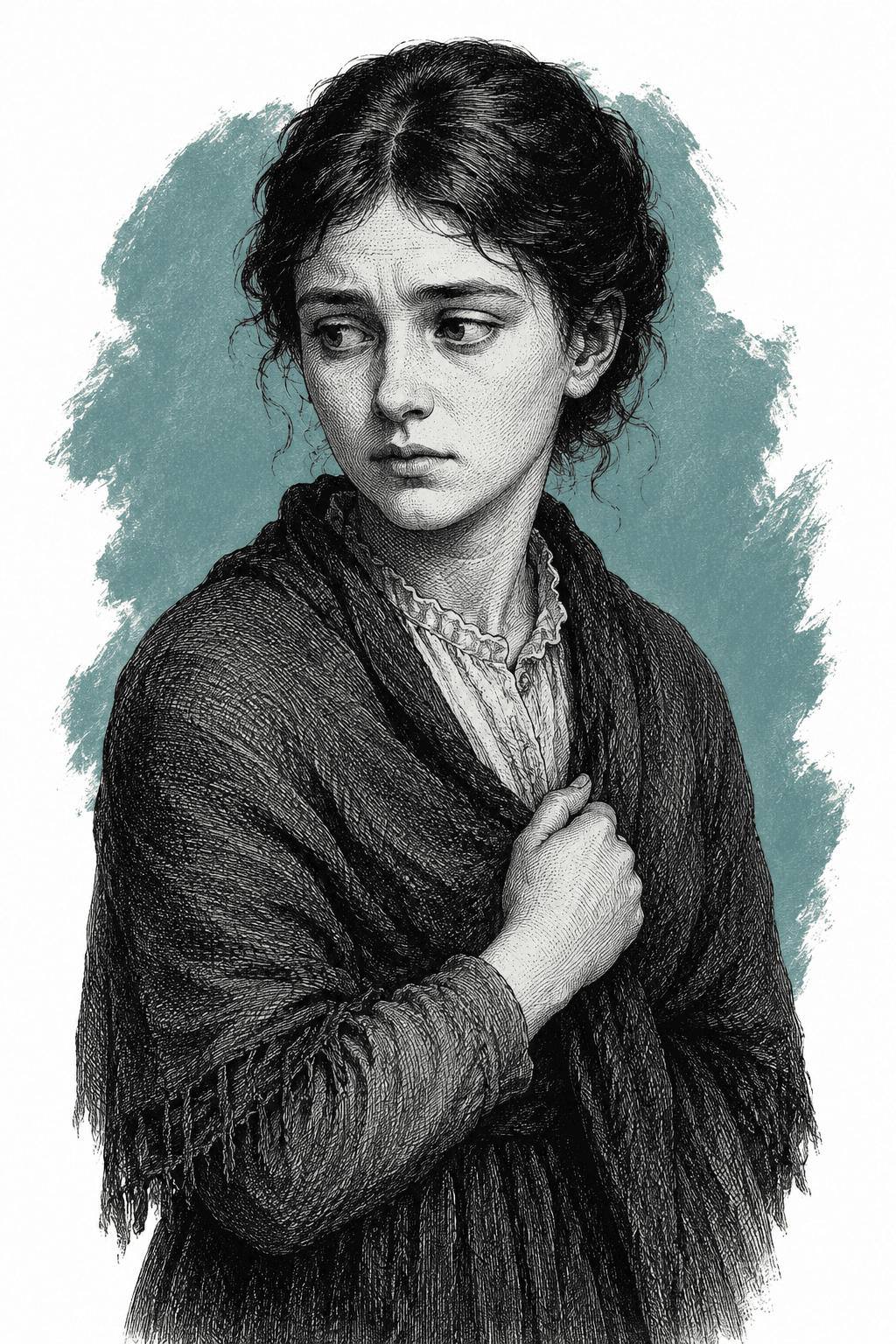
Corley
The other man in "Two Gallants": a police inspector's son who talks about nothing but himself and has plans for a housemaid.
To get something out of the young woman without giving anything back. Lenehan asks twice whether he is sure he can bring it off, and the answer comes back with an edge on it: "I'll pull it off," he said. "Leave it to me, can't you?"
The book

At a glance
- One of the two men in "Two Gallants", the sixth story
- Son of an inspector of police, whose build and gait he inherited
- None; friends give him the hard word whenever a job comes up
- A housemaid in a house on Baggot Street; she does not know his name
- Rutland Square down to Stephen's Green, then out to Donnybrook by tram and back
- A down-and-out Corley cadges money from Stephen Dedalus late in Ulysses
Who they are in the book
Spoiler-freeCorley is one of the two men in "Two Gallants", the sixth of the fifteen stories in Dubliners, the 1914 collection by the Irish writer James Joyce. He is the son of a police inspector and inherited his father's frame and walk. He has no job. He is often seen talking earnestly with plain-clothes policemen, and he is fond of delivering final judgments about matters he claims to know the inside of.
For most of the story he is describing to his friend Lenehan a young housemaid he picked up on Dame Street a few weeks earlier, who works in a house on Baggot Street. He has lied to her about his job and has not told her his name. He is going to meet her again that evening and has something specific in mind, which he will not say out loud and which Lenehan keeps circling.
How Corley Is Portrayed
- How he looksBurly, upright, swaying his head from side to side as he walks. His head is large, globular and oily and sweats in all weathers, and his big round hat sits sideways on it like a bulb grown out of another bulb.
- How he talksWithout listening. His conversation is mainly about himself: what he said to a person, what the person said to him, and what he said to settle the matter. When he quotes himself he aspirates the first letter of his own name.
- What he tells his friendHe met her under Waterhouse's clock, walked her round by the canal, took her out to a field at Donnybrook. She brings him cigarettes every night and pays his tram fare both ways, and once brought him two cigars.
- The liesHe told her he was out of a job. He told her he worked at Pim's. He did not tell her his name, because he was too wary. He says she thinks he is a bit of class.
- The earlier girlHe mentions one who used to go with him and is now, in his phrase, on the turf — he saw her driving down Earl Street with two men. Asked whether that was his doing, he says philosophically that there were others at her before him.
- How he handles the meetingHe crosses the road without saluting her and starts talking at once. He lets Lenehan look at her from a distance but bars an introduction, and returns his friend's greeting only by vaguely tilting his hat. He always keeps her waiting a bit, he says.
Corley walks the housemaid home, waits at the foot of her area steps while she goes down and comes back, and then walks off fast without a word. Lenehan runs after him through a drizzle asking three times whether it came off, and gets nothing until they reach a lamp. Then Corley stops, puts out his hand with what the story calls a grave gesture, and opens it: a small gold coin, taken from a servant girl's employer's house or her own savings — Joyce does not say which, and that is the last sentence of the story.
The title is bitter and the printers did not need it explained. "Two Gallants" was the story that broke the book's first publishing contract in 1906, when Grant Richards's printer refused to set it at all.
If you like Dubliners


If you like James Joyce
Explore authors with a similar voice, perspective, and influence.
Ezra Pound
The impresario who dragged Joyce's early books into print, brought him to Paris, and championed Ulysses until the world caught up.
View author
Sylvia Beach
His publisher of last resort and first devotion — the bookseller who printed Ulysses when no one else would.
View author
Louis-Ferdinand Céline
The doctor of the Paris slums who wrote the century's blackest, funniest novel — and changed the sound of French prose.
View author