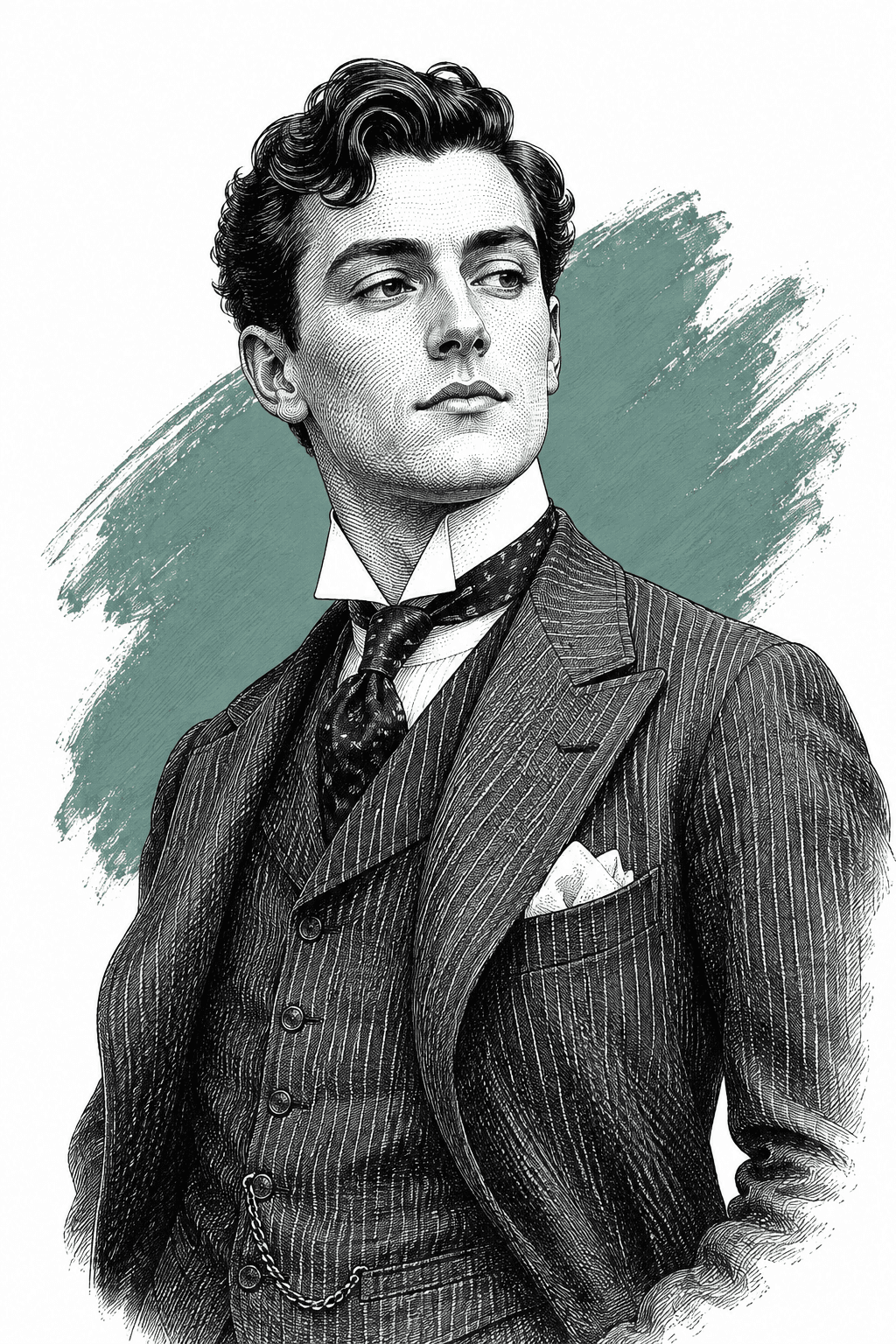
Jimmy Doyle
The rich butcher's son in "After the Race", spending a night with continental friends who are better at everything than he is.
To be one of them. The story names three reasons for his excitement that night: rapid motion, being noticed, and having money in his control.
The book

At a glance
- The subject of "After the Race", the fifth story
- About twenty-six
- Son of a Dublin butcher turned merchant prince, who pays his bills and is covertly proud of the excess
- A big English Catholic college, law at Dublin University, and a term at Cambridge to see a little life
- The Naas Road, Dame Street, his parents' house, Ségouin's hotel, Stephen's Green, and a yacht at Kingstown
- Ségouin and his cousin Rivière, a Hungarian pianist named Villona, an Englishman named Routh, and an American named Farley
Who they are in the book
Spoiler-freeJimmy Doyle is the subject of "After the Race", the fifth of the fifteen stories in Dubliners, the 1914 collection by the Irish writer James Joyce. He is about twenty-six, the son of a Dublin butcher who made a fortune in shops and police contracts and is described in the papers as a merchant prince. The money bought Jimmy an English Catholic college, a law course at Dublin University and a term at Cambridge, where he met a Frenchman named Charles Ségouin.
The story covers the evening after a motor race through Dublin. Jimmy rides back into the city in Ségouin's car, dines with him, and ends the night playing cards on an American's yacht at Kingstown. He is about to put a large part of his money into Ségouin's new motor business in Paris, on his father's advice. Joyce keeps the whole story at the pitch of Jimmy's excitement, which is not the same thing as endorsing it.
How Jimmy Doyle Is Portrayed
- How he looksAbout twenty-six, with a soft light brown moustache and rather innocent-looking grey eyes. Dressed for dinner he looks very well, and his father, watching him settle his bow tie in the hall, may have felt he had bought his son qualities that are often not for sale.
- Where the money came fromHis father began as an advanced Nationalist, modified his views early, made money as a butcher in Kingstown, opened shops across Dublin and secured some of the police contracts. Jimmy did not study very hard and took to bad courses for a while.
- In the carHe has to lean forward to catch the Frenchmen's quick talk over the wind and the engine and a Hungarian humming beside him, guess at the meaning and shout back something suitable. It is not altogether pleasant for him, and he is pleased anyway.
- The investmentHe is about to stake the greater part of his substance on Ségouin's motor firm. It was his father who first suggested it, and Ségouin has managed to give the impression that including the Irish money at all is a favour of friendship.
- At dinnerThe talk turns to politics, and Jimmy, under generous influences, feels the buried zeal of his father wake up in him and rouses the torpid Englishman at the table. Their host has to lift a glass to Humanity and open a window to cool the room down.
- The speechOn the yacht he makes a long one, with the Hungarian calling "Hear! hear!" at every pause and a great clapping of hands at the end. On its quality the story commits to one sentence: "It must have been a good speech."
- The cardsHe does not know who is winning but he knows he is losing, and he keeps mistaking his cards so that the others have to calculate his IOUs for him. He wants them to stop and does not say so.
The last game is between the Englishman Routh and the Frenchman Ségouin, and Routh wins. Jimmy and the American are the heaviest losers, and Jimmy has no idea how much he has written away. He puts his head in his hands and counts the beats in his temples, glad of the dark stupor that will cover up his folly, knowing he will regret it in the morning. The door opens and the Hungarian, who left the cabin before the money started moving and is the only poor man in the party, announces: "Daybreak, gentlemen!"
"After the Race" was one of the three stories printed in a Dublin farming weekly, The Irish Homestead, in 1904 — it ran in December, under the name Stephen Daedalus. Joyce later thought it one of the weakest things in the book and considered rewriting it.
If you like Dubliners


If you like James Joyce
Explore authors with a similar voice, perspective, and influence.
Ezra Pound
The impresario who dragged Joyce's early books into print, brought him to Paris, and championed Ulysses until the world caught up.
View author
Sylvia Beach
His publisher of last resort and first devotion — the bookseller who printed Ulysses when no one else would.
View author
Louis-Ferdinand Céline
The doctor of the Paris slums who wrote the century's blackest, funniest novel — and changed the sound of French prose.
View author