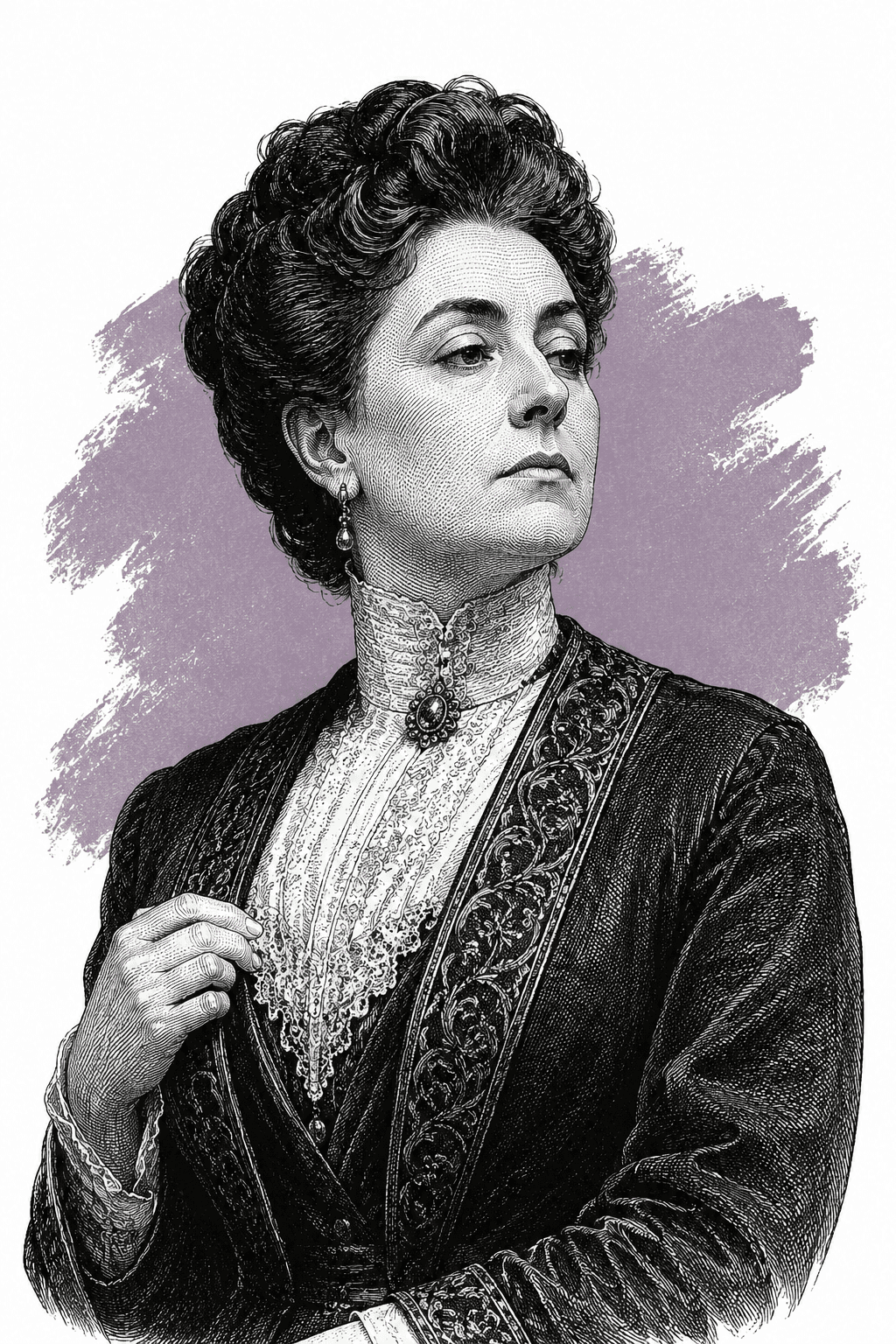
Mrs Kearney
The mother in "A Mother", who arranged her daughter's concert contract and stops the concert dead when the fee comes up short.
The eight guineas her daughter contracted for, in full and on the night. "I'm asking for my rights," she said.
The book

At a glance
- The subject of "A Mother", the thirteenth story
- Miss Devlin, educated at a high-class convent in French and music
- Married to Mr Kearney, a bootmaker on Ormond Quay, much older than herself; two daughters, the elder Kathleen
- Eight guineas for Kathleen to accompany four grand concerts at the Antient Concert Rooms
- The Kearney house, and the dressing room and corridors of the Antient Concert Rooms across four nights
- Her daughter Kathleen is named in "The Dead" as one of a party going to the Aran Isles
Who they are in the book
Spoiler-freeMrs Kearney is the subject of "A Mother", the thirteenth of the fifteen stories in Dubliners, the 1914 collection by the Irish writer James Joyce. She was Miss Devlin, convent-educated in French and music, naturally pale and unbending in manner, with few friends. The story says flatly that she became Mrs Kearney out of spite, marrying a much older bootmaker on Ormond Quay once her friends had begun to talk about how long she had been waiting.
Her elder daughter Kathleen has been engaged as accompanist for a series of four concerts in Dublin at eight guineas, and Mrs Kearney has done most of the organising herself because the society running them cannot. Two of the four nights are poorly attended, one is cancelled, and by the last one her daughter has been paid half. Joyce is careful to make her right about the contract and impossible about everything else, and the story turns on a room full of men deciding which of those two things matters more.
How Mrs Kearney Is Portrayed
- How she marriedThe young men she met were ordinary and she gave them no encouragement, consoling her romantic desires by eating a great deal of Turkish Delight in secret. When she drew near the limit and her friends began to loosen their tongues about her, she silenced them by marrying Mr Kearney.
- How she handles her husbandAt a party in a strange house she lifts an eyebrow ever so slightly and he stands up to take his leave. When his cough troubles him she puts the eiderdown quilt over his feet and makes a strong rum punch. She respected him, the story says, as she respected the General Post Office: as something large, secure and fixed.
- The language movementWhen the Irish Revival began to be appreciable she took advantage of her daughter's Irish name, brought an Irish teacher to the house, and had the girls send Irish picture postcards to their friends. Soon Kathleen Kearney was spoken of as clever at music and a believer in the language movement, which was the point of the exercise.
- What she is genuinely good atShe has tact and she knows the trade. She knows which performers go into capitals on the bill and which into small type, that the first tenor will not want to follow a comic turn, and that the doubtful items should be slipped in between the old favourites. The man arranging the series calls on her every day for advice.
- What she spendsBlush-pink charmeuse from Brown Thomas's to let into the front of Kathleen's dress, which cost a pretty penny, and a dozen two-shilling tickets for the final concert sent to friends who could not be trusted to come otherwise.
- The standWith the hall clapping and stamping for the first item she holds the concert up. Her line to the secretaries is short and she repeats it: her daughter will not go on without her money. Four pounds eight into her hand, or a foot she will not put on that platform.
- What it costs herEveryone in the building takes the committee's side. Mr Holohan tells her he thought she was a lady and walks away from her mid-sentence, and another man announces that Kathleen Kearney's musical career in Dublin is finished after this.
The committee's answer is that the other four guineas will be paid after a meeting the following Tuesday, and that if Kathleen does not play the second half they will consider the contract broken and pay nothing at all. Mrs Kearney refuses, wraps her daughter's cloak round her and sends her husband out for a cab. Another woman steps in to play the accompaniments and the concert goes on without them. On the way out she stops in the doorway and glares into Mr Holohan's face to tell him she is not done with him. "But I'm done with you," said Mr Holohan.
Joyce leaves the arithmetic where a reader can check it. Mrs Kearney is owed the money, the society is disorganised and evasive, and nobody in the building disputes either fact — they close ranks because she pressed the claim out loud, in front of an audience, and because she is a woman doing it. She says so herself: they would not have dared treat her that way if she had been a man. The last line of the story approves of Holohan.
If you like Dubliners


If you like James Joyce
Explore authors with a similar voice, perspective, and influence.
Ezra Pound
The impresario who dragged Joyce's early books into print, brought him to Paris, and championed Ulysses until the world caught up.
View author
Sylvia Beach
His publisher of last resort and first devotion — the bookseller who printed Ulysses when no one else would.
View author
Louis-Ferdinand Céline
The doctor of the Paris slums who wrote the century's blackest, funniest novel — and changed the sound of French prose.
View author