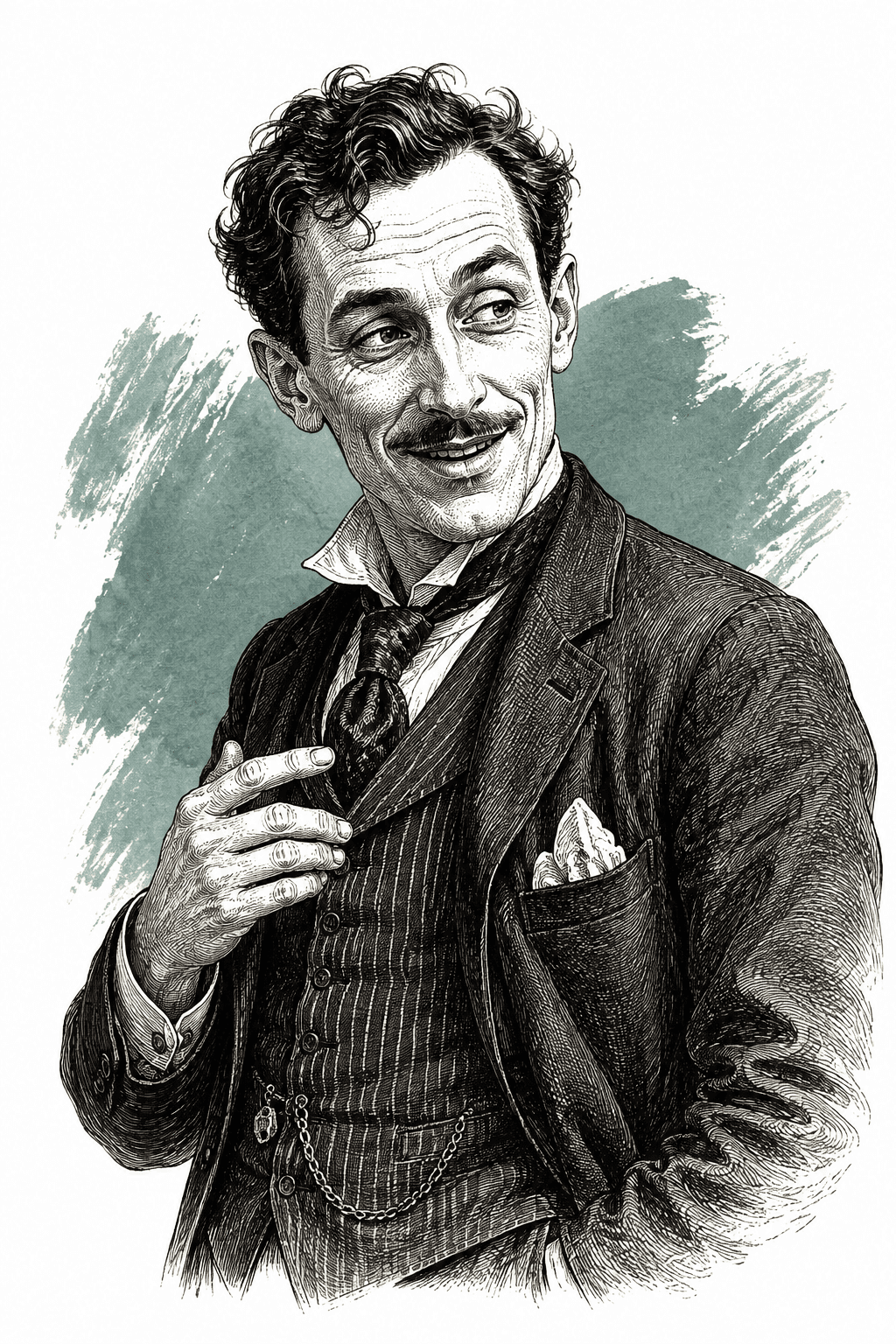
Ignatius Gallaher
The friend home from London in "A Little Cloud": a Dublin man who got out, made a career on the English press, and came back to be admired.
Money, and to enjoy himself before he settles down. He tells Chandler: "I mean to marry money. She'll have a good fat account at the bank or she won't do for me."
The book

At a glance
- A character in "A Little Cloud", the eighth story
- Journalist on the London press
- Eight years; Chandler saw him off at the North Wall
- The story reports one version: some shady affair, a money transaction — but says nobody denied him talent
- Corless's, a smart Dublin bar, over four whiskies and a cigar
- He is talked about, in the same tone, in a newspaper office in Ulysses
Who they are in the book
Spoiler-freeIgnatius Gallaher is a character in "A Little Cloud", the eighth of the fifteen stories in Dubliners, the 1914 collection by the Irish writer James Joyce. Eight years before the story opens he left Dublin — under a cloud, according to one version, after some unclear business about money — and he has since made a name as a journalist in London. He is back for a short holiday, and has arranged to meet his old friend Thomas Chandler for a drink.
He does most of the talking. He has been to Paris, to Berlin, to the Moulin Rouge, and he has stories about all of them that he is happy to tell a man who has never been further than the Isle of Man. Joyce lets him be genuinely likeable for about two pages and then keeps him talking, and the more he talks the less there is. He is the only person in the book who represents escape, and the book is not impressed by him.
How Ignatius Gallaher Is Portrayed
- How he looksA heavy pale clean-shaven face, a large closely cropped head going grey and thin on top, bluish slate-coloured eyes, and a vivid orange tie. He takes his hat off to show his friend the thinning hair and asks whether he looks older.
- How he drinksWhisky, neat, and quickly, while Chandler waters his own. He orders for both of them, tells his friend not to make punch of it, and calls the barman garçon.
- The talk about ParisNot so beautiful as they say, he decides, but there is no city like it for movement and excitement, and no woman like the Parisienne. He has been to the students' balls and to the Bohemian cafés, and says they are not for a pious chap like Chandler.
- The stories he tellsHe works through the vices of several European capitals in what the story calls a calm historian's tone, awards the palm to Berlin, and finishes with a story about an English duchess which he says he knows to be true.
- The invitation he turns downChandler asks him home to meet his wife. Gallaher is awfully sorry, he leaves tomorrow night, he is committed to a card party with a clever young chap — and next year, perhaps, when he takes a little skip over.
- What he thinks of marriageHe shuts one eye over the rim of his glass and says there is no blooming fear of it, that he intends to see a bit of life first, and imitates with his mouth the act of tasting something gone stale.
Gallaher does not have an ending, which is part of the point: he finishes his drink, looks at his gold watch, mentions an appointment and goes, and the story stays with Chandler in his front room. What he leaves behind is the idea that Chandler's life is small, and the story spends its last pages showing what that idea does to a man holding a baby.
Joyce based the name and something of the type on Fred Gallaher, a Dublin journalist of his father's generation who had made a reputation abroad. He reused the character years later in Ulysses, where a group of newspapermen recall a scoop of Gallaher's and admire him at a distance, much as Chandler does here.
If you like Dubliners


If you like James Joyce
Explore authors with a similar voice, perspective, and influence.
Ezra Pound
The impresario who dragged Joyce's early books into print, brought him to Paris, and championed Ulysses until the world caught up.
View author
Sylvia Beach
His publisher of last resort and first devotion — the bookseller who printed Ulysses when no one else would.
View author
Louis-Ferdinand Céline
The doctor of the Paris slums who wrote the century's blackest, funniest novel — and changed the sound of French prose.
View author