Fifteen short stories set in Dublin around 1904. A girl sits at a window deciding whether to sail for Argentina with a sailor. A clerk pawns his watch to pay for a night's drinking. A laundry worker takes her one evening out. A man at his aunts' Christmas dance discovers he did not know his wife as well as he thought. James Joyce arranged the stories roughly by age — childhood first, then youth, then working life, then public life — and closed the book with "The Dead", the longest of them and the one most often called the finest short story in English. It took him nine years to get the collection into print. Printers and publishers objected to the real street names, the real pubs, the mention of a dead king, and the way his characters actually spoke.
The story, in more detail
James Joyce was twenty-two and living in Dublin when he wrote the first of these stories. The editor of a farming weekly called The Irish Homestead asked him for something simple and rural, and he sent back "The Sisters", about a boy and a dead priest. The paper printed it in July 1904, then "Eveline" in September and "After the Race" in December, all three under the name Stephen Daedalus rather than his own. He had twelve stories by 1905 and added three more later; "The Dead", which he wrote in Trieste in 1907, was the last.
Then the trouble started. The London publisher Grant Richards signed a contract in 1906 and his printer refused to set "Two Gallants". Richards asked for cuts, Joyce refused most of them, and the contract collapsed. Four more publishers turned the book down. In 1909 the Dublin firm Maunsel & Co. took it on, and its printer, John Falconer, set the whole thing in type. But Maunsel's managing director, George Roberts, took fright at the real Dublin businesses named in the stories and at a passage about the recently dead King Edward VII in "Ivy Day in the Committee Room", and he refused to publish. In September 1912 the printed sheets were destroyed. Joyce said Falconer burned them; Roberts said they were guillotined. Joyce got one set of proofs out of the building by a trick, left Dublin, and never came back.
Grant Richards took the book on again from those rescued proofs and published it in London on 15 June 1914, in an edition of 1,250 copies. It sold 379 in the first year, and Joyce had contracted to buy 120 of those himself. Five hundred and four sets of sheets were later sold to the New York publisher B. W. Huebsch, who brought out the American edition in 1916. Joyce was thirty-two, unknown, and living on language-teaching money in Trieste. The stories he had fought nine years for are now the book most people read first when they read him at all.
What's inside
What happens, beginning to end — the ending included. Open when you're ready.
Three stories open the book, each told by a boy who is never named. In "The Sisters" a priest who had been teaching him privately dies after a third stroke, and the boy listens to the adults not quite saying what was wrong with the man. In "An Encounter" he and a schoolfriend skip a day of school to walk across Dublin to the docks, and in a field on the way back a middle-aged stranger sits down beside them and talks. In "Araby" he promises to bring a present back from a bazaar for the sister of a friend, and gets there just as the stalls are closing.
Four stories follow young adults. "Eveline" is a girl of nineteen at the window of the house she keeps for her father, weighing an offer of escape. "After the Race" follows Jimmy Doyle, a rich butcher's son, through a day and night with a set of continental motor-racing friends he cannot quite keep up with. "Two Gallants" walks two idle men, Lenehan and Corley, around Dublin on a Sunday evening while one of them works a young housemaid for something. "The Boarding House" is about a landlady, her daughter, and a lodger who has gone too far and knows it.
Four more take people in the middle of their working lives. In "A Little Cloud" a timid law clerk meets an old friend who left for London and made good, and comes home to his wife and baby in a new and bitter mood. "Counterparts" follows a copying clerk named Farrington through a humiliating day at the office and a night of drinking he cannot afford. "Clay" is a small woman named Maria going out to a family's Hallow Eve party. "A Painful Case" is about a bank cashier who arranges his life to avoid other people, and then does not.
Three stories move out into public life: an election committee room on the anniversary of Charles Stewart Parnell's death, a mother who stops a concert dead over her daughter's fee, and a group of Dublin businessmen who decide their friend's drinking can be fixed by a religious retreat. Then "The Dead", which is roughly twice as long as anything before it. Gabriel Conroy and his wife Gretta arrive late at his aunts' Christmas dance. There is a goose, a speech, an argument about Irish nationalism, and a song heard from the top of the stairs on the way out.
How it ends — spoilers aheadThe final movement, ending included. Open when you're ready.
"The Dead" ends in a hotel room. On the way out of the party Gretta hears a guest singing an old song called "The Lass of Aughrim", and it stops her on the stairs. Gabriel spends the cab ride and the walk up to the room wanting her, and when he finally asks what she is thinking about she tells him: a boy named Michael Furey, who used to sing that song, who worked in the gasworks in Galway, and who came to her window in the rain the night before she left for Dublin, already dying, and said he did not want to live. He was seventeen. "I think he died for me," she answers when Gabriel asks what killed him. She cries herself to sleep. Gabriel lies awake beside her, understands that he has never felt anything like that for anyone, and watches the snow come on again outside — snow that is, as the newspapers had said, general all over Ireland. The last sentence is the most quoted in Joyce: "His soul swooned slowly as he heard the snow falling faintly through the universe and faintly falling, like the descent of their last end, upon all the living and the dead."
The other stories tend to stop rather than resolve, usually a line or two after the thing the reader has been waiting for arrives. Eveline gets to the quayside and cannot make her feet move. "Two Gallants" ends with Corley silently opening his hand to show Lenehan a small gold coin. "Counterparts" ends with Farrington beating his young son with a walking-stick while the boy offers to say a Hail Mary for him. "A Painful Case" ends with Mr Duffy alone on Magazine Hill four years after he broke off the one friendship he had, having just read in the paper how the woman died. Joyce leaves the summing-up to the reader on purpose. Nothing is explained after the fact.
Themes and analysis
These readings discuss events throughout the book, including its ending.
Araby, at closing time
The boy has already carried his romantic devotion through a market before he reaches Araby, imagining an ordinary errand as a sacred mission. At the bazaar, the churchlike silence survives but no revelation rewards him: coins are counted and the stallholder returns to an inconsequential conversation. The supposedly distant world repeats the routine from which he hoped to escape. His remaining money makes the disappointment material, while his final judgment turns against his own grand expectations. That fierce self-accusation is an emotional ending, not a calm explanation that makes the adults' delays or his loneliness disappear.
In ‘Araby’, the boy’s imagined adventure meets a bazaar already closing for the night. An interpretive literary illustration of the moment of disappointment. (Illustration — The Paris Atlas)
A song on the stairs
Gabriel first responds to Gretta's absorption by composing an imaginary painting of her. He can arrange the colors and give the picture a title without knowing what holds her attention. As they leave, his own memories of their marriage fill the silence he has not yet asked her to explain. The song eventually discloses a past that his picture cannot contain. Joyce makes the difference between seeing and understanding central to the encounter: Gretta is not merely a beautiful attitude for her husband to interpret, but a person whose remembered life exceeds his view.
In ‘The Dead’, Gretta’s stillness as she hears ‘The Lass of Aughrim’ opens a distance Gabriel does not yet understand. A literary-scene reconstruction. (Illustration — The Paris Atlas)
Quotes from Dubliners
Quoted verbatim from the text, each line verified against its source.
“
His soul swooned slowly as he heard the snow falling faintly through the universe and faintly falling, like the descent of their last end, upon all the living and the dead.
— Narration (Gabriel Conroy's reflection) · James Joyce, “The Dead,” Dubliners (1914) — the collection's final sentence
“
Gazing up into the darkness I saw myself as a creature driven and derided by vanity; and my eyes burned with anguish and anger.
— The boy narrator · James Joyce, “Araby,” Dubliners (1914) — the story's final sentence
Why we recommend it
1
The best way into James Joyce
His later books are famously hard work. This one is not: short stories in clear sentences about people you recognise. Everything he became is already here, in a form anybody can read on a train.
2
'The Dead' on its own
The last story is regularly named the finest short story written in English. It is fifty pages about a Christmas party, and the last page of it has been reprinted more than anything else Joyce wrote.
3
A real city, on purpose
Joyce named the actual streets, shops and pubs, which is one reason the book took nine years to get printed. Dublin can be walked with it in hand, and people do.
Dubliners is fifteen separate short stories rather than a novel, so almost everyone here appears in one story and nowhere else. Each card says which story its subject belongs to. A few names do cross between stories: Mr Holohan, who organises the concerts in "A Mother", is mentioned in passing in "Two Gallants"; Mr Crofton canvasses for votes in "Ivy Day in the Committee Room" and turns up again at the church in "Grace"; and Kathleen Kearney, the young accompanist in "A Mother", is named in "The Dead" as one of a party going to the Aran Isles. Watch the surnames, though — the Mrs Mooney who keeps the boarding house and the Ginger Mooney who works in the laundry in "Clay" are two different women.
The landlady in "The Boarding House", known to her lodgers as The Madam, who finds out what her daughter and one of them have been up to and takes her time.
The lodger in "The Boarding House" who has gone too far with the landlady's daughter, and spends one Sunday morning working out that he has no way back.
The tea salesman in "Grace" who falls down a pub staircase and bites his tongue, and whose friends decide the cure is a religious retreat.
Bring it to book club
Joyce ordered the stories by the age of their subjects, from childhood to old age. Does the book get darker as it goes, or only more resigned?
Almost every story stops without telling you what it meant. Which ending left you most certain of what had happened, and which left you least?
The publishers and printers who blocked the book objected to real place names, real businesses and the characters' language. Reading it now, what do you think they were actually afraid of?
A complete discussion guide is on our editorial calendar. Join the letter to hear when it ships.
Timeline
1904
A Dublin farming weekly, The Irish Homestead, prints "The Sisters", "Eveline" and "After the Race" under the pen name Stephen Daedalus.
1906
The London publisher Grant Richards signs a contract, then withdraws after his printer refuses to set "Two Gallants".
1907
Joyce writes "The Dead" in Trieste, three years after most of the other stories, and the collection is complete at fifteen.
1909
The Dublin firm Maunsel & Co. contracts to publish the book; its printer, John Falconer, sets the whole text in type.
1912
Maunsel refuses to publish and the sheets are destroyed in September. Joyce gets a set of proofs out by a ruse and leaves Dublin for the last time.
1914
Grant Richards publishes Dubliners in London on 15 June, in a printing of 1,250 copies. It sells 379 in the first year, 120 of them bought by Joyce under the terms of the contract.
1916
B. W. Huebsch brings out the American edition in New York, using 504 sets of sheets bought from Richards.
1987
John Huston films "The Dead", his last picture, released after his death.
Book editions
Hardcover
Hardcover
Grant Richards
·
1914
First edition, published in London on 15 June in a printing of 1,250 copies.
Hardcover
Hardcover
B. W. Huebsch
·
1916
First American edition, made from 504 sets of sheets bought from Grant Richards.
Paperback
Penguin Modern Classics
·
2000
ISBN-13
9780141182452
Edited with an introduction and notes by Terence Brown.
Ebook
Ebook
Public domain — free on Project Gutenberg.
Audiobook
Audiobook
Several unabridged recordings; the stories are short enough to take one at a time.
Joyce's first novel, published two years after this book and set in the same city. It follows one boy, Stephen Dedalus, from early childhood to the point where he leaves Ireland. Stephen is the young man Joyce carried on into Ulysses, where he shares the book with Leopold Bloom. Read the three in that order — these stories, then Portrait, then Ulysses — if you want to watch the writing change.
Joyce's next novel, set in the same city a few years later. Several people from these stories walk through it as minor Dubliners — Lenehan from "Two Gallants", Bob Doran from "The Boarding House", Bantam Lyons, and Ignatius Gallaher, who is talked about in a newspaper office. Read Dubliners first: it is much shorter and much easier, and it is the same Dublin.
The American version of the same idea, five years later: separate short stories about separate people that add up to one town. Sherwood Anderson's Ohio and Joyce's Dublin were written independently and are usually taught together.
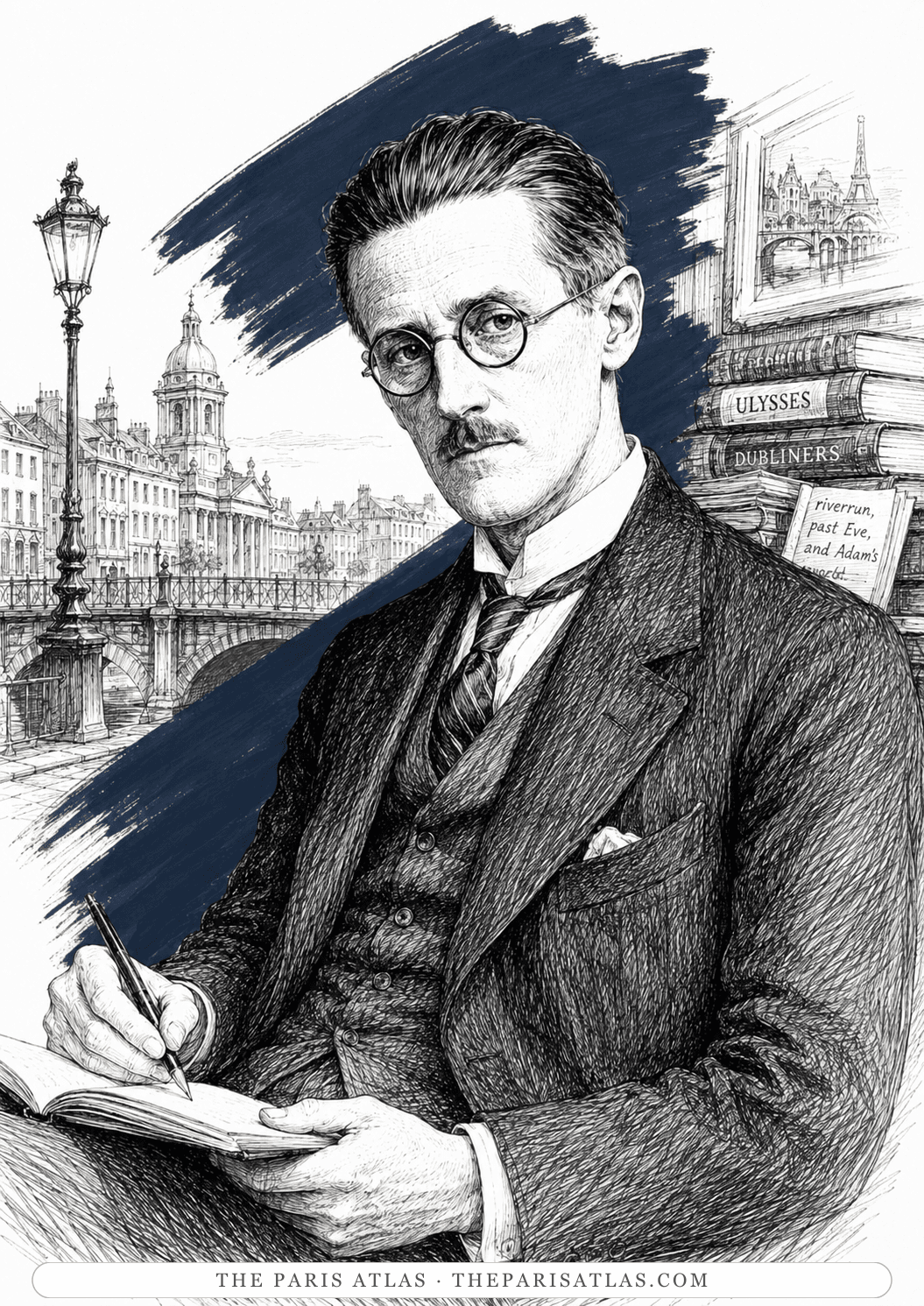
The Irish writer James Joyce. It was his first published book of fiction, brought out in London in 1914, when he was thirty-two and living in Trieste.
What is Dubliners about?
Fifteen short stories about ordinary people in Dublin around 1904 — a shop girl, a clerk, a laundry worker, a bank cashier, a schoolteacher at a Christmas party. There is no continuing plot. The stories are arranged roughly by the age of their subjects, from childhood to old age.
Why did Dubliners take nine years to publish?
Printers and publishers objected to it. Grant Richards's printer refused to set "Two Gallants" in 1906; the Dublin firm Maunsel & Co. took it on in 1909 and then balked at the real Dublin businesses Joyce named and at a passage about the dead King Edward VII. The printed sheets were destroyed in September 1912. Grant Richards finally published the book on 15 June 1914 from proofs Joyce had rescued.
What is the best-known story in Dubliners?
"The Dead", the last and longest. It is about a Christmas party and what a man learns about his wife on the way home from it, and it is regularly named the finest short story written in English. John Huston filmed it in 1987 as his last picture.
Is Dubliners a good place to start with James Joyce?
Yes. It is by far his most straightforward book — short stories in plain sentences, no experiments with form. Readers who find Ulysses or Finnegans Wake forbidding usually have no trouble here.
Do characters from Dubliners appear in Joyce's other books?
Several do. Lenehan from "Two Gallants", Bob Doran from "The Boarding House", the tea salesman Tom Kernan from "Grace", Bantam Lyons and the journalist Ignatius Gallaher all turn up in Ulysses, which is set in the same city a few years later. Mrs Sinico, who dies in "A Painful Case", is remembered there too.
Are the places in Dubliners real?
Almost all of them. Joyce used actual streets, shops, pubs and churches, which is one of the reasons the book was blocked for so long — publishers feared complaints from the named businesses. Readers still walk the routes with the book in hand.
If you like James Joyce
Explore authors with a similar voice, perspective, and influence.
Ezra Pound
The impresario who dragged Joyce's early books into print, brought him to Paris, and championed Ulysses until the world caught up.
The sources below include the primary text, editions, scholarship, archival materials, and other records that informed this page. They document Dubliners, its publication, and its place in literary history.
1Dubliners
Novel
James Joyce, 1914
Used for
The primary text represented by this page, used for descriptions of the work’s contents and for any quoted passages shown here.
2Dubliners — Project Gutenberg text
Website
Project Gutenberg; updated May 21, 2021, 2001
Used for
Complete Araby and selected song-on-stairs, departure and hotel-conversation passages in The Dead read in the public English transcription. Analysis is literary interpretation, not a whole-collection or original-printing collation.
The primary text is the baseline reference for every book page. Additional references document publication history, interpretation, and historical context where that evidence is available.




 View source