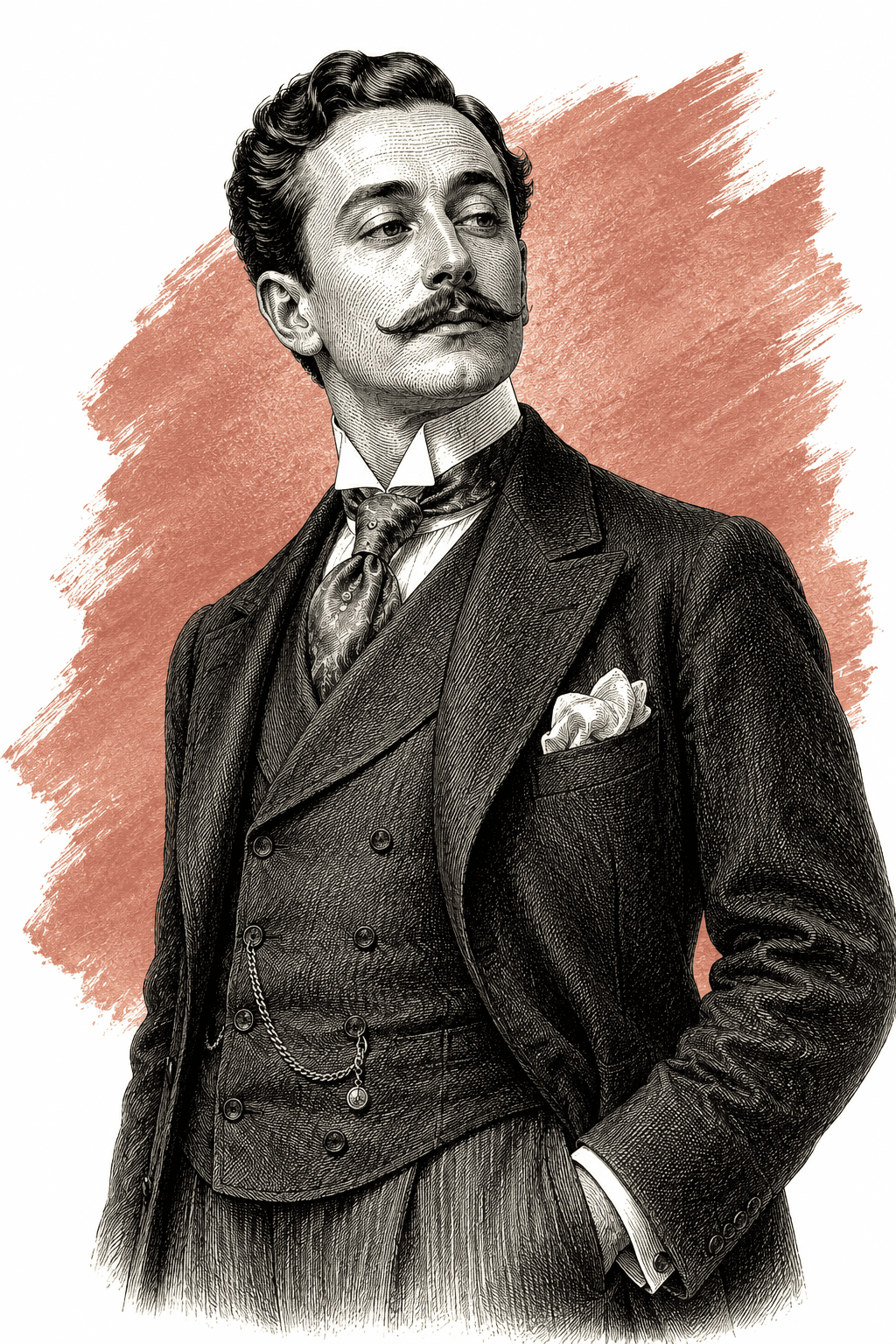
Eveline Hill
The nineteen-year-old at the centre of "Eveline": keeping house for a violent father, and offered a way out by a sailor.
To be safe and treated with respect. Sitting at the window she thinks: "Why should she be unhappy? She had a right to happiness."
The book

At a glance
- The subject of "Eveline", the fourth story
- Over nineteen
- Shop assistant at the Stores; hands her whole wage, seven shillings, to her father
- Keeps house for her father and minds two young children left in her charge
- Mother dead; her brother Ernest dead; her brother Harry working away in the church decorating trade
- A passage on the night boat with Frank, and a home waiting in Buenos Aires
Who they are in the book
Spoiler-freeEveline Hill is the subject of "Eveline", the fourth of the fifteen stories in Dubliners, the 1914 collection by the Irish writer James Joyce. The story is short — about six pages — and almost all of it takes place while she sits at a window in the evening, thinking. She is nineteen, works in a shop called the Stores, hands over her entire wage of seven shillings a week, keeps house for her father, and looks after two younger children left in her charge.
Her mother is dead, one brother is dead, and the other is away working most of the time. She has agreed to leave Ireland with a sailor called Frank and marry him in Buenos Aires, and she has written two letters, one to her brother and one to her father. The story is the hour before she has to go. Joyce gives her the case for going and the case for staying in almost equal weight, and lets the reader feel how thin the difference is.
How Eveline Hill Is Portrayed
- Where she isAt the window with her head against the curtains, smelling dusty cretonne — the printed cotton the furniture is covered in. The story returns to that smell twice, and it is the only thing that stays constant while everything she thinks about changes.
- The houseShe has dusted the same objects once a week for years without ever finding out who the priest in the yellowing photograph on the wall was, beyond that he was a school friend of her father's and is now in Melbourne.
- The jobAt the Stores she is chivvied in front of customers by a Miss Gavan — "Look lively, Miss Hill, please" — and she reckons she would not cry many tears at leaving it.
- Her fatherHe beat her brothers when they were growing up and has begun threatening her, saying what he would do to her only for her dead mother's sake. Every Saturday night she has to argue him out of her own wages before she can go out and buy Sunday's dinner.
- What she remembers about him tooThat when she was laid up for a day he read her a ghost story and made her toast at the fire, and that on a picnic to the Hill of Howth he put on her mother's bonnet to make the children laugh.
- The promiseA street organ outside brings back the night her mother died, and the promise she made to keep the home together as long as she could. She hears her mother's voice again repeating a phrase nobody has ever satisfactorily translated: "Derevaun Seraun! Derevaun Seraun!"
- FrankA sailor with a face of bronze and a peaked cap pushed back on his head, who has been to Canada and through the Straits of Magellan, took her to see an opera called The Bohemian Girl, and calls her Poppens for fun. Her father found out and forbade her to speak to him, so they meet in secret.
She gets as far as the quayside at the North Wall, in a crowd of soldiers, with the passage already booked and the boat's whistle blowing. Frank has her hand and is calling her to come. She grips the iron railing with both hands and will not move. He is carried through the barrier and shouts back for her to follow, and she stands there and gives him nothing: "Her eyes gave him no sign of love or farewell or recognition." The story ends on that line. Joyce never says whether she was right.
"Eveline" was one of the three stories that appeared in a Dublin farming weekly, The Irish Homestead, in 1904, ten years before the book came out, printed under the name Stephen Daedalus rather than Joyce's own. It is the shortest thing in the collection and the one most often set for schoolchildren.
If you like Dubliners


If you like James Joyce
Explore authors with a similar voice, perspective, and influence.
Ezra Pound
The impresario who dragged Joyce's early books into print, brought him to Paris, and championed Ulysses until the world caught up.
View author
Sylvia Beach
His publisher of last resort and first devotion — the bookseller who printed Ulysses when no one else would.
View author
Louis-Ferdinand Céline
The doctor of the Paris slums who wrote the century's blackest, funniest novel — and changed the sound of French prose.
View author