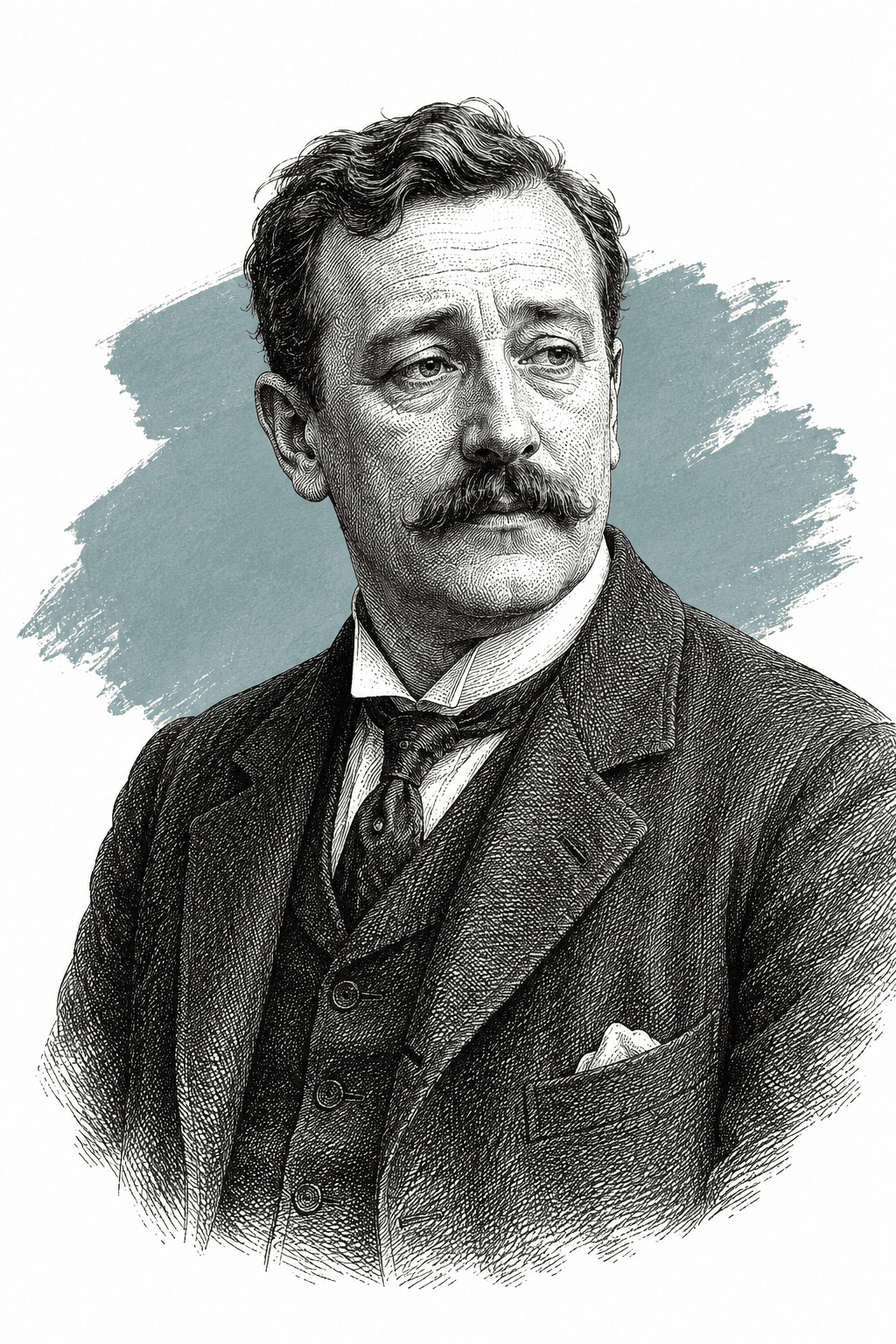
Gabriel Conroy
The man "The Dead" follows: a Dublin schoolteacher and part-time book reviewer, arriving late at his aunts' Christmas dance with his wife.
To get through the evening without embarrassing himself, and then to be alone with his wife. As the party breaks up the story puts it in five words: "He longed to be alone with her."
The book

At a glance
- A character in "The Dead", the fifteenth and last story
- Schoolteacher, and a books columnist for The Daily Express at fifteen shillings a week
- Married to Gretta; two children, Tom and Eva; nephew of Kate and Julia Morkan
- His aunts' house on Usher's Island, Dublin, on a snowy night around Christmas, and a hotel room afterwards
- An overcoat with a light fringe of snow on the shoulders, and goloshes, which nobody in the house has heard of
- Monkstown, outside the city; he has taken a room at the Gresham rather than drive home in the cold
Who they are in the book
Spoiler-freeGabriel Conroy is a character in "The Dead", the last and longest of the fifteen stories in Dubliners, the 1914 collection by the Irish writer James Joyce. He teaches, writes a weekly books column in a newspaper, and is the favourite nephew of two elderly sisters, Kate and Julia Morkan, who hold a dance and supper in their rented rooms every Christmas. He arrives late with his wife, Gretta, carves the goose, and gives the after-dinner speech he has been nervous about all evening.
He is comfortable, well-off by the standards of the room, and slightly ashamed of both facts. He has booked a hotel room rather than take a cab home, he makes his wife wear rubber overshoes because that is what people do on the continent, and he assumes his education puts him above the other guests. Almost everything he does that night goes a little wrong in a way only he notices: a friendly remark to the maid gets a bitter answer, and a fellow teacher needles him in front of the dancers until he loses his temper. Joyce spends the first forty pages building him up as the capable man of the family and the last ten taking that apart.
How Gabriel Conroy Is Portrayed
- The first thing he doesHe stamps the snow off his overshoes in the hall and makes a friendly joke to Lily, the caretaker's daughter, about her getting married one of these days. She answers with real bitterness about men. He goes red, pushes a coin into her hand as a Christmas box and hurries upstairs.
- His jobHe teaches, and writes a literary column every Wednesday in The Daily Express for fifteen shillings. The story says the review copies were almost more welcome to him than the paltry cheque, and that he used to wander down the quays to the second-hand booksellers after school.
- The argument about IrelandMiss Ivors, a nationalist and a fellow teacher, calls him a West Briton for writing in that paper and presses him about why he cycles in France and Belgium instead of visiting the west of Ireland. He tells her he is sick of his own country, and cannot answer when she asks why.
- Carving the gooseAt the supper table he is entirely at ease for the only time that night. The story says he was an expert carver and liked nothing better than to find himself at the head of a well-laden table, and he serves everyone twice before touching his own plate.
- The speechHe toasts his aunts and their niece as the Three Graces of the Dublin musical world. He had planned to quote Robert Browning and drops the idea, deciding the guests would not follow it and would think he was showing off.
- The story about the horseWaiting for cabs in the hall, he acts out a family anecdote about his grandfather's mill horse, which was driven out to a military review and stopped in the street to walk round and round a statue as though it were still turning the mill. He paces the circle himself, in his overshoes, and the whole hall laughs.
- The mirrorLate in the night he catches sight of himself full length in the hotel glass and does not like it: a well-filled shirt-front, gilt-rimmed glasses, and a face whose expression always puzzled him.
The evening ends with Gabriel wanting his wife badly, and finding out on the way to bed that she has spent the last hour thinking about someone else. A guest sang "The Lass of Aughrim" as they were leaving, and the song belonged to a boy named Michael Furey who had courted her in Galway when she was young and who died at seventeen after standing in the rain outside her window. She tells the whole story and falls asleep crying. Gabriel lies awake beside her and takes the full measure of himself: he has never felt for anyone what that boy felt, he has been playing the fussy nephew and the after-dinner speaker all evening, and the aunts he toasted will soon be dead too. The story closes with him watching the snow fall across the whole of Ireland, including the graveyard where Michael Furey is buried.
Gabriel is generally read as Joyce's most direct self-portrait outside his novels — a young Dublin intellectual who writes book reviews, holidays on the continent, and has decided he has outgrown the place. Joyce's biographer Richard Ellmann traced the closing scene to Joyce's own wife, Nora Barnacle, who had been courted in Galway by a young man named Michael Bodkin. He died young, and she took Joyce to his grave in 1912.
If you like Dubliners


If you like James Joyce
Explore authors with a similar voice, perspective, and influence.
Ezra Pound
The impresario who dragged Joyce's early books into print, brought him to Paris, and championed Ulysses until the world caught up.
View author
Sylvia Beach
His publisher of last resort and first devotion — the bookseller who printed Ulysses when no one else would.
View author
Louis-Ferdinand Céline
The doctor of the Paris slums who wrote the century's blackest, funniest novel — and changed the sound of French prose.
View author