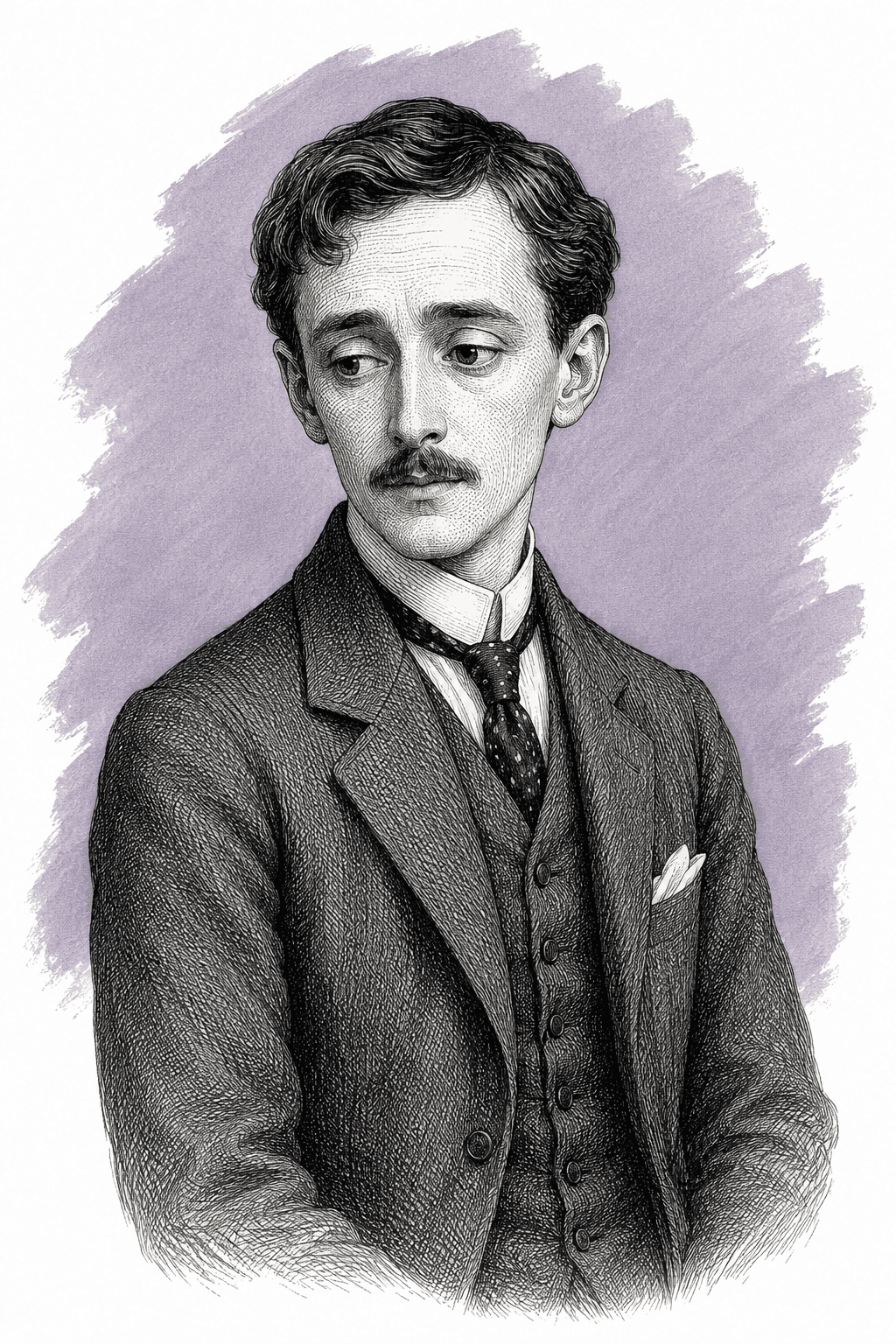
Gretta Conroy
Gabriel Conroy's wife in "The Dead" — from Galway, in the west of Ireland, and the reason the story ends where it does.
To go west again. When she hears her husband has been invited to the Aran Isles she claps her hands and says she would love to see Galway again; he tells her coldly that she can go if she likes.
The book

At a glance
- A character in "The Dead", the fifteenth and last story
- Connacht, in the west of Ireland; raised partly by her grandmother in Nuns' Island, Galway
- Married to Gabriel Conroy; two children, Tom and Eva
- The Morkan sisters' Christmas dance on Usher's Island, and a room at the Gresham Hotel afterwards
- A blue felt hat and a skirt in terracotta and salmon-pink panels; her hair is bronze
- Nursed Gabriel's mother through her last illness, though the older woman had opposed the marriage
- Nora Barnacle, Joyce's wife — the source of the closing scene · 1884–1951 · Galway
Who they are in the book
Spoiler-freeGretta Conroy is a character in "The Dead", the last of the fifteen stories in Dubliners, the 1914 collection by the Irish writer James Joyce. She is married to Gabriel Conroy, a Dublin schoolteacher, and the two of them spend the story at his elderly aunts' Christmas dance. She is warm, teasing and popular in the house, and for most of the evening she is a minor figure at the edge of her husband's night.
She comes from Connacht, in the west of Ireland, and was brought up partly by her grandmother in Galway before being sent to a convent in Dublin. Gabriel's late mother thought her beneath him and once called her country cute, which he still resents; Gretta nursed that same woman through her last illness. In the last quarter of the story the book turns and gives her the material that has been sitting under it all along.
How Gretta Conroy Is Portrayed
- How she is introducedShe arrives frozen after a cab ride, kisses both aunts, and immediately tells on her husband: he makes their son wear green eyeshades at night, makes the daughter eat porridge she hates, and now makes his wife wear rubber overshoes.
- The joke about the overshoesShe says the next thing he will buy her is a diving suit, and the room falls apart laughing. It is her one long speech in the first half of the story and it is at Gabriel's expense.
- How she talks to himPlainly, and often in front of other people. When he refuses the trip west she turns to another guest and says, "There's a nice husband for you, Mrs Malins."
- On the stairsGoing home, she stops halfway down the first flight in the dark to listen to a man singing at the piano upstairs. Gabriel watches her without being seen and thinks she looks like a painting he would call Distant Music.
- The kiss in the hotel roomShe crosses the room without being asked, rises on tiptoe and kisses him, and says he is a very generous person. He takes it as encouragement. It was not.
- The songThe tune she heard is "The Lass of Aughrim", sung badly by a hoarse tenor. She asks its name in the hall with colour in her cheeks and her eyes shining, which Gabriel misreads completely.
In the hotel room she tells Gabriel why the song stopped her. As a girl in Galway she knew a boy named Michael Furey, who worked in the gasworks, sang "The Lass of Aughrim", and was already ill when she was sent up to the convent in Dublin. The night before she left, he came to her grandmother's house in the rain, stood shivering at the end of the garden, and told her he did not want to live. He died a week later, at seventeen. "I think he died for me," she says. Then she cries herself to sleep, and the story leaves her there and stays with her husband.
The scene came out of Joyce's own marriage. Nora Barnacle, from Galway, had been courted as a girl by a young man named Michael Bodkin who died young, and according to Joyce's biographer Richard Ellmann she told her husband the story of the boy who came to her window in the rain. Nora took Joyce to Bodkin's grave when the two of them visited Galway in 1912.
If you like Dubliners


If you like James Joyce
Explore authors with a similar voice, perspective, and influence.
Ezra Pound
The impresario who dragged Joyce's early books into print, brought him to Paris, and championed Ulysses until the world caught up.
View author
Sylvia Beach
His publisher of last resort and first devotion — the bookseller who printed Ulysses when no one else would.
View author
Louis-Ferdinand Céline
The doctor of the Paris slums who wrote the century's blackest, funniest novel — and changed the sound of French prose.
View author