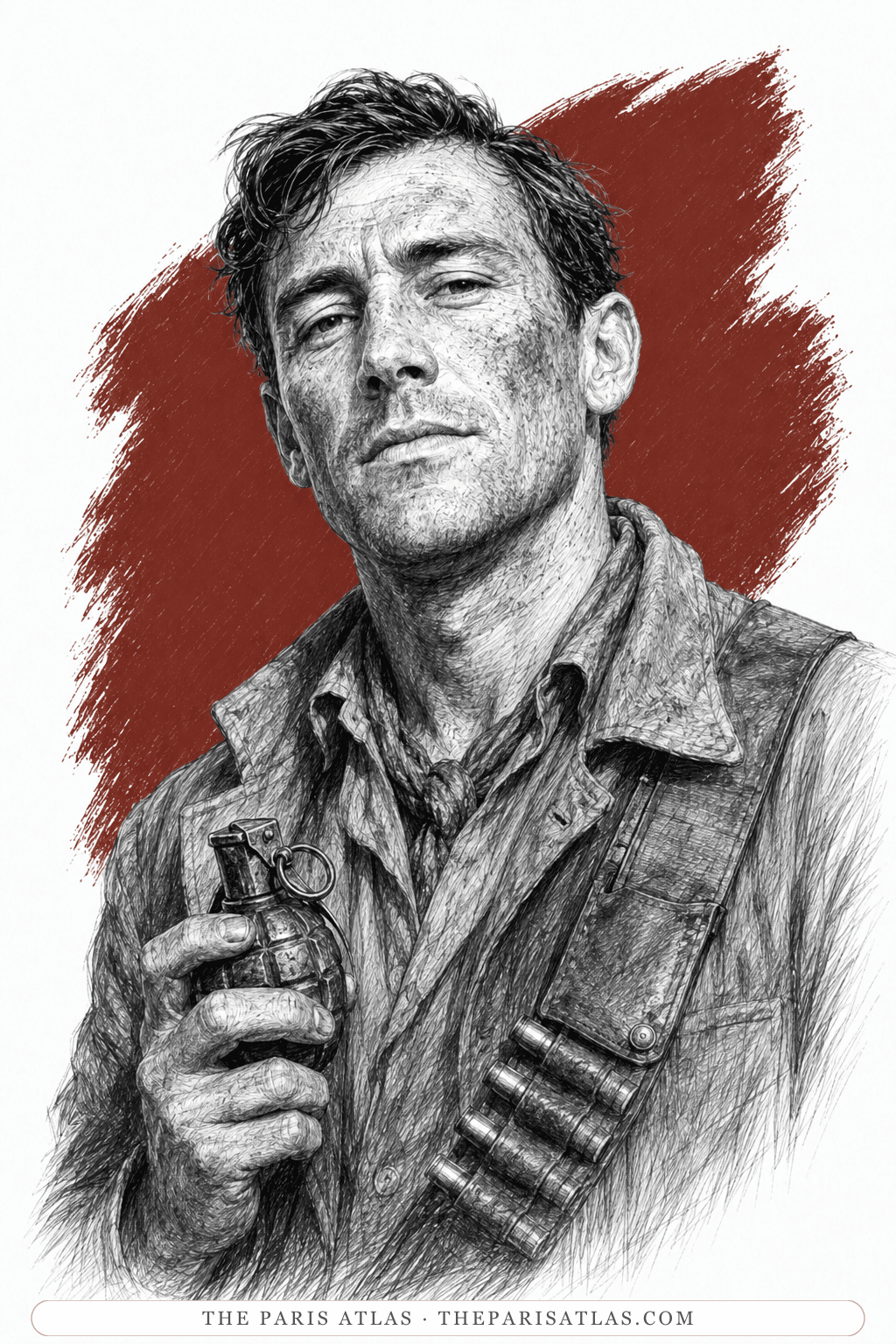
Douglas Moyle
He passed Orwell the bomb that broke up the Fascist counterattack on the captured redoubt, and volunteered afterwards to go back out and look for the missing men. A former sailor, he was the one who identified the warships closing on Barcelona harbour in May as British destroyers, correctly.
The book

At a glance
- One of the English volunteers in the P.O.U.M. militia, serving in Orwell's unit
- A sailor
- Orwell gives none: no age, no description, no first sight of him
- Chapter 7, the night raid outside Huesca, and Chapter 10, the Barcelona street fighting of May 1937
Who they are in the book
Spoiler-freeDouglas Moyle was one of the English volunteers George Orwell served with in Spain in 1937. Orwell had gone out to fight for the Spanish Republic against the army revolt led by General Franco, and had joined the militia of the P.O.U.M., a small revolutionary socialist party. A militia at that stage of the Spanish Civil War was not a regular army unit but a column of volunteers raised and equipped by a party or a trade union. Moyle had been a sailor before he came out. Orwell names him in two episodes, and both times it is because Moyle did something at a moment when there was no time to think about it.
The first is a night raid in April 1937 on a Fascist position outside the town of Huesca. Fascist is the word Orwell uses throughout the book for Franco's side. A party of about fifteen crawled a hundred and fifty yards through mud and rain, cut the wire and took the position, and then the men they had driven out began shooting back from about twenty yards away. Orwell writes that there were eight or nine of them bunched together and that one well-placed bomb would have killed the lot. He had thrown all of his own and did not know how the captured Fascist ones worked, so he called out to ask whether anybody had a bomb to spare. Moyle felt in his pocket and passed one across. Orwell threw it, and it landed almost exactly where the enemy rifle had been flashing.
An hour or so later the raid was over and two men were unaccounted for. Georges Kopp, the Belgian officer commanding the unit, asked for five volunteers to go back out into the open ground and look for them. Moyle and Orwell went, with three Spaniards. It was already getting light, the Fascists had reoccupied their position in much greater numbers, and a burst of fire put the search party face down in the grass. Lying there, they thought they could hear voices moving towards them. Orwell shouted "Run!" to Moyle and ran, and says plainly in the book that their nerves were all to pieces.
Moyle appears once more, a few weeks later and two hundred miles away. In May 1937 the rival parties on the Republic's own side turned on each other in the streets of Barcelona for the best part of a week, and Orwell spent three days of it posted on a rooftop with a rifle. Warships came in towards the harbour and nobody in the building knew whose they were. Moyle, who had been a sailor, said they looked like British destroyers. Orwell records that they were British destroyers, and that nobody there found it out until afterwards.
How Douglas Moyle Is Portrayed
- The bomb he passed acrossInside the enemy position they had just taken, with rifles firing at them from twenty yards away, Orwell called out to ask whether anyone had a bomb to spare. Moyle reached into his pocket and handed one over. That was the bomb that drove the counter-attack back a hundred yards.
- Volunteering to go back outTwo men were missing after the raid and the sky was already turning blue. When Georges Kopp, the unit's Belgian commander, asked for five volunteers to search the ground in front of the parapet, Moyle was one of the two Englishmen who went.
- The order to runSixty or seventy yards out from their own trench, pinned flat in the grass by rifle fire, the search party thought they could hear the enemy coming after them. Orwell's shout of "Run!" was aimed at Moyle. He decided afterwards that the voices had probably been imagination.
- Naming the warshipsIn May 1937 the parties on the Republic's own side fought each other in the streets of Barcelona, and Orwell was posted on an observatory roof above the fighting. From up there the men watched low grey shapes closing in on the harbour. Moyle, who had been a sailor, identified them as British destroyers. Orwell confirms in the same paragraph that he was right.
If you like Homage to Catalonia


If you like George Orwell
Explore authors with a similar voice, perspective, and influence.

Henry Miller
The Brooklyn dropout who arrived in Paris broke at thirty-eight and wrote the exuberant, banned books that ended American censorship.
View author
Louis-Ferdinand Céline
The doctor of the Paris slums who wrote the century's blackest, funniest novel — and changed the sound of French prose.
View author
Simone de Beauvoir
French writer and philosopher whose novels, memoirs, and social analysis examined freedom, gender, responsibility, aging, and the material conditions that shape a life.
View author