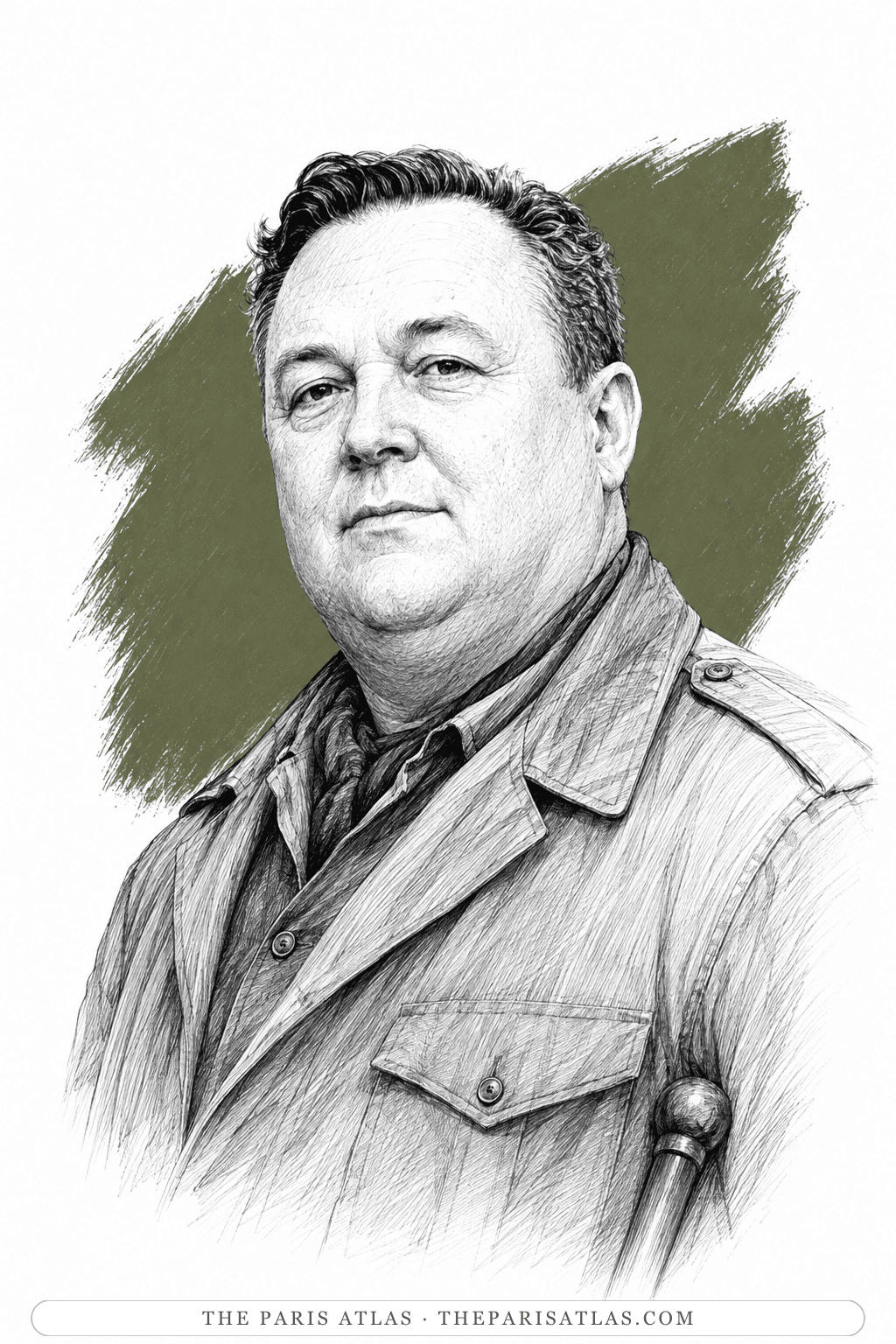
Georges Kopp
The Belgian commander of Orwell's militia unit, first seen riding a black horse at the head of a ragged column. He talked the Barcelona street fighting down at his end of the Ramblas by walking unarmed towards men with loaded rifles, and was arrested a few weeks later.
In Orwell's account, to go on being useful to the Spanish Government's war and to keep his own people from being killed pointlessly. He kept the peace at the Café Moka rather than storming it, and when he was finally arrested he was carrying a letter from the Ministry of War sending him to an engineering post at the front.
The book

At a glance
- Commander of Orwell's unit in the P.O.U.M. militia, and his friend
- Belgian, and on the Belgian Army reserve when he left for Spain
- An engineer
- In the line since October 1936; militiaman to major; wounded once
- Stout and plump, with a fresh-coloured face and thick folds at the back of the neck; he carried a walking stick cocked behind his back
- Family, nationality and livelihood; going home to Belgium would have meant prison
- Chapters 2 to 8, the May fighting in Chapter 10, and Chapters 13 and 14
Who they are in the book
Spoiler-freeGeorges Kopp appears in the second chapter as "the stout Belgian commandante", riding a black horse beside the red flag at the head of the column going up to the Aragón front. George Orwell served under him for months and became his friend. Kopp had been an engineer in civil life. He had left Belgium without permission while on the Army reserve, and had earlier helped to manufacture munitions illegally for the Spanish Government, so that returning home would have meant years in prison. He had been in the line since October 1936, had worked up from militiaman to major, and had been wounded once.
He is the book's steadiest figure and its driest. On his tours of inspection he told the men there would be no battle, in a phrase Orwell repeats: this was not a war but a comic opera with an occasional death. Lying among fir-trees below Monte Oscuro while a Fascist bugle-call rang out from the opposite hill, he caught Orwell's eye and thumbed his nose at the sound. When a raid went wrong and one of his officers was missing, he paced up and down the parapet in the open, pale to the folds at the back of his neck, ignoring the bullets and repeating the man's name.
His best hour is in Barcelona in May 1937. Hand-grenades were being bowled down the pavement at police barricaded inside the Café Moka next door to the P.O.U.M. building. Kopp looked out of the window, said "Let us investigate," walked downstairs, pulled back a German who was drawing a bomb pin out with his teeth, told everyone in several languages that bloodshed had to be avoided, then stepped into the street, laid his pistol on the ground where the police could see it, and walked unarmed up to their doorway. Orwell's comment is that he would not have done it for twenty pounds. Kopp then negotiated a local truce, visited the police in the café repeatedly, accepted fifteen bottles of beer from them, and gave them back one of his own rifles to replace one they had lost.
How Georges Kopp Is Portrayed
- How the book describes himStout at his first appearance and plump at his last, with a fresh-coloured face and thick folds of fat at the back of the neck. Orwell never gives his height, age, hair or eye colour.
- First sight of himAt the head of the column marching out of Alcubierre, beside the red flag, on a black horse, while a boy from the militia cavalry galloped up and down the rising ground posing at the summit of each one.
- The walking stickHe carried one in Barcelona and cocked it behind his back. Grenades were bursting in the street below the P.O.U.M. building; he looked out of the window, said they had better investigate, and strolled down the stairs in what Orwell calls his usual unconcerned manner.
- The comic operaHis summary of the Aragón front, delivered frankly on his tours of inspection: this was not a war, it was a comic opera with an occasional death. Orwell notes that the stagnation had political causes he knew nothing about at the time.
- Thumbing his noseHidden among small fir-trees west of Monte Oscuro with Orwell, Bob Edwards and three Spaniards, watching Fascists climb the grey hill opposite. A bugle-call rang out from their lines and Kopp answered it with a schoolboy gesture.
- JorgeAfter the night raid on the Fascist redoubt, with two men unaccounted for, he walked up and down inside the parapet, pale, paying no attention to the bullets cracking past his head, muttering the name of his missing friend and battalion commander. Then he asked for five volunteers to go back out and look.
- Walking towards loaded gunsAt the Café Moka he stopped the bombing, took off his pistol in full view of the police inside, and walked slowly up to their doorway with two Spanish officers. A guard came out in shirtsleeves and livid with fright to talk to him. Nobody was killed on that stretch of the Ramblas.
- Fifteen bottles of beerThe truce he arranged with the police in the café held for three days. They had looted everything drinkable in the place and made him a present of the beer; in return he handed over one of the P.O.U.M.'s own rifles to replace one they had mislaid. The empty bottles were later filled with water in case the supply was cut off.
- Three namesThe book calls him Georges Kopp on the Aragón front, George Kopp when the news of his arrest reaches Barcelona, and Major Jorge Kopp when Orwell is pleading for him at the War Department. Spanish-speaking comrades used the Spanish form.
- The letterHe carried a letter from General Pozas, commanding the Army of the East, describing him as a "person of all confidence" and recommending him for the engineering section. The police seized it when they arrested him. Orwell spent an afternoon getting it back out of the Chief of Police's office.
- In jailA hundred people penned into two rooms of a converted shop, bare stone floor, one bench, steel shutters over the windows. Kopp had kept his uniform neat and had contrived to shave. He greeted the Orwells cheerfully with the observation that he supposed they would all be shot, and complained mainly about the food.
- Buen chicoOrwell went into the Café Moka afterwards to ask the police there to testify that Kopp had stopped the fighting and saved some of their lives. One of them had heard the story from his comrades and said Kopp was a good fellow. Orwell knew at the time that it would come to nothing.
Kopp went to Valencia on 15 June 1937 for an interview at the Ministry of War, and came back to Barcelona with orders for the eastern front.
If you like Homage to Catalonia


If you like George Orwell
Explore authors with a similar voice, perspective, and influence.

Henry Miller
The Brooklyn dropout who arrived in Paris broke at thirty-eight and wrote the exuberant, banned books that ended American censorship.
View author
Louis-Ferdinand Céline
The doctor of the Paris slums who wrote the century's blackest, funniest novel — and changed the sound of French prose.
View author
Simone de Beauvoir
French writer and philosopher whose novels, memoirs, and social analysis examined freedom, gender, responsibility, aging, and the material conditions that shape a life.
View author