Aunt Angela
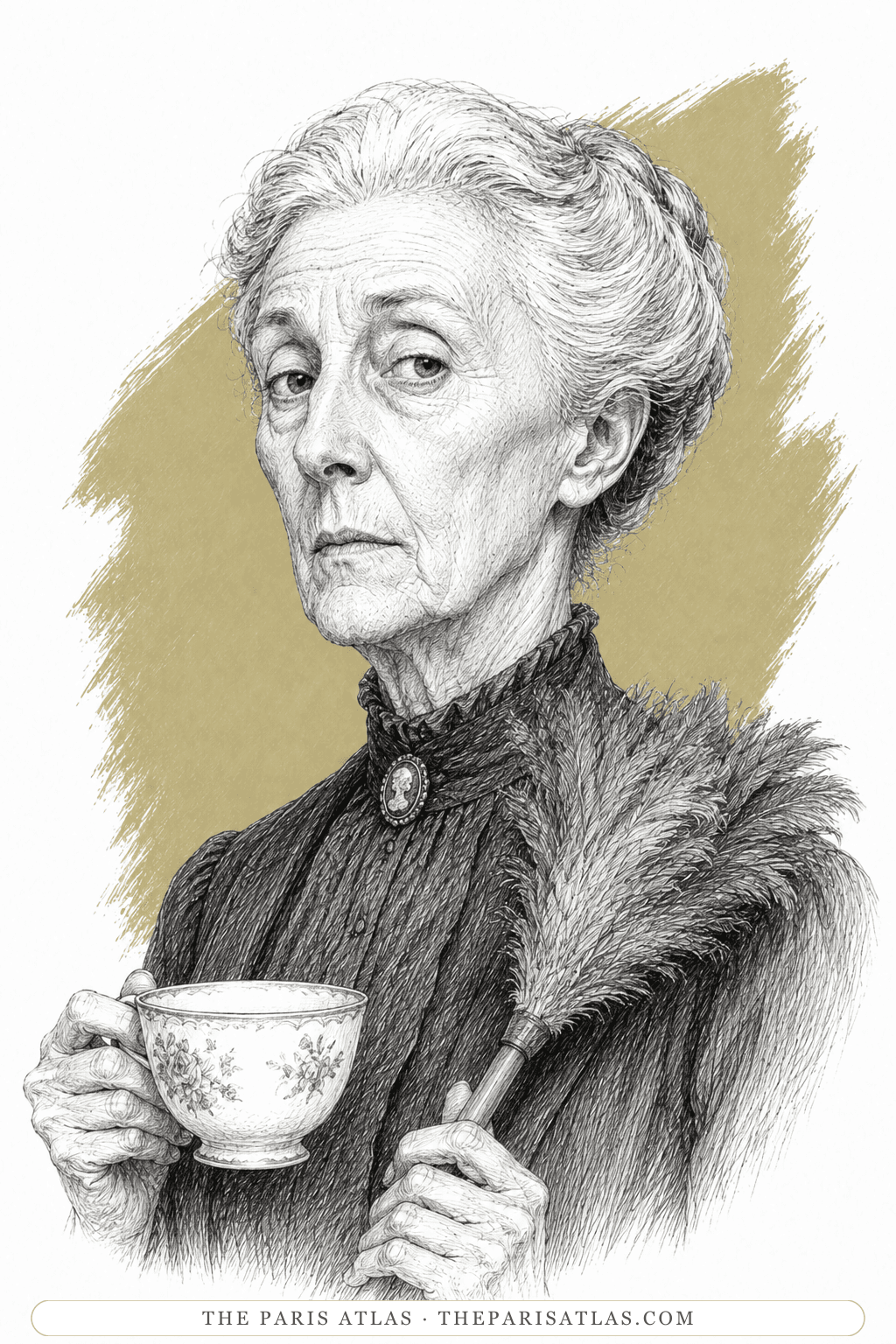
Gordon's aunt at Highgate, sixty-nine, living on an annuity of ninety-eight pounds a year and running two decades behind the fashion in novels. She dusts the never-to-be-used Crown Derby tea-service and the aspidistras.
The next novel from the public library, which is ten minutes' walk from her door. Reading fiction is the one pleasure Orwell allows her, and she follows the fashion about two decades behind it, plodding along in the rear.
The book

At a glance
- Gordon's aunt, and one of the three Comstocks of her generation still alive in 1934
- Sixty-nine
- An annuity of ninety-eight pounds a year, twelve and sixpence a week of it going on house rates
- Briarbrae, a small semi-detached house in Highgate, bought with the annuity in 1912
- Novels only since 1902, and about two decades behind the current mode
- Chapter 3; by letter and family news in the later chapters
Who they are in the book
Spoiler-freeAngela Comstock is an aunt of Gordon Comstock, the London bookshop assistant whose year the novel follows, and she is sixty-nine. She lives alone at Briarbrae, a small semi-detached house in Highgate, and she owns it. In 1912 she was induced to buy the house together with a tiny annuity, which leaves her the only one of her generation of Comstocks who ever had a home of her own. The rest of them lived in rented rooms and boarding houses. George Orwell introduces her in Chapter 3, in the survey of what is left of the family, as poor, shrivelled, parchment-yellow and skin-and-bone. She never married, and Orwell states it in a mock-heroic parody: Angela the Ever-virgin, whom no man living or dead can truly say he has kissed.
The annuity is ninety-eight pounds a year, which is thirty-eight shillings a week, and twelve and sixpence of that goes on house rates. She keeps the middle-class habit of thinking of her income as a yearly and not a weekly thing. Orwell says she would probably have starved from time to time if Julia Comstock, Gordon's older sister, had not smuggled her packets of cakes and bread and butter out of the Earl's Court teashop where she works a seventy-two-hour week. Years earlier, when Gordon was twenty-four and out of work after his mother's death, he lodged at Briarbrae for two whole months while his aunt had barely enough to eat for herself.
Her days are a round of dusting, and Orwell gives the round a page of mock-epic. She goes to and fro with a feather mop made from the tail feathers of a turkey, polishing the dark-leaved aspidistras and flicking the dust off a Crown Derby china tea-service that is never going to be used, and comforting herself between rounds with dark brown tea. The aspidistra is the plant Gordon has spent the whole novel declaring war on.
Her one pleasure is novels, and she came to them late. Gran'pa Comstock forbade his daughters fiction while he lived, so she began only in 1902 and never caught up. Rhoda Broughton and Mrs Henry Wood in the nineteen-hundreds, Hall Caine and Mrs Humphry Ward in the war years, Silas Hocking and H. Seton Merriman in the twenties, and by the nineteen-thirties she had almost, but not quite, reached W. B. Maxwell and William J. Locke. The public library is ten minutes' walk from Briarbrae. Of the post-war novelists she has heard only at a distance, with their immorality and their cleverness, and Orwell closes the account on a line: "Walpole we know, and Hichens we read, but Hemingway, who are you?"
How Aunt Angela Is Portrayed
- How Orwell describes herPoor, shrivelled, parchment-yellow and skin-and-bone in the family survey, and faded and mummified in the earlier passage where Gordon lodges with her. He gives her no face beyond that.
- BriarbraeA miserable little semi-detached house in Highgate, and hers. Buying it with a tiny annuity in 1912 makes her the only Comstock of her generation who ever had a home to call her own, and Orwell's mock-epic promotes it to a palace in the northern mountains.
- The turkey-feather mopAll day she goes to and fro with it, polishing the dark-leaved aspidistras and flicking the hated dust off a resplendent Crown Derby china tea-service that is never to be used. Between rounds she drinks dark brown tea, Flowery Orange and Pekoe Points.
- Ninety-eight pounds a yearHer annuity, and thirty-eight shillings a week, of which twelve and sixpence goes on house rates. She still counts her income by the year rather than the week, which Orwell files as a middle-class habit.
- Julia's parcelsCakes and bread and butter smuggled to her out of the teashop, without which Orwell says she would probably have starved occasionally. They are always presented as just a few little things that it seemed a pity to throw away, with the solemn pretence that she does not really need them.
- The two months at BriarbraeAfter his mother died Gordon was out of work, and he stayed with his aunt for two whole months while he looked for a job. Orwell's aside is that she had barely enough to eat for herself.
- Two decades behind the fashionGran'pa Comstock forbade his daughters novels while he lived, so she began in 1902 and never made up the distance: Rhoda Broughton and Mrs Henry Wood, then Hall Caine and Mrs Humphry Ward, then Silas Hocking and H. Seton Merriman, and by the thirties W. B. Maxwell and William J. Locke. Orwell says she would get no further, and ends the run on a line that has stuck: "Walpole we know, and Hichens we read, but Hemingway, who are you?"
- The lettersWhen Gordon has cut himself off from everyone, she keeps writing. Orwell's word for what she and Uncle Walter do in their long, fatuous letters is bleating, and Gordon does not answer them. The last family news of her is that she has had bad colds all winter.
If you like Keep the Aspidistra Flying


If you like George Orwell
Explore authors with a similar voice, perspective, and influence.

Henry Miller
The Brooklyn dropout who arrived in Paris broke at thirty-eight and wrote the exuberant, banned books that ended American censorship.
View author
Louis-Ferdinand Céline
The doctor of the Paris slums who wrote the century's blackest, funniest novel — and changed the sound of French prose.
View author
Simone de Beauvoir
French writer and philosopher whose novels, memoirs, and social analysis examined freedom, gender, responsibility, aging, and the material conditions that shape a life.
View author