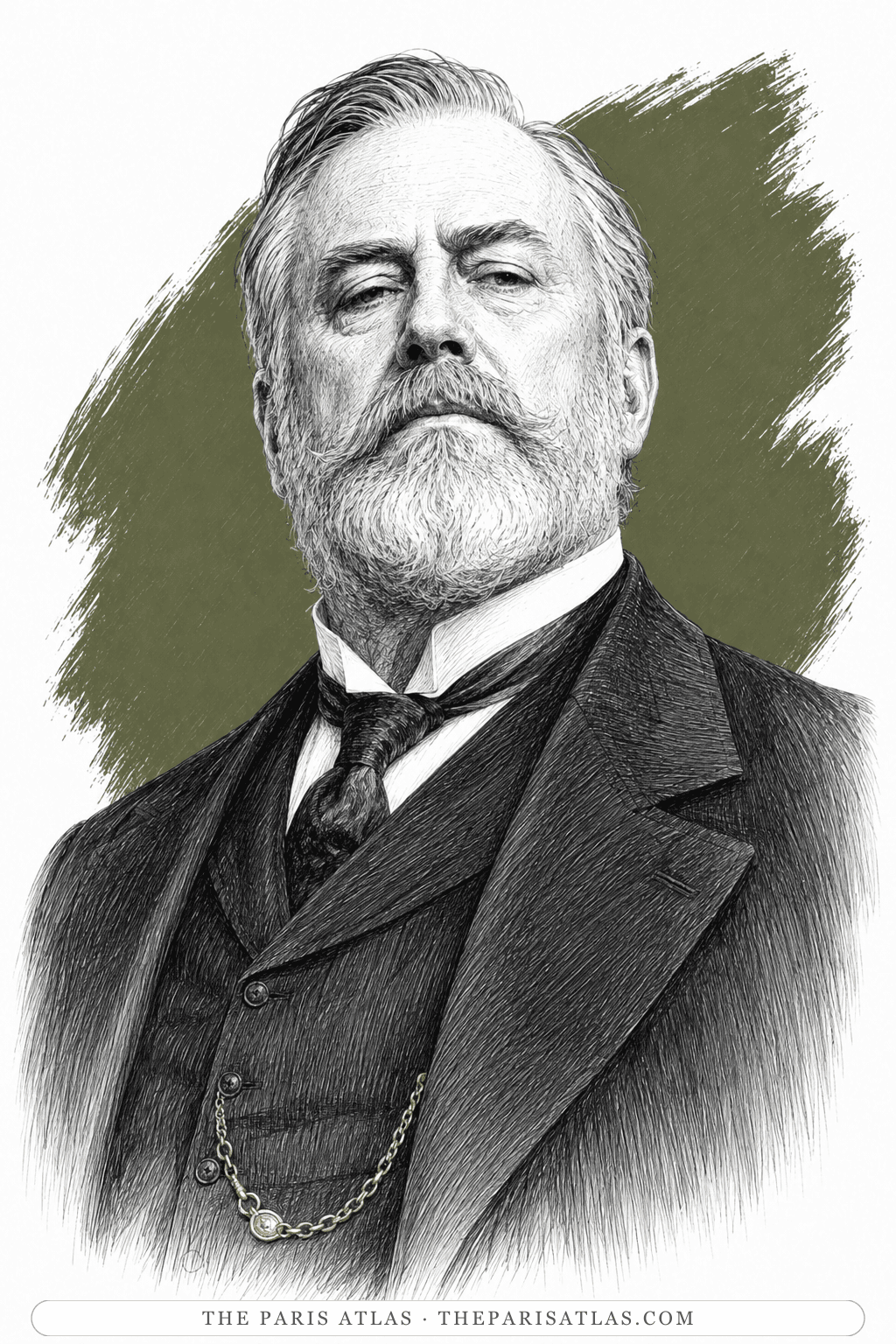
Gran'pa Comstock
Samuel Ezekiel Comstock, dead long before the book opens and still sitting on the whole family. He made fifty thousand pounds, built a red brick mansion George Orwell calls as durable as a pyramid, begot twelve children of whom eleven survived, forbade his daughters to read novels, drove all of them into professions they were unsuited for, and lay on them, in Orwell's phrase, as a garden roller lies upon daisies. His grave is marked by a granite monolith weighing close on five tons.
Obedience. He picked his children's careers for them, forbade his daughters to read novels, and only one of the eleven dared to marry while he was alive.
The book

At a glance
- Samuel Ezekiel Comstock
- 9 July 1828 to 5 September 1901; died of a stroke
- Grandfather; died four years before Gordon was born
- Fifty thousand pounds, split into shares of about five thousand
- Twelve, of whom eleven lived to adulthood
- Kensal Green, under about five tons of granite
Who they are in the book
Spoiler-freeSamuel Ezekiel Comstock is the grandfather of Gordon Comstock, the poet at the centre of Keep the Aspidistra Flying, the novel George Orwell published in 1936. He was born on 9 July 1828 and died on 5 September 1901, four years before Gordon was born, so the two never met. Gordon was taught as a child to call him Gran'pa Comstock, and the name stuck.
He is the only Comstock who ever made money. Orwell's phrase for how he made it is that he plundered the working class and the foreigner of fifty thousand pounds. With it he built a red brick mansion which Orwell says was as durable as a pyramid, and he had twelve children, eleven of whom lived. Then he died suddenly of a stroke, and within a generation every penny had gone.
The reason he gets a whole chapter of a novel he does not appear in is that Orwell blames him for the state of everyone else in it. All eleven of his children turned out listless and unsuccessful. He had put them into careers they were hopeless at, and he had frightened them out of any ambition of their own. Orwell's image for what he did to them is a garden roller lying on daisies, with no chance of the flattened shapes ever springing up again.
How Gran'pa Comstock Is Portrayed
- The money and the houseFifty thousand pounds, made in the second half of the nineteenth century, and a red brick mansion built to last. When it was sold after his death the estate was divided roughly equally and each surviving child got about five thousand pounds.
- The careers he chose for his sonsNone of the boys had a proper profession, because their father had taken great pains to put every one of them into work they were completely unsuited for. Gordon's father, who had a literary mind and could not bear figures, was made a chartered accountant.
- The ban on novelsOn some whim he forbade his daughters to read fiction. His daughter Angela only started reading novels in 1902, after his death, and spent the rest of her life running about twenty years behind whatever was being published.
- The only act of defiance in the familyJust one of the eleven, Gordon's father John, dared to get married while the old man was still alive. Several of the daughters married in middle age once he was dead. More than half of the eleven died unmarried.
- The gravestoneIn Kensal Green cemetery his children put up a granite monolith reading, in part, A FAITHFUL HUSBAND, A TENDER FATHER AND AN UPRIGHT AND GODLY MAN, and ending HE SLEEPS IN THE ARMS OF JESUS. The stone weighs close on five tons. Orwell's comment is that if you want to know what a dead man's relatives really thought of him, a rough test is the weight of his tombstone.
- The family after himHe was one of twelve children himself and produced eleven. Those eleven produced two between them, Gordon and his sister Julia, and by 1934 those two had produced none. In thirty years there had not been a single birth in the family, only deaths.
If you like Keep the Aspidistra Flying


If you like George Orwell
Explore authors with a similar voice, perspective, and influence.

Henry Miller
The Brooklyn dropout who arrived in Paris broke at thirty-eight and wrote the exuberant, banned books that ended American censorship.
View author
Louis-Ferdinand Céline
The doctor of the Paris slums who wrote the century's blackest, funniest novel — and changed the sound of French prose.
View author
Simone de Beauvoir
French writer and philosopher whose novels, memoirs, and social analysis examined freedom, gender, responsibility, aging, and the material conditions that shape a life.
View author