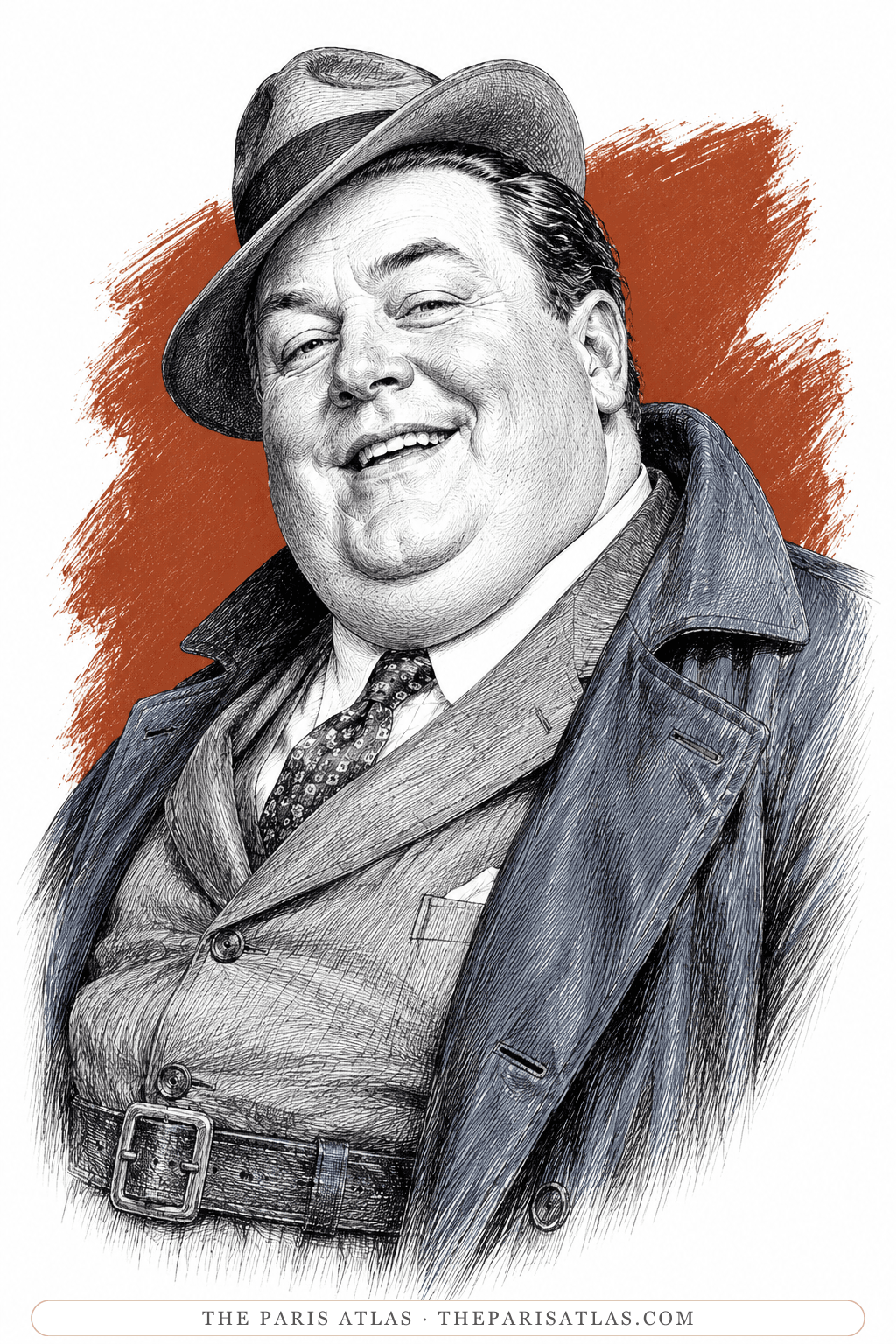
Flaxman
The first-floor lodger: a very fat travelling salesman for a cosmetics firm, exiled to Willowbed Road after his wife found out about Paris. He calls everyone 'chappie', and he is the only person in the house who tries to cheer Gordon up.
Company and a good time, in that order. He cannot bear to walk to the Crichton Arms alone, and his account of ten days in Paris on thirty pounds his wife never heard about still makes his mouth water three months later.
The book

At a glance
- First-floor lodger at 31 Willowbed Road; travelling rep for the Queen of Sheba Toilet Requisites Co.
- Thirty-eight or thirty-nine
- Living apart from his wife and children at the start of the book
- The Crichton Arms, most evenings
- "Chappie", to everybody
Who they are in the book
Spoiler-freeFlaxman is thirty-eight or nine, travelling representative of the Queen of Sheba Toilet Requisites Co., and he comes round the angle of the stairs in a smart grey suit, yellow shoes, a rakish trilby and a belted blue overcoat of startling vulgarity, saluting Gordon Comstock with a lemon-coloured glove. He is really horribly fat. He fills his trousers, George Orwell writes, as though he had been melted and poured into them, and he detests being alone even for the length of the walk to the pub.
He is genuinely fond of Gordon, whom he considers clever, cleverness being to him a kind of amiable lunacy. Gordon is rude to him almost every time they meet, mostly because he cannot afford to buy a round, and Flaxman does not hold it against him. It is Flaxman who telephones a lie to Mr McKechnie to cover the missing day, and Flaxman who turns up at the police cell in the morning.
How Flaxman Is Portrayed
- How he comes down the stairsRound the angle of the staircase with the light dancing step peculiar to fat men, in a smart grey suit, yellow shoes and a rakish trilby, under a belted blue overcoat that Orwell calls of startling vulgarity. He salutes Gordon with a lemon-coloured glove. A coarse rich voice has been singing Who's Afraid of the Big Bad Wolf? on the landing above.
- The arm round the shouldersHe throws a roly-poly arm round Gordon at every opportunity, and pats the vague frontier between his belly and his chest whenever his own size comes up. Gordon, who hates being touched, wriggles free each time.
- Stout, never fatNo fat person, Orwell notes, uses the word if there is any way of avoiding it. Flaxman had been on the point of calling himself robust, but something in Gordon's greenish eye deterred him and he compromised on stout. Gordon offers a comparison: "Like Cortez… He was stout, but he had eagle eyes."
- ParisThe firm paid a thirty-pound bonus to all its travellers and sent him over with two others to push a new lipstick on French firms. He did not think it necessary to mention the thirty pounds to his wife.
- The decanterThere was a leakage somewhere, and he came home to retribution. His wife broke his head with a cut-glass whisky decanter, a wedding present they had had for fourteen years, and went to her mother's with the children. He is not letting it worry him. It has happened several times before.
- The barmaidHe is dolled up in yellow gloves because of the new ash-blonde in the saloon bar at the Crichton Arms, to whom he gave a stick of the firm's lipstick the previous night. Gordon watches the whole performance later through a chink in the frosted window, from outside, with fourpence halfpenny in his pocket.
- The telephone callWith Gordon in the cells, Flaxman rings up Mr McKechnie to say the assistant is down with influenza, and makes it pretty convincing by giving him a temperature of a hundred and three. It holds for about a day, until the local paper comes out.
- The prairie oysterHe arrives at the cell with Ravelston, cocks a practised eye at Gordon, says he has seen them worse, and observes that his eyes look as if they had been taken out and poached. On the way out he is heard down the passage giving Ravelston minute instructions on how to make one.
- How it ends for himHis wife forgives him and he goes back to Peckham, in what Orwell calls aspidistral bliss. He also sends Gordon a line to wish him luck, which is more than most of the household manage.
If you like Keep the Aspidistra Flying


If you like George Orwell
Explore authors with a similar voice, perspective, and influence.

Henry Miller
The Brooklyn dropout who arrived in Paris broke at thirty-eight and wrote the exuberant, banned books that ended American censorship.
View author
Louis-Ferdinand Céline
The doctor of the Paris slums who wrote the century's blackest, funniest novel — and changed the sound of French prose.
View author
Simone de Beauvoir
French writer and philosopher whose novels, memoirs, and social analysis examined freedom, gender, responsibility, aging, and the material conditions that shape a life.
View author