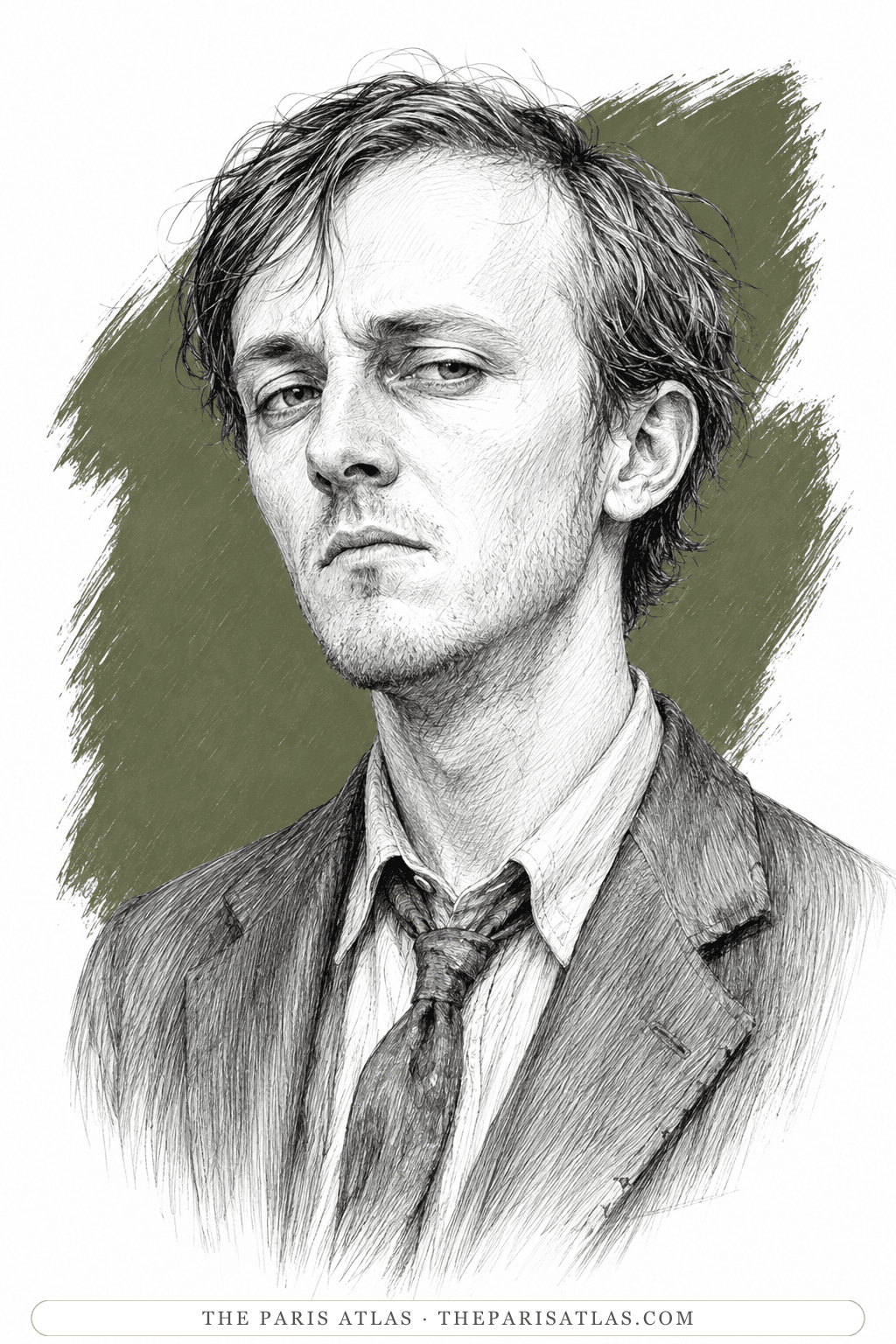
Gordon Comstock
Twenty-nine, five feet seven, the last of the Comstocks, assistant in a second-hand bookshop at two pounds a week. He published one book of poems, gave up a job that was going well, and has declared war on money.
To live outside the money-world without going under. He states the rule himself and keeps breaking it: "I've made war on money, and I've got to keep the rules. The first rule is never to take charity."
The book

At a glance
- Assistant at Mr McKechnie's bookshop and twopenny lending library, London
- Twenty-nine when the book opens; thirty by Chapter 9
- 1905, the last of the Comstocks
- Two pounds a week
- Mice, a book of poems: thirteen reviews, a hundred and fifty-three copies sold, then remaindered
- London Pleasures: two thousand lines planned, under five hundred finished in two years
- A top floor back at 31 Willowbed Road, NW, twenty-seven and six a week
- Five feet seven, mouse-coloured hair too long, twenty-six teeth left
- Six years in the accounts department of a red lead firm, then copywriting at the New Albion Publicity Company
Who they are in the book
Spoiler-freeGordon Comstock is the central figure of George Orwell's novel and is present on almost every page of it. He is twenty-nine when the book opens and thirty by the middle of it. He is five feet seven, with mouse-coloured hair usually too long, a pale face already lined, a small pointed chin that makes the whole face pear-shaped rather than oval, and hazel eyes inclining to green. He counts his remaining teeth at twenty-six. His coat is out at elbow in the right sleeve and its middle button is missing. He works ten hours a day in Mr McKechnie's bookshop and lending library, greeting the subscribers with what Orwell calls a homey, family-doctor geniality, and he takes two pounds a week for it.
He is a published poet, once. Mice came out two years before the novel begins, a foolscap octavo at three and sixpence, later reduced to a shilling. Thirteen papers reviewed it and The Times Literary Supplement said it showed exceptional promise. It sold a hundred and fifty-three copies and was remaindered, and in two years at the shop not a single customer has taken it off the shelf. Since then he has been working on London Pleasures, a poem about a day in London planned at two thousand lines in rhyme royal. After two years there are not five hundred lines he would call finished, and the manuscript has become a scrawled, grimy labyrinth he can only tinker with.
The poverty is chosen, and the book is careful to say so. The Comstocks were the landless gentry, a family that rose on the wave of Victorian prosperity and sank faster than the wave; the commonest phrase in the household was "We can't afford it". Gordon was sent to pretentious schools at about a hundred and twenty pounds a year while his sister Julia was taken away from hers at sixteen. At sixteen he worked out his own position: you can be rich, or you can deliberately refuse to be rich, and the fatal thing is to worship money and fail to get it. He did six years in the accounts department of a red lead firm, then went to the New Albion Publicity Company, where he found he could compose an advertisement as though he had been born to it. That was what frightened him. He asked Ravelston to find him a job that was not a good job, and Ravelston found the bookshop.
What the war on money actually produces is a man who is unkind to everyone who cares about him. He posts an unsigned sheet of paper to Rosemary reading only "You have broken my heart." He tears up a friendly letter from a critic who had merely got a date muddled, and posts back an obscenity. He refuses to let Rosemary buy him a plate of spaghetti and makes her cry about it in the street. Orwell does not soften any of it, and he does not let Gordon off the observation that lack of money is at the bottom of all of it — social failure, artistic failure, sexual failure, because Gordon says that himself, over and over, and the novel keeps testing whether it is true.
How Gordon Comstock Is Portrayed
- How he looks at the startChapters 1 and 2 give a small frail figure: five feet seven, delicate bones, quick fretful movements. He is never quite unconscious of his height, and when he knows he is being watched he carries himself very upright and throws a chest, which occasionally deceives simple people. His hair is usually too long, so that his head looks a little too big for his body, and he smooths it without noticing. The one feature he does not mind is what people call a good forehead, meaning a high one; walking home into the wind he gets more of it than ever.
- No overcoatIt is up the spout for fifteen shillings, and he goes about without one, hoping passers-by will read the lack as caprice. The rest is in the same state: ready-made flannel trousers stained and shapeless, shoes that need resoling, a discoloured Woolworth's tie. Dressing for the literary party in Chapter 4 he turns his collar inside out and knots the tie so the torn place does not show.
- The threepenny-bitHe has fivepence halfpenny, and threepence of it is a coin he refuses to spend because producing it alone would show the shop-girl it was his last. His verdict on it: "It isn't a coin, it's the answer to a riddle." Outside a pub, hours later, he takes it out and throws it away into the darkness rather than use it.
- Tobacco arithmeticFour Player's Weights on a Wednesday with no money until Friday, and smoking one of them costs half an hour of that night's writing time. Going to a literary tea-party he puts a single cigarette into an empty Gold Flake packet, because a packet with one in it looks like a packet that was full an hour ago.
- The secret cup of teaMaking tea in your bedroom is the second-worst offence in his lodging house. He keeps a sixpenny Woolworth's kettle, a packet of Lyons' tea and a tin of condensed milk in a suitcase under the bed, all wrapped in newspaper so they cannot chink, and he smuggles the used leaves down two flights to the W.C. He compares the difficulty to a murderer's, disposing of the body.
- The feud with the plantThere is an aspidistra on his window-sill with seven leaves that never puts out an eighth. He has tried starving it of water, grinding hot cigarette ends against its stem and mixing salt into its earth. He wipes his kerosene-stained fingers on the leaves. "I'll beat you yet, you b——," he tells it.
- The poem that goes backwardsA night's work on London Pleasures produces two lines crossed out, and he registers a sense of achievement in the destruction. He carries the manuscript in his pocket long after he has stopped believing in it, because it is a thing made outside the money-world and the weight of it against his ribs holds him up.
- A scarecrow, she tells himIn Chapter 6 Rosemary looks properly at him for the first time in a while and itemises what she sees: the pale wasted face, the uncut hair, a coat button broken in half, and no buttons at all on the shirt under the tie. She calls him a perfect scarecrow and asks whether there is any need to go about looking like a rag-bag. He has not shaved, and she rubs her cheek against the day-old beard anyway.
- Eightpence in a wet fieldThe scene the book builds its whole Sunday towards fails on money, twice. He cannot go through with it partly because he never thought about contraception and partly because he is thinking about the coins in his pocket. "I can't make love to you when I've only eightpence in my pocket," he tells her afterwards. "At least when you know I've only eightpence."
- The night he goes too farDrunk on the fifty-dollar cheque, he pulls Rosemary into a dark side street, shoves her against a wall and thrusts his hand into the front of her dress. She notes that the movement is brutal, as though she were a stranger to him, and that she has stopped being Rosemary and become a girl's body. She smacks his face and goes home. He does not follow, because his legs are too heavy and it does not seem worth it.
- The thing he is good atCopywriting. He took to it almost from the first day at the New Albion: the vivid phrase that sticks and rankles, the neat little paragraph that packs a world of lies into a hundred words. He watched his own talent develop with surprise, then amusement, then horror, and gave a month's notice.
- The letters he writes when he is hurtTwo of them, both posted at once so that they cannot be reconsidered in the morning. To Rosemary, one line in the middle of an otherwise blank sheet, no address and no signature. To Paul Doring, who had invited him again and explained the mix-up, a single obscene sentence over his full name.
- Down, not outAfter the night in the cells he stops wanting to escape money and starts wanting to escape decency. He takes the worst job and the worst room he can find, shaves three times a week, washes only the parts that show, and lies on the bed watching bugs cross the ceiling two by two. He calls it going under ground.
- Bread and margarineBy Chapter 10 he is a small slouching figure, shabby almost to raggedness, waiting in an archway with his hair blown about by the wind, haggard and despondent. Rosemary finds grey in his hair. Chapter 11 puts it plainest: shabby to the point of raggedness, the face much thinner, and carrying the dingy greyish pallor of people who live on bread and margarine.
The drunken night costs him the job, and he does not look for a better one.
If you like Keep the Aspidistra Flying


If you like George Orwell
Explore authors with a similar voice, perspective, and influence.
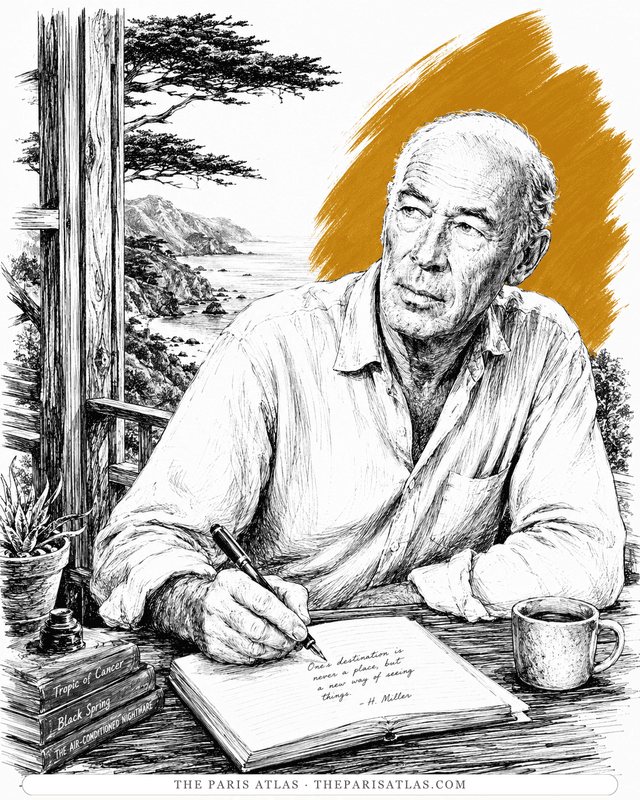
Henry Miller
The Brooklyn dropout who arrived in Paris broke at thirty-eight and wrote the exuberant, banned books that ended American censorship.
View author
Louis-Ferdinand Céline
The doctor of the Paris slums who wrote the century's blackest, funniest novel — and changed the sound of French prose.
View author
Simone de Beauvoir
French writer and philosopher whose novels, memoirs, and social analysis examined freedom, gender, responsibility, aging, and the material conditions that shape a life.
View author