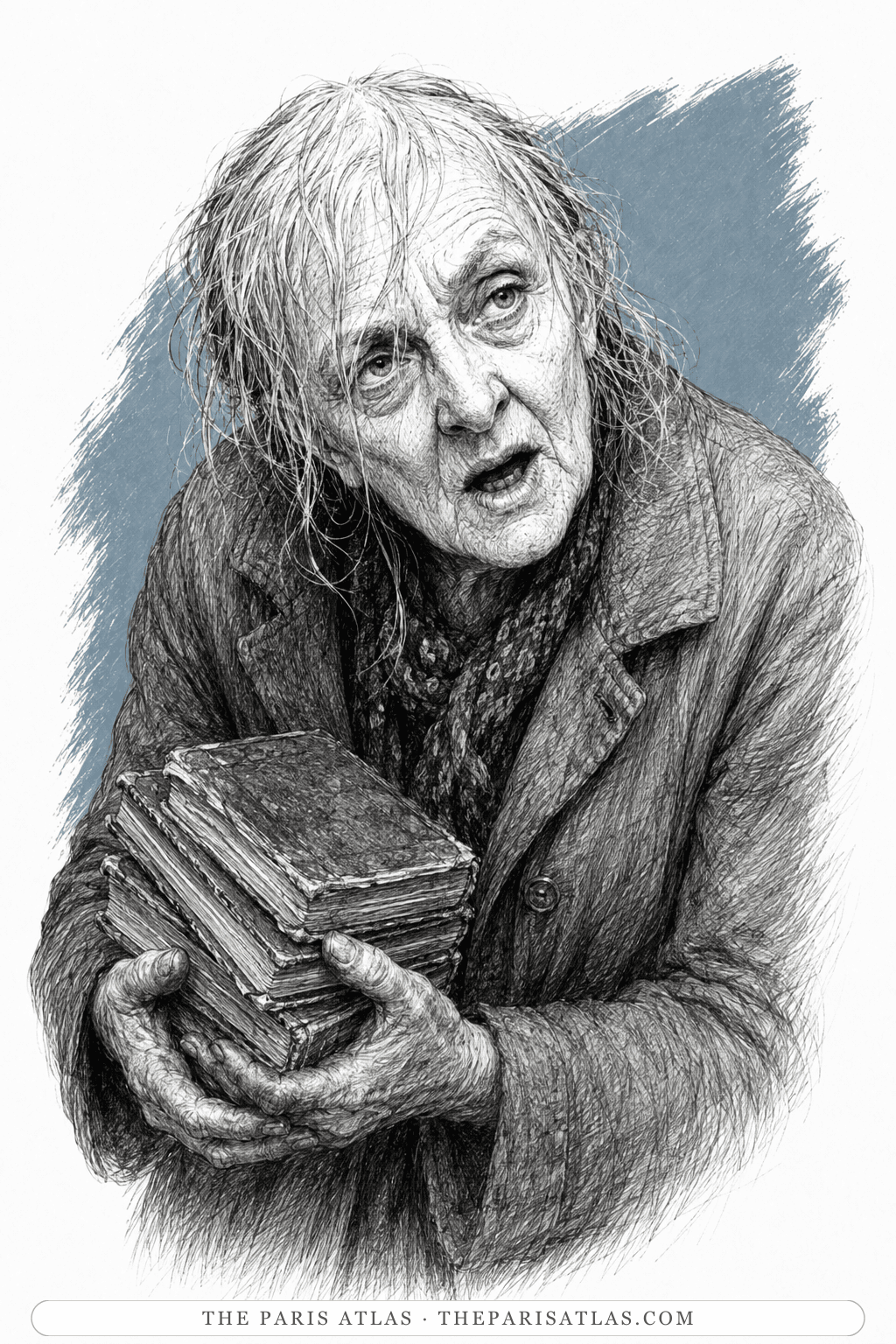
The old woman selling books
One of a pair of old creatures in greasy overcoats reaching almost to the ground, who comes into the shop with a sack under her coat and asks hoarsely whether they buy books. She looks up between grey strings of hair with what George Orwell calls a sort of hopeful malevolence, thrusts a dozen filthy volumes almost into Gordon Comstock's face at half a crown the lot, and when he refuses demands to know what he made her take them out of the bag for.
Half a crown for the sack of books she has carried to the shop under her coat.
The book

At a glance
- An unnamed woman who tries to sell books to Gordon's shop
- Her husband, who waits at the kerb and coughs
- An 1884 edition of Charlotte M. Yonge's novels
- Half a crown for the lot
- Chapter 1, for about a page
Who they are in the book
Spoiler-freeShe has no name in the book. She comes into the second-hand bookshop on the first afternoon of Keep the Aspidistra Flying, George Orwell's novel of 1936, tries to sell a sack of old books to the assistant behind the counter, is refused, and leaves. The whole scene runs to about a page.
The assistant is Gordon Comstock, the poet the novel follows, who is himself down to fivepence halfpenny and will not be paid again until Friday. He watches her and her husband shuffle up the street before she reaches the door and decides they are there to steal from the sixpenny box outside. What she is actually doing is trying to raise half a crown, which is two shillings and sixpence, roughly a day's wage for a man on two pounds a week.
Orwell writes her without any softening. She has a smell, a grievance and a hard bargaining manner. Then, once she has gone, he gives Gordon a thought about her: that she and her husband have been thrown out by the money god, and that London holds tens of thousands more like them.
How The old woman selling books Is Portrayed
- The pair on the pavementTwo old people in long greasy overcoats reaching almost to the ground, shuffling towards the shop. Her husband stops at the kerb a few yards off and waits. Gordon watches them through the glass and thinks: thieves, better keep an eye on the boxes outside.
- The look through the doorShe pushes the door open and looks up at Gordon between grey strings of hair with what Orwell calls a sort of hopeful malevolence. "Ju buy books?" she demands, hoarsely.
- The sackA greasy little sack produced from under the overcoat. She shuts the door with a clang, moves confidentially close, and gives off what Orwell describes as a very powerful smell of very old breadcrusts. Another customer in the shop edges away into the corner.
- The price, named before the goods are seen"Will you 'ave 'em? Only 'alf a crown the lot." She keeps hold of the neck of the sack while she says it. Half a crown is two shillings and sixpence.
- What is actually in the bagAn 1884 edition of the novels of Charlotte M. Yonge, filthy, and looking as though they had been slept on for years. She thrusts an armful of them almost into Gordon's face. He steps back, revolted, and tells her the shop cannot sell that kind of thing.
- How she takes no for an answer"Wotcher make me take 'em out o' me bag for, then?" She goes off mumbling, with what Orwell calls malevolence in the hump of her shoulders. Gordon makes a detour round her to get away from the smell and holds the door open without saying anything.
If you like Keep the Aspidistra Flying


If you like George Orwell
Explore authors with a similar voice, perspective, and influence.

Henry Miller
The Brooklyn dropout who arrived in Paris broke at thirty-eight and wrote the exuberant, banned books that ended American censorship.
View author
Louis-Ferdinand Céline
The doctor of the Paris slums who wrote the century's blackest, funniest novel — and changed the sound of French prose.
View author
Simone de Beauvoir
French writer and philosopher whose novels, memoirs, and social analysis examined freedom, gender, responsibility, aging, and the material conditions that shape a life.
View author