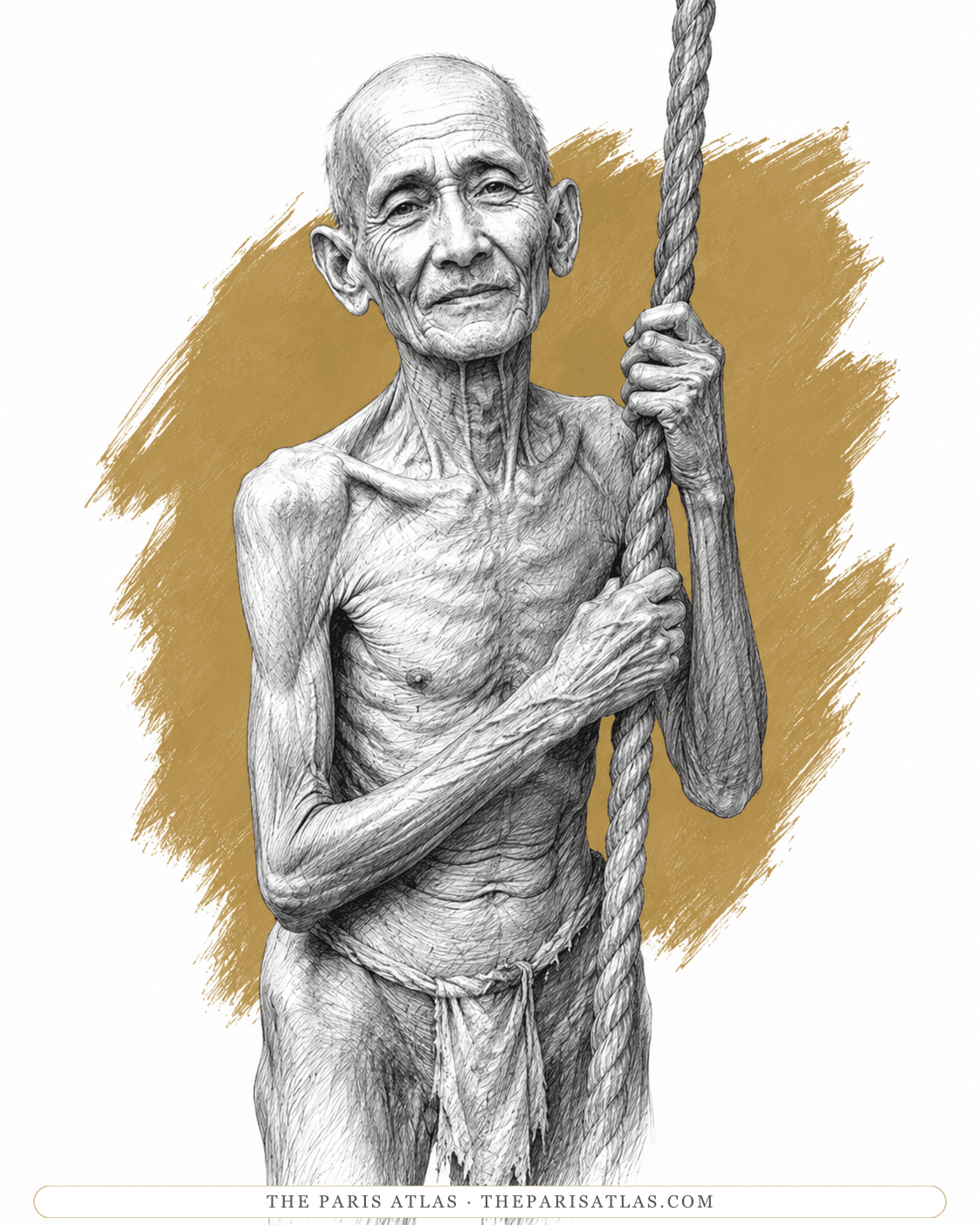
Mattu
The old Hindu durwan who looks after the European church, lives in a hut of flattened kerosene tins and rings the bell in the six-foot tin steeple. He is more like a grasshopper than a human being, and once told the doctor he believed he was ten years old.
Enough to eat. His wage does not cover it, so he waits for Europeans to pass and begs from them, and both men on the veranda throw him coins.
The book

At a glance
- Caretaker of the European church in Kyauktada
- Eighteen rupees a month
- A hut of flattened kerosene tins beside the church
- Old and fever-stricken
- Chapter 3, and the church service in chapter 24
Who they are in the book
Spoiler-freeMattu is the caretaker of the small European church in Kyauktada, the town in Upper Burma where Burmese Days takes place. He is Indian, elderly and ill with recurrent fever, and he lives beside the church in a hut built out of flattened kerosene tins. His wage is eighteen rupees a month, and it is not enough to feed him.
He first appears in chapter 3, on the veranda of Dr Veraswami, the Indian doctor who is the closest friend of John Flory, the English timber merchant at the centre of the novel. Mattu stands in the sun below the rail, rubs his stomach with one hand and mimes putting food into his mouth with the other. The doctor drops him a four-anna piece, and Flory throws down another.
What happens next is the reason George Orwell puts him in the book. Dr Veraswami, who argues throughout the novel that Indians are inferior to Englishmen and that British rule is a gift, points down at Mattu and uses him as proof: look at his thin legs, look at his servility, look at his ignorance. His clinching example is that Mattu, asked once how old he was, answered that he believed he was ten years old. Flory does not contradict him. He makes a bitter joke instead, telling Mattu to spend the money on drink.
Mattu returns in chapter 24 for the church service that closes the novel's main action. He rings the bell, he pulls the fan inside, and he is standing at the door when the service is interrupted.
How Mattu Is Portrayed
- How the book draws himAn old man wrecked by fever, so thin that Orwell says he is more like a grasshopper than a human being, dressed in a few square inches of dirty rag. Dr Veraswami's version is that the calves of his legs are not as thick as an Englishman's wrists.
- Where he livesIn a hut made of flattened kerosene tins, next to the church he looks after.
- Eighteen rupees a monthThat is his pay, and when a European comes into view he hurries out, bows very low and wails about it. On the doctor's veranda he massages his stomach with one hand and mimes eating with the other until money is thrown down to him.
- "I believe that I am ten years old"Dr Veraswami's proof of Indian ignorance, quoted to Flory: he once asked Mattu his age and got that answer. Mattu is somewhere in old age.
- The bellThe church has a tin steeple six feet high with an absurd bell in it. Mattu pulls the rope for the six-weekly service, and stops as soon as he sees that everybody has arrived.
- The fan over the front pewsOnce the service starts he stations himself by the door and works the punkah, a cloth fan swung from the ceiling by a rope. It is rigged so that it only fans the front pews, where the Europeans sit.
- Shoved asideIn the middle of the sermon Ma Hla May, the Burmese woman Flory kept as his mistress and then turned out, forces her way into the church past Mattu at the door to shout at Flory in front of the congregation.
If you like Burmese Days


If you like George Orwell
Explore authors with a similar voice, perspective, and influence.
Henry Miller
The Brooklyn dropout who arrived in Paris broke at thirty-eight and wrote the exuberant, banned books that ended American censorship.
View author
Louis-Ferdinand Céline
The doctor of the Paris slums who wrote the century's blackest, funniest novel — and changed the sound of French prose.
View author
Simone de Beauvoir
French writer and philosopher whose novels, memoirs, and social analysis examined freedom, gender, responsibility, aging, and the material conditions that shape a life.
View author