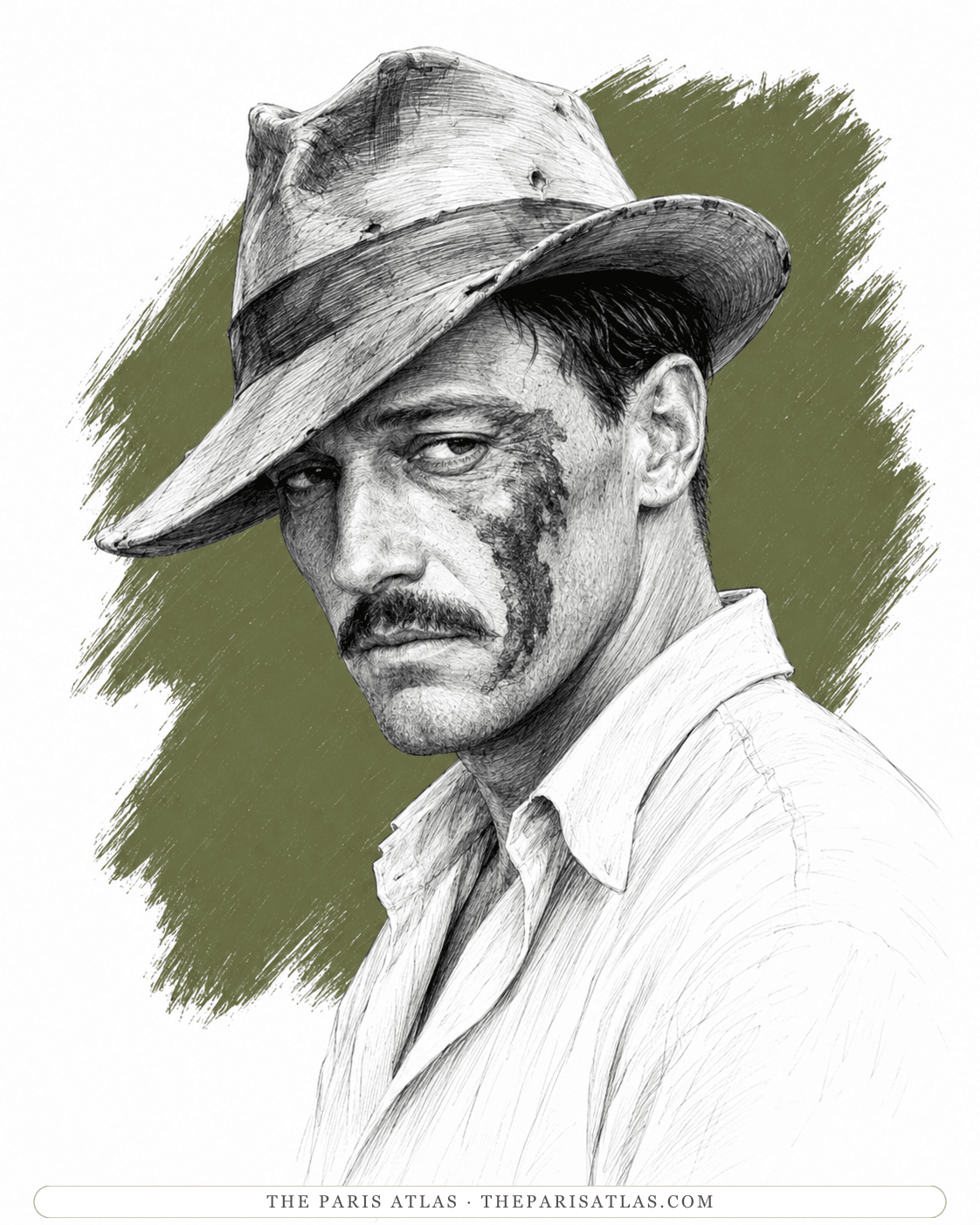
John Flory
The teak-company man at the centre of the book: thirty-five, fifteen years in Burma, a dark blue birthmark down his left cheek, and a set of opinions about the Empire that he has never once spoken in front of another Englishman.
One person to share the life he already has. Not England, not escape — someone who would see Burma with eyes something like his own, so that he could stop living his real life in secret. He says it outright on the club veranda: this country could be a paradise if one weren't alone.
The book

At a glance
- The novel's central figure; a timber-firm man in Kyauktada, Upper Burma
- Thirty-five
- Middle height, not ill made; neither fat nor bald
- Not quite twenty; fifteen years by the time the book opens
- Extracting teak; about three weeks a month in jungle camp
- Barely seven hundred rupees a month, by Mrs Lackersteen's reckoning
- Dark blue, from the left eye to the corner of the mouth
- Ko S'la, his servant of fifteen years; a cocker spaniel called Flo
- Dr Veraswami — the only person in Burma he speaks to honestly
Who they are in the book
Spoiler-freeJohn Flory came out to Burma at not quite twenty, after a cheap third-rate public school and a childhood spent living down the nickname the birthmark earned him. His parents found him the job in a timber firm and paid a premium they could not afford; he repaid them with careless scrawls at intervals of months. Fifteen years later he is thirty-five, spends about three weeks in four in camp extracting teak, and comes into Kyauktada chiefly in order to idle. Orwell gives him the birthmark in the second paragraph he appears in and never lets him forget it: a ragged crescent running from the left eye to the corner of the mouth, dark blue, so that at all times when he is not alone there is a sidelongness about his movements as he manoeuvres to keep it out of sight.
His real trouble is that his mind grew after his life had been decided. He dodged the war, drank, took Burmese mistresses, learned to live in books, and then worked out what the Empire was for — 'the lie that we're here to uplift our poor black brothers instead of to rob them' — at an age when there was nothing to be done with the conclusion. He does not want the British thrown out; he says plainly that he is in Burma to make money like everyone else. What he cannot bear is the pose. So he keeps a secret life: the veranda of Dr Veraswami, the only person in fifteen years he has talked to honestly, where the two of them argue about the Empire with the sides reversed and Flory calls it a little Black Mass on the sly.
The cost of that arrangement is paid by other people. When Ellis writes a notice for the club board designed to reach the doctor as a public insult, Flory signs it, because refusing would mean a row and he cannot face a row. When Elizabeth Lackersteen arrives he turns Ma Hla May, the mistress he bought from her parents two years earlier for three hundred rupees, out of the house with a cheque and shuts himself in the bedroom until the bullock cart has gone. He knows what he has done to her — the text has him think that it was true what she said, he had robbed her of her youth — and he does it anyway, and then offers her money, which is the only thing he knows how to offer.
Elizabeth is not a person to him so much as an exit. What he wants is someone to share Burma with, to hate it as he hates it and love it as he loves it, and he tells her so at length on a club veranda in the moonlight while she waits for him to propose and wonders whether the jungle has a gramophone. He is at his best on the shooting trip, and at his worst every time he tries to make her see the country. The novel is unsparing about the gap: he had forgotten that most people can be at ease in a foreign country only when they are disparaging the inhabitants.
How John Flory Is Portrayed
- The birthmarkA ragged crescent from the left eye to the corner of the mouth, dark blue, so that from that side his face looks bruised. He turns sidelong whenever anyone can see him, covers it with his hand when he is ashamed, and cannot bring himself to kiss Elizabeth in daylight because of the snub it might invite.
- BluefaceThe school nickname, earned at nine in his first days there and dropped only when the school poet produced a couplet rhyming his face with a monkey's, after which it was Monkey-bum instead. Orwell's own figures for the mark are a bruise, a splash of ink, a smear of dirt and a streak of blue paint. Once, thrown from a pony and grazed, Flory claps a hand over the birthmark although the damage is on the other cheek.
- The rest of his faceAbout thirty-five, of middle height and not ill made, with very black stiff hair growing low on his head and a cropped black moustache. His skin is naturally sallow and burnt darker over that. The cheeks are lank and the skin round the eyes looks sunken and withered, so the face is haggard in spite of the sunburn; he has not grown fat or bald, and does not look older than he is. His beard is black and grows quickly, so he is usually unshaven until the evening.
- What he wearsThe usual white shirt, khaki drill shorts and stockings, and, instead of a topi, a battered Terai hat cocked over one eye, with a bamboo stick and a wrist-thong in his hand. For the club he sends for his best Palm Beach suit, a silk shirt and sambhur-skin shoes; out shooting it is a pagri-cloth shirt open at the throat, shorts, puttees and shooting boots. At home he lies on the bed in black Shan trousers and nothing else.
- The voice, and the half-smileHis voice trembles when it should be firm and his features sometimes twitch without his meaning them to. He stands a little sidelong to a room with the half-smile of a man who is never sure of his popularity, and at the doctor's house he talks freely for the only time in the book.
- The double lifeFifteen years of agreeing at the club and disagreeing in private. He calls his talks at the doctor's house a safety-valve, and says he has never talked honestly to anyone else in the country. Orwell's line on the arrangement: it is a corrupting thing to live one's real life in secret.
- Signing the noticeEllis drafts an insult to Dr Veraswami for the club board and Flory adds his name to it, knowing the doctor will hear of it by morning. He does it, the book says, because he lacked the small spark of courage that was needed to refuse — and because it was easier to insult his friend than to face the jeering.
- Ma Hla MayHe bought her from her parents for three hundred rupees. He tells her to get out of the room as soon as he has finished with her, pushes her out by the shoulders, kicks her sandals after her, and gets rid of her for good on a pretext when Elizabeth arrives. When she comes back and prostrates herself on his floor he cannot look at her, and pays her instead.
- The green pigeonBathing alone in a jungle pool, he watches a green pigeon on a branch and is hit by the loneliness of it: beauty is meaningless until it is shared. He is a good enough shot to kill the same bird a chapter later, and tells Elizabeth it is murder to shoot them.
- Guide to Burma, and bad at itHe takes Elizabeth to a Burmese play, into the bazaar and to a Chinese grocer's, talking the whole time about what centuries of culture stand behind a dancer's arm. Each trip goes wrong. He wants her to love the country; she reads the wish as perverse, ungentlemanly, a deliberate seeking after the squalid.
- The fall from the ponyTrying to tent-peg in front of Elizabeth on Verrall's chestnut, he goes over the horse's head because the girth was loose, and lies bleeding on the maidan while she walks past looking through him. His servants had come out to watch. Ko S'la's verdict is that a fall hurts at his age.
- The swimWith the club surrounded, he is the one who notices the river. He goes over the veranda rail, down the bank and into the water, is carried a quarter of a mile, wades ashore at the police lines and orders the sepoys to fire over the crowd's heads rather than into it — which Ellis regards as a wasted opportunity and the Government as against regulations.
- The line he says to himself'Where is the life that late I led?' It arrives twice in the same chapter, once when Elizabeth has made him feel that he can begin again and once an hour later, after Ma Hla May has come back and he has watched her walk down the path with bitter offence in the carriage of her back.
John Flory quotes
The official holds the Burman down while the businessman goes through his pockets.
Why, of course, the lie that we're here to uplift our poor black brothers instead of to rob them.
Beauty is meaningless until it is shared.
U Po Kyin decides that a white man cannot be accused, only caught, and pays Ma Hla May fifty rupees to do the catching.
If you like Burmese Days


If you like George Orwell
Explore authors with a similar voice, perspective, and influence.

Henry Miller
The Brooklyn dropout who arrived in Paris broke at thirty-eight and wrote the exuberant, banned books that ended American censorship.
View author
Louis-Ferdinand Céline
The doctor of the Paris slums who wrote the century's blackest, funniest novel — and changed the sound of French prose.
View author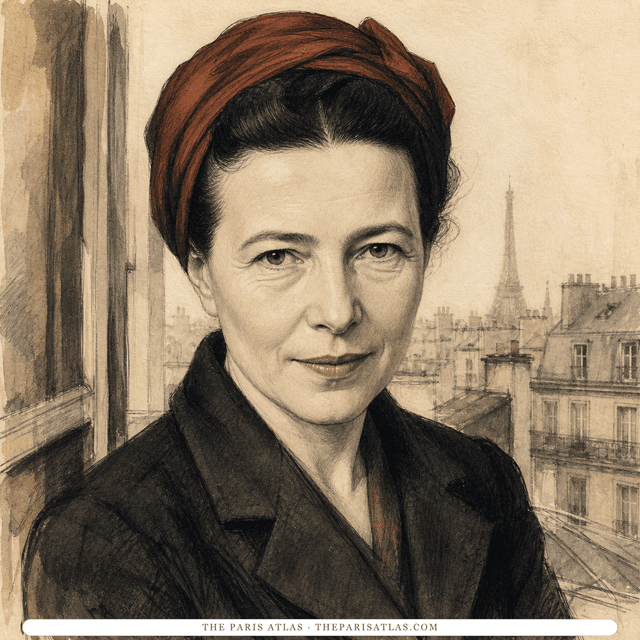
Simone de Beauvoir
French writer and philosopher whose novels, memoirs, and social analysis examined freedom, gender, responsibility, aging, and the material conditions that shape a life.
View author