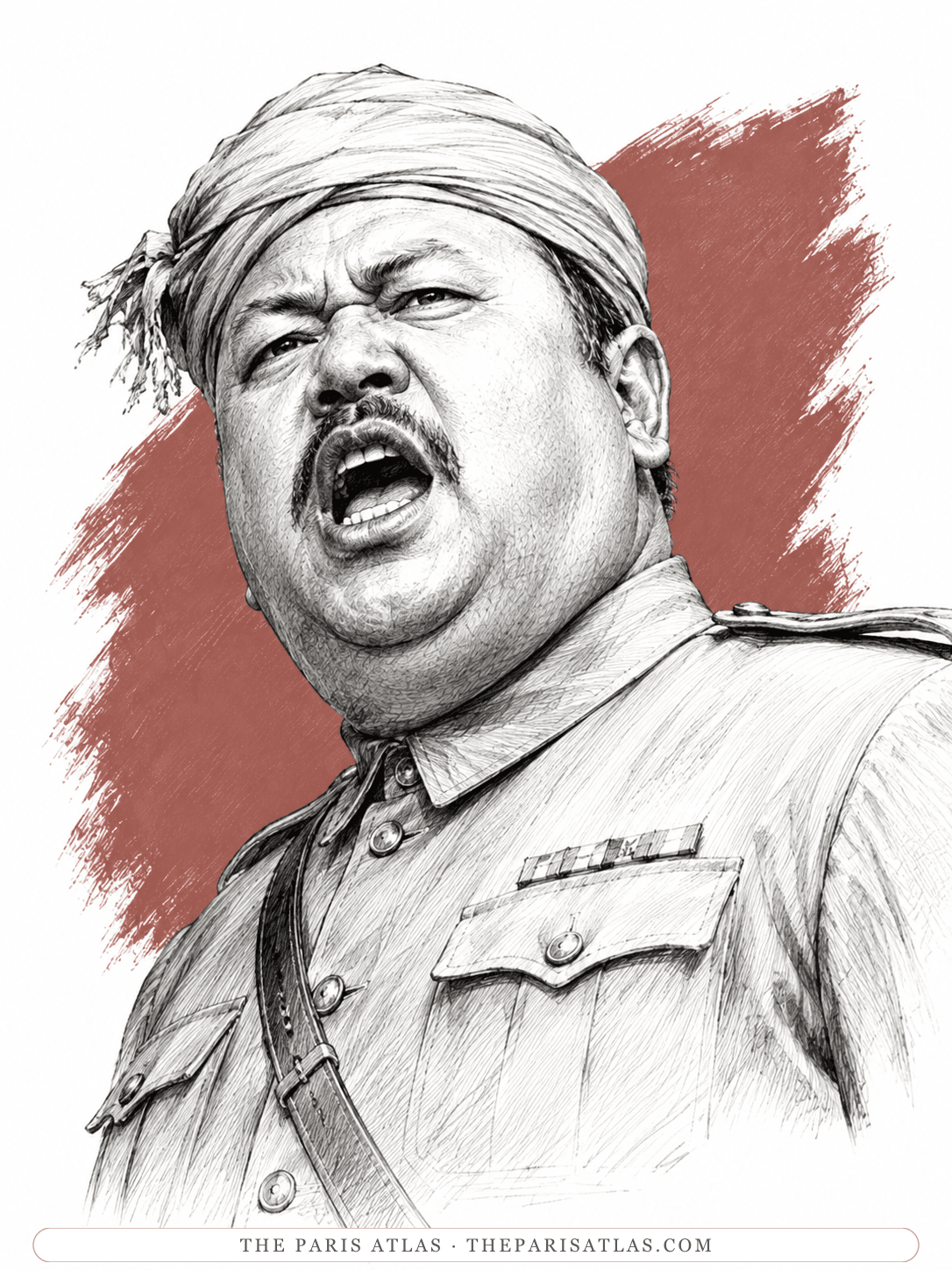
The fat Sub-inspector
The police officer George Orwell shows interrogating a suspected ring-thief at the station, turning on the man and roaring in an enormous voice that he stole the ring, then bellowing at him to turn round, on an inspiration. Westfield calls him Maung Ba. Orwell later wrote in The Road to Wigan Pier that this was the scene an American missionary walked in on while he was serving in the Burma police.
The book

At a glance
- Sub-inspector at the Kyauktada police station
- Maung Ba, used once by Westfield
- Westfield, the District Superintendent of Police
- Chapter 6
Who they are in the book
Spoiler-freeThe Sub-inspector runs the day-to-day work of the police station at Kyauktada, the town in Upper Burma where the novel takes place. He is Burmese and he is fat, and the only name he is given is the one his British superior uses in passing: Maung Ba. He holds a rank that puts him above the constables and below Westfield, the District Superintendent of Police, who is English.
George Orwell gives him one scene, early in chapter 6, and uses it to show how the machinery of colonial policing actually worked at the bottom. Westfield has come in early and is leaning against the ink-stained table watching an interrogation. The suspect is a man of about forty in a ragged cloth kilted to the knee, with tick-bites all over his shins and a grey, frightened face. He is accused of stealing a ring set with two emeralds.
The evidence against him is that he is poor. The Sub-inspector's argument, made to Westfield in English, is that a coolie could not own an emerald ring, therefore he stole it. He then puts his face up against the suspect's and roars three accusations at him. The man denies all three.
Then the Sub-inspector has an idea. He orders the man to turn round and bend over, the constables twist him into position, he pulls off the man's clothing and points to old scars on his buttocks. The man has been flogged with bamboos before, which proves he is a repeat offender, which proves he stole the ring. Westfield, who privately hates arresting petty thieves, looks away, says to put him in the lock-up, and asks how many are in there now. Three.
How The fat Sub-inspector Is Portrayed
- How the book draws himFat, and Burmese. Orwell gives him nothing else physically. He conducts the interrogation while Westfield, the English police superintendent, leans on a notched and ink-stained table watching.
- His theory of the caseThe suspect was caught with a ring set with two emeralds and gave no explanation. How, the Sub-inspector asks, could a poor coolie own an emerald ring? Therefore he stole it.
- The shoutingHe advances his face until it is almost touching the suspect's and roars, in an enormous voice, that the man stole the ring, that he is an old offender, that he has been in prison. The answer to each is no.
- "Turn round! Bend over!"Orwell calls it an inspiration. The two constables seize the man and bend him over, the Sub-inspector strips off his clothing and points to the scars from an old bamboo flogging. That, he tells Westfield, proves the man is an old offender and therefore proves the theft.
- What the Englishman doesThe suspect turns his face towards Westfield in agony, and Westfield looks away. He orders the man locked up and strolls off with his hands in his pockets. He dislikes arresting small thieves and arrests him anyway.
- The lock-up he keepsUpstairs behind six-inch wooden bars, guarded by a constable with a carbine: dark, stifling, unfurnished except for a stinking earth latrine, three men inside. A constable's wife is ladling out rice and watery dahl. The Government pays her two and a half annas a meal per prisoner and she keeps one anna of it.
If you like Burmese Days


If you like George Orwell
Explore authors with a similar voice, perspective, and influence.

Henry Miller
The Brooklyn dropout who arrived in Paris broke at thirty-eight and wrote the exuberant, banned books that ended American censorship.
View author
Louis-Ferdinand Céline
The doctor of the Paris slums who wrote the century's blackest, funniest novel — and changed the sound of French prose.
View author
Simone de Beauvoir
French writer and philosopher whose novels, memoirs, and social analysis examined freedom, gender, responsibility, aging, and the material conditions that shape a life.
View author