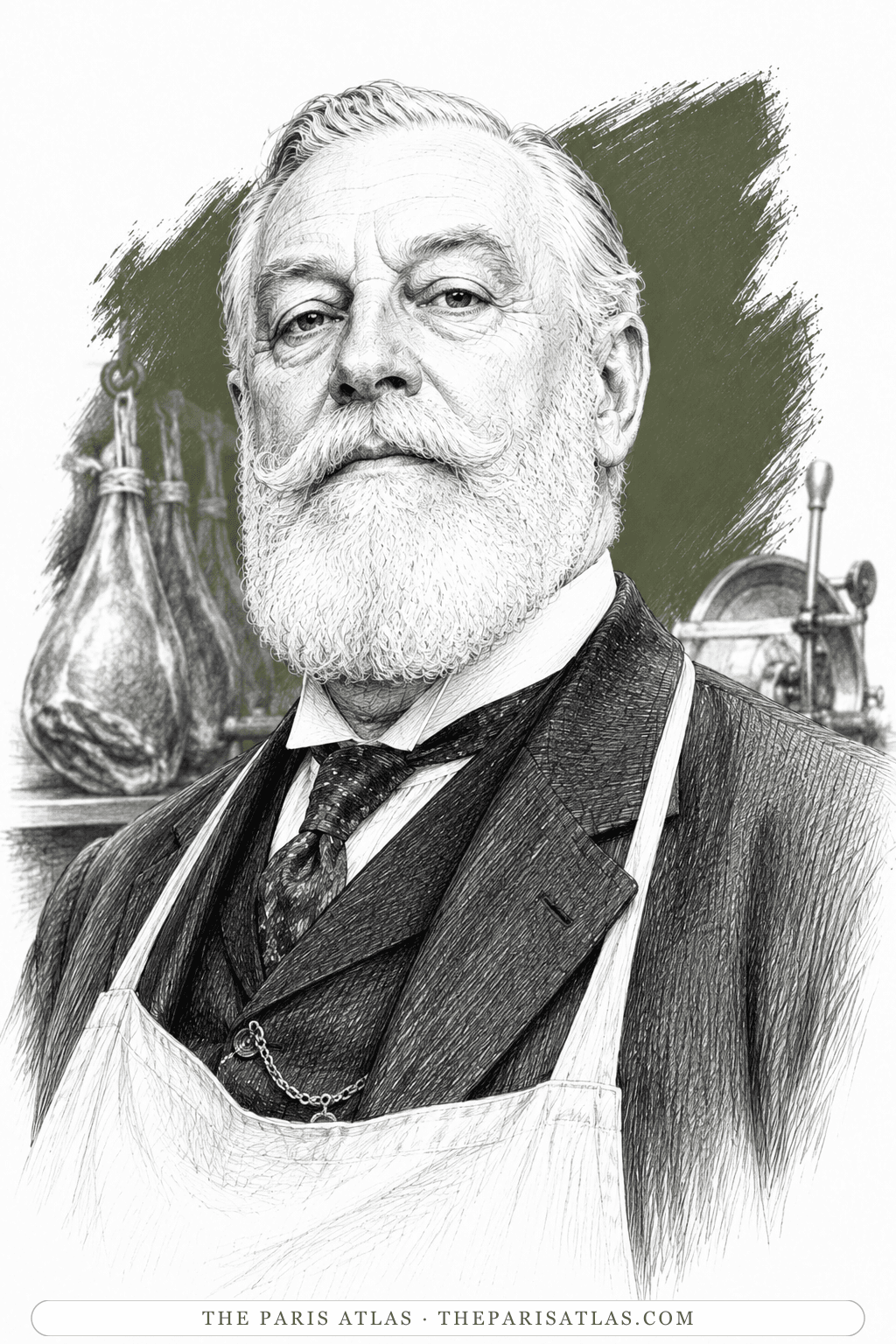
Old Grimmett
The high-class grocer of Lower Binfield, and Bowling's employer for nearly six years from the age of sixteen. A white-whiskered Liberal, a Baptist, a town councillor, and a sharp man in business.
To be both a pillar of chapel and a sharp man in business, and to be seen managing it. He is a councillor, a Liberal official, and audible through the Tin Tab wall at extempore prayer.
The book

At a glance
- Grocer of Lower Binfield; Bowling's employer 1909–1914
- Twelve shillings a week to start; twenty-eight by 1914
- Eleven a day except Thursdays and Sundays
- Liberal town councillor; Baptist, at the Tin Tab
- Part II, chapters 7 and 8; his grave and his old shop in Part IV
Who they are in the book
Spoiler-freeWhen Bowling had to leave school at sixteen his father had already arranged a place for him with Grimmett, who wanted a smart lad. He started as errand boy at twelve shillings a week, of which he kept four, moved into the shop and his first white apron six months later when an assistant left, and stayed nearly six years, ending on twenty-eight shillings.
Bowling describes him as a fine, upstanding, white-whiskered old chap, like a stouter version of Uncle Ezekiel and, like him, a good Liberal — but less of a firebrand and a great deal more respected. He was a town councillor and an official of the local Liberal Party, he trimmed his sails during the Boer War, he was a bitter enemy of trade unions, and he was chapel, a big noise in the Baptist chapel known locally as the Tin Tab, in a town where the Bowlings were church.
The shop is where Bowling learned the trade he still half remembers: tying a parcel, packing currants, grinding coffee, working the bacon-slicer, carving ham, dusting eggs without breaking them, judging a pound of cheese by eye, passing off an inferior article as a good one, and, hardest of all, remembering where the stock was kept. It was an eleven-hour day except Thursdays and Sundays, and Christmas week was a nightmare.
How Old Grimmett Is Portrayed
- How he lookedA fine, upstanding old chap with white whiskers, whom Bowling describes as a rather stouter version of his great-uncle Ezekiel.
- Prayers before the shuttersThe working day began with a prayer before they put up the shutters. The old story about the Nonconformist grocer telling James to sand the sugar and water the treacle and then come up to prayers was whispered constantly in the shop, and Bowling notes that Grimmett did not in fact sand the sugar, because he knew it doesn't pay.
- The photographHe once sacked an assistant for possessing a photograph of Keir Hardie.
- The householdA widower, with three assistants besides the errand boy and the van-man, and his own daughter acting as cashier. He did all the high-class grocery trade of the town and the country round it.
- What the war did for himHe had already done pretty well out of the war scare in August 1914 and still held enough of his Liberal principles to say the war would be a bad business. By 1916 he was doing well out of it, had turned patriotic, and sat on the local board that tried conscientious objectors.
- SwallowedIn 1938 the shop is still a grocer's, taken over by the International. Bowling says it gives you an idea of the power of the big combines that they could swallow up a cute old skinflint like Grimmett, and bets he got out while the going was good.
- The tombstoneIn the churchyard, under a huge marble thing shaped rather like a veal-and-ham pie, with an iron railing round it.
If you like Coming Up for Air


If you like George Orwell
Explore authors with a similar voice, perspective, and influence.

Henry Miller
The Brooklyn dropout who arrived in Paris broke at thirty-eight and wrote the exuberant, banned books that ended American censorship.
View author
Louis-Ferdinand Céline
The doctor of the Paris slums who wrote the century's blackest, funniest novel — and changed the sound of French prose.
View author
Simone de Beauvoir
French writer and philosopher whose novels, memoirs, and social analysis examined freedom, gender, responsibility, aging, and the material conditions that shape a life.
View author