Private Lidgebird
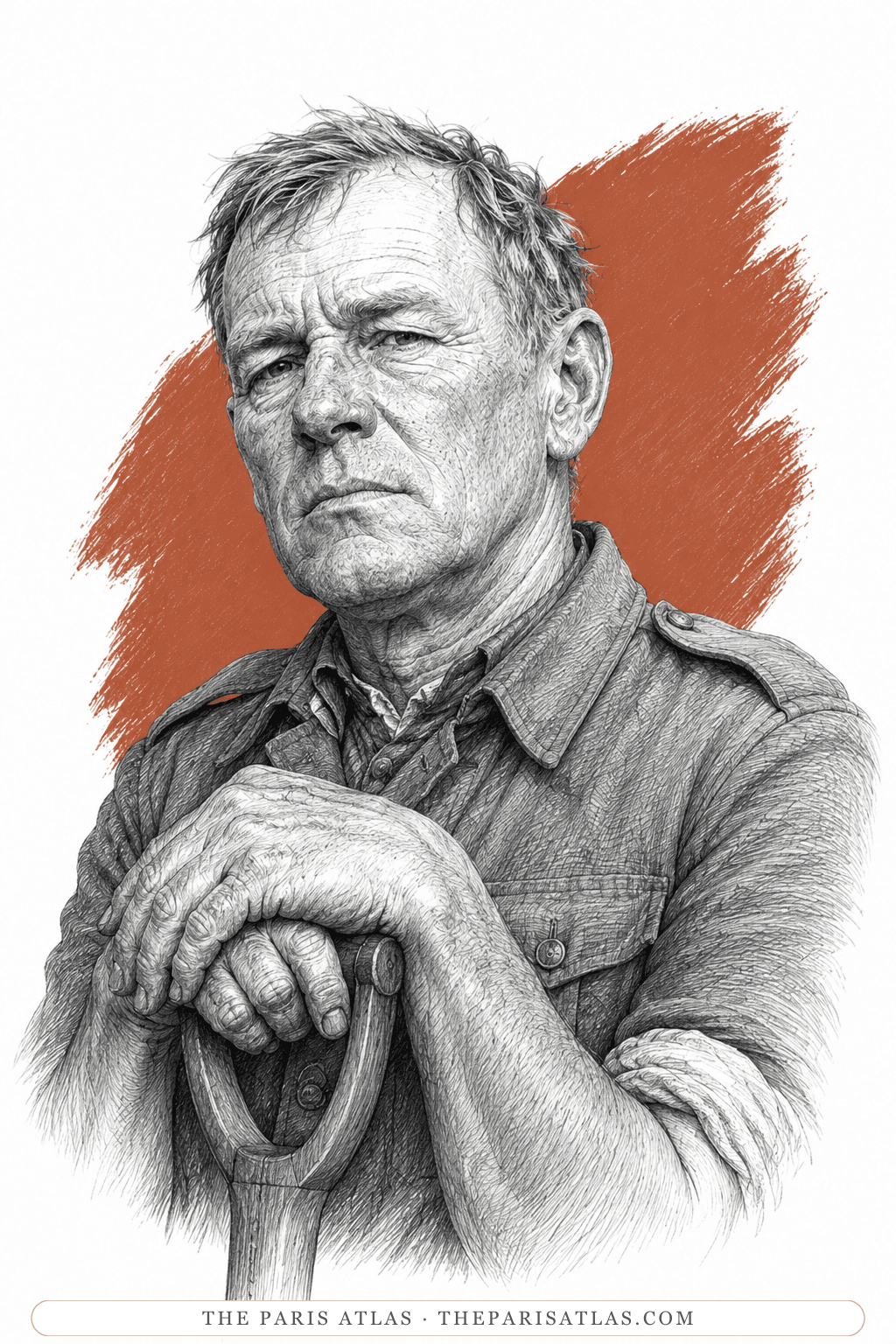
The other man at Twelve Mile Dump, the forgotten wartime supply depot on the Cornish coast where George Bowling spent nearly two years guarding tins of bully beef: a very deaf, surly old soldier who had been a market gardener before he joined the Army. He dug a patch round one of the huts and planted potatoes, then kept hens, then produced a pig from somewhere, and barely spoke to Bowling in all that time.
To grow things. Given a bare piece of Cornish coast and no orders, he plants potatoes, digs a second patch, keeps hens, and gets hold of a pig.
The book

At a glance
- A private soldier stationed at Twelve Mile Dump on the north Cornish coast
- A market gardener
- Eleven tins of bully beef
- From the middle of 1917 to the beginning of 1919
- Part Two, Chapter 8
Who they are in the book
Spoiler-freePrivate Lidgebird is the only other man at Twelve Mile Dump, a supply depot on the north Cornish coast in George Orwell's Coming Up for Air. George Bowling, who narrates the novel, was posted there from the middle of 1917 to the beginning of 1919, and the two of them spent that time guarding eleven tins of bully beef for an organisation that did not exist.
Bowling had been sent down in the middle of 1917 to check whether any stores existed at the dump. They consisted of eleven tins of bully beef, left behind by officers who had been there earlier on some other errand. Before he could report this, a telegram arrived putting him in charge of the stores and telling him to stay until further notice. He wired back that there were no stores. The following day an official letter made him officer commanding Twelve Mile Dump, and he stayed until the beginning of 1919. The West Coast Defence Force that the dump was supposed to belong to never got past being an idea.
It was a lonely stretch of coast where the only people Bowling ever saw were a few local men who had barely heard there was a war on. A quarter of a mile away and down a hill, the sea broke over enormous flats of sand. It rained nine months of the year, and for the other three a wind blew off the Atlantic. There was nothing on the site but two Army huts, the eleven tins, Bowling and Lidgebird. Once a month a form arrived asking for the number and condition of pick-axes, entrenching tools, barbed wire, blankets, groundsheets, first-aid outfits, corrugated iron and tins of plum-and-apple jam. Bowling wrote nil against everything and posted it back.
Lidgebird had been left there by the earlier officers, and Bowling never found out what he was supposed to be doing. He was very deaf, he was old, and he was surly. In eighteen months Bowling got one fact out of him: before he joined the Army he had been a market gardener.
That fact accounts for everything else he does. Before Bowling even arrived he had dug a patch of ground round one of the huts and planted potatoes. In the autumn he dug a second patch, and went on until he had about half an acre under cultivation. At the beginning of 1918 he started keeping hens, and by the end of that summer there were a good number of them. Towards the end of the year he produced a pig, and Bowling never discovered where it came from. He does not think it ever crossed the old man's mind to wonder what the two of them were doing on that coast, or what the West Coast Defence Force was, or whether it existed.
Bowling finishes the account by saying it would not surprise him to hear that Lidgebird is still there, raising pigs and potatoes on the spot where Twelve Mile Dump used to be, and that he hopes he is.
How Private Lidgebird Is Portrayed
- Who he isA very deaf old private soldier, left behind at Twelve Mile Dump by officers who had passed through earlier. Bowling never found out what his job there was supposed to be.
- His mannerSurly. Bowling shared a lonely stretch of coast with him for a year and a half and could never get much out of him.
- The one thing Bowling learned about himHe had been a market gardener before he joined the Army.
- The half acreHe had dug a patch round one of the huts and planted potatoes before Bowling even got there, dug another patch in the autumn, and kept going until about half an acre was under cultivation.
- The hens and the pigHe started keeping hens at the beginning of 1918 and had a good many by the end of the summer. Towards the end of the year he produced a pig from somewhere Bowling never identified.
- What he never askedBowling does not believe it occurred to him to wonder what the two of them were doing there, what the West Coast Defence Force was, or whether it was real.
- How Bowling leaves himWith the thought that he may still be on the same ground, raising pigs and potatoes where the dump used to be, and the line that he hopes he is.
If you like Coming Up for Air


If you like George Orwell
Explore authors with a similar voice, perspective, and influence.
Henry Miller
The Brooklyn dropout who arrived in Paris broke at thirty-eight and wrote the exuberant, banned books that ended American censorship.
View author
Louis-Ferdinand Céline
The doctor of the Paris slums who wrote the century's blackest, funniest novel — and changed the sound of French prose.
View author
Simone de Beauvoir
French writer and philosopher whose novels, memoirs, and social analysis examined freedom, gender, responsibility, aging, and the material conditions that shape a life.
View author