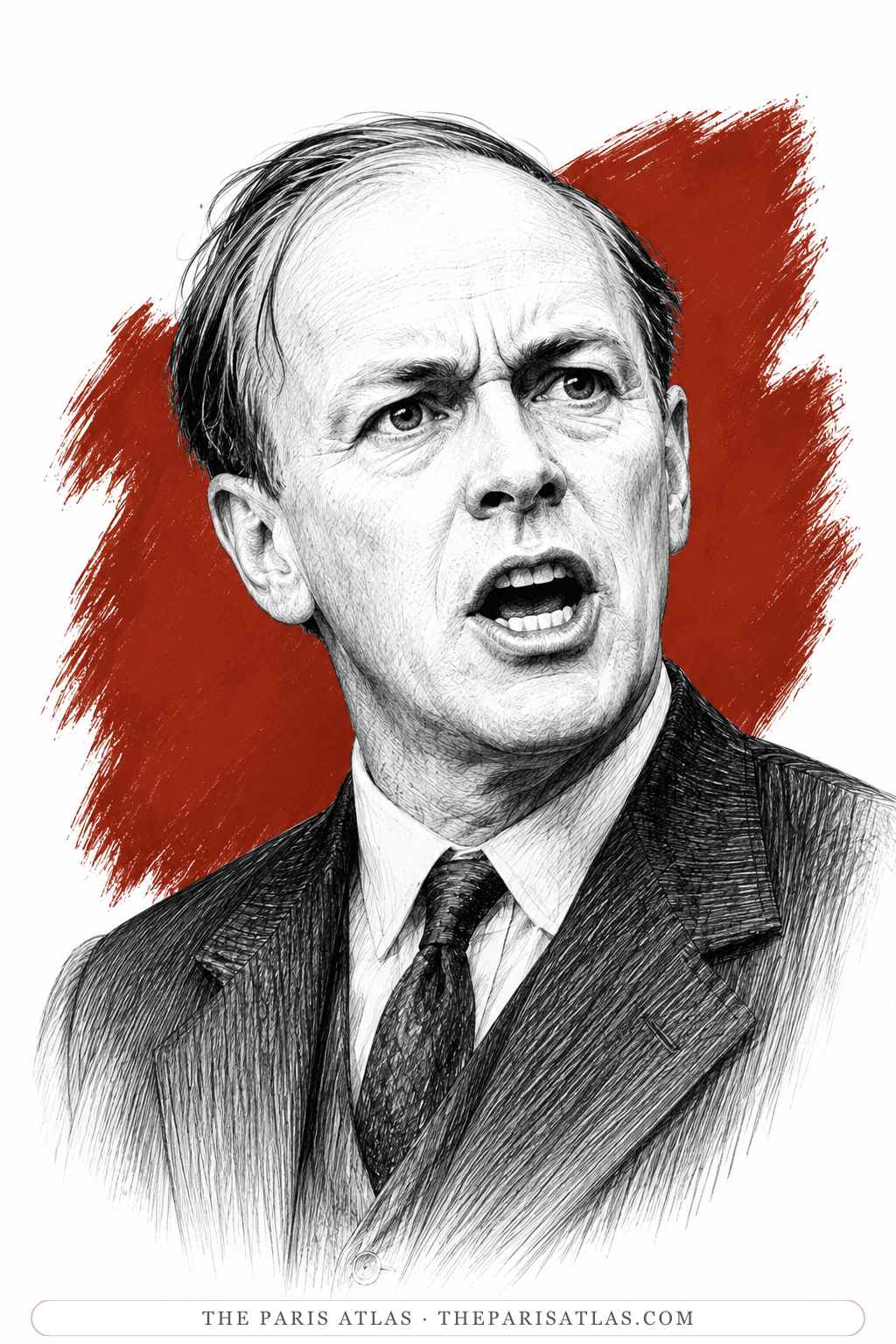
George Bowling
The narrator: forty-five, fourteen stone eleven, false teeth, a bowler hat, a wife, two children and an insurance round in the home counties. Born in Lower Binfield in 1893, and the only person in the book who remembers it.
To get one week of the feeling he had before 1914, and to catch the big carp in the hidden pool behind Binfield House. He calls it coming up for air, like a sea-turtle surfacing for one breath before it sinks back among the seaweed.
The book

At a glance
- Narrator; insurance salesman in a London suburb
- Forty-five; born in 1893
- Not much over fourteen stone in January 1938; 14 stone 11 pounds off a slot machine in late June
- Forty-eight or forty-nine inches, last measured in January 1938
- Bricky-red face, butter-coloured hair, pale blue eyes; never grey, never bald
- 191 Ellesmere Road, West Bletchley, on the Hesperides Estate
- Inspector for the Flying Salamander, about seven pounds a week
- Hilda, married 1923; Lorna, eleven; Billy, seven
- 57 High Street, Lower Binfield, Oxfordshire
- France 1915–16, wounded; then a forgotten food dump in Cornwall until 1919
- Seventeen pounds won on a horse and told to nobody
Who they are in the book
Spoiler-freeGeorge Bowling tells the whole novel himself, in the first person, talking to the reader as though across a bar. He is forty-five, born in 1893, the younger son of a corn and seed merchant in the Oxfordshire market town of Lower Binfield. He lives at 191 Ellesmere Road, West Bletchley, a leasehold house on an estate called the Hesperides, which he will be paying for over sixteen years and does not own. He works for an insurance company called the Flying Salamander, where he is an Inspector, and earns about seven pounds a week: two days in the district office and the rest driving a 1927 car round his district, assessing shops and talking wavering clients into signing.
He is fat, and he is not defensive about it. His weight, from the fortune-telling machine on the towpath, is fourteen stone eleven pounds. People he has never met call him Tubby. He describes his own red face, his butter-coloured hair, his pale-blue eyes and his cheap suits without asking for sympathy, and he is clear-eyed about what the fat has done to his life: a fat man cannot be tragic, cannot pick primroses in public, cannot go fishing at forty-five without being laughed at by his own children. His summary of himself is that he is fat but thin inside.
He is also better read than he lets on. He was the clever one at school, was talked of for a scholarship, and then left at sixteen for a grocer's counter when his father's trade failed. His real education came during the war, in a forgotten Army posting on the Cornish coast where he had a year with nothing to do but read: H. G. Wells, Compton Mackenzie, Conrad, and eventually Lawrence. He belongs to the Left Book Club and takes two novels a week out of the Boots library. He states repeatedly that he is not a highbrow and has no interests you would not expect of a middle-aged man with two children, and then spends the book noticing things nobody around him notices.
What sets the plot going is a set of false teeth and seventeen pounds. A colleague talked him into ten shillings on a horse called Corsair's Bride, and instead of spending the winnings on the family he quietly put them in the bank and said nothing. The new teeth freshen him up, the past starts coming back at him, and he decides to spend some of the money on a week alone in the town he grew up in.
How George Bowling Is Portrayed
- How he opensThe first sentence of the book is his: the idea really came to him the day he got his new false teeth. He then describes shaving with a blunt blade, being shut out of his own bathroom by a seven-year-old, and going downstairs in a bad temper with a soapy neck.
- What he looks like in 1938A bricky-red face, butter-coloured hair and pale blue eyes, which he also calls boiled blue. He is forty-five and says he has never gone grey or bald. His arms are pudgy and freckled to the elbow, his upper half is close to the shape of a tub, and standing upright he can see only the front halves of his feet. Bending down makes him puff and blow.
- The two weightsThe book weighs him twice and the figures do not agree. In January he puts his weight at not much over fourteen stone and his waist at either forty-eight or forty-nine inches, he forgets which. In late June a slot machine on the towpath at Lower Binfield prints 14 stone 11 pounds, and he notes that he has put on four pounds in three days, probably on the drink.
- He has not always been fatHe has been fat for eight or nine years and dates it to 1930, when it arrived so suddenly that he compares it to a cannon ball lodging inside him. In France in 1916 the men in his company still called him George rather than Fatty. At nearly thirty he thought himself not bad-looking, with a red face and butter-coloured hair.
- The false teethHe says nine people out of ten would take the new set for natural, and that with them in he probably does not look forty-five. Out of his mouth and magnified in a tumbler of water on the bathroom shelf, they look to him like the teeth in a skull.
- What he wearsIn January it is a grey herring-bone suit a bit the worse for wear, a blue overcoat that cost fifty shillings, a bowler hat and no gloves. For the week in Lower Binfield in June he buys a blue flannel suit with a thin white stripe, which the tailor tells him has a reducing effect, and wears it with a trilby. He thinks it may pass him off as a stockbroker and decides by the end of the week that it does not.
- The boy in 1900At seven he was about four feet high and, by his own account, an ugly little boy, with butter-coloured hair cropped short except for a quiff at the front. He was not fat. On Sunday mornings he was buckled into a thick black suit and an Eton collar, with his stockings pulled up over his knees.
- Behind the counter at twentyFor his five years at Grimmett's from 1909 he describes an alert young chap with a round, pink, snubby face and butter-coloured hair no longer cropped but greased and slicked back. He worked in a white apron with a pencil behind his ear and spoke with a trace of a Cockney accent, which he later got rid of. By about 1911 there were a moustache, button boots and collars three inches high.
- The nicknameStrangers on trains call him Tubby without introducing themselves. A soap salesman named Waters greets him weekly in the saloon bar of the Crown at Pudley by prodding his ribs and singing "Here a sheer hulk lies poor Tom Bowling", and the bar never tires of it. Bowling's observation is that nobody would give a hunchback a nickname about his back.
- What his trade has taught himHe says his own line, insurance, is a swindle, but an open one with the cards on the table, and that building societies are the cleverer racket because the victims think they are being done a kindness. He can talk a doubtful client into a policy by laying on the bonuses or by hinting at what will become of the man's widow.
- The fish sausageIn a chromium milk-bar off the Strand he bites into a frankfurter and it bursts. It is filled with fish. He walks out without touching his coffee, and decides he has bitten into the modern world and found out what it is made of.
- The prophetic moodTwice he describes seeing the future as clearly as if he had X-rays in his eyes: a bomber over the train in the morning, then a vision of the Strand in three years, chipped and dusty, a thin sergeant coughing his guts out, a child in Birmingham howling for bread. He is not frightened of the war, he says, but of the after-war.
- The primrosesStopping his car on a March road, he leans over a gate, looks at a wood fire gone to white ash with red under it, and finds he is happy. He squats down to pick primroses because he is too fat to bend, and throws them over the hedge when he hears a car coming rather than be seen holding them.
- The trip is a small crimeHe books a week off with a story about a relative, fixes Birmingham as his alibi, and gets a colleague travelling that way to post a letter from a hotel there. Driving west, he imagines the whole world in pursuit: Hilda and the children, the Flying Salamander directors in their Rolls-Royces, the Home Secretary, Scotland Yard, and Hitler and Stalin on a tandem bicycle.
- The last name in the registerAt the George in Lower Binfield he gives his name very distinctly, expecting to be recognised — the Bowlings were an old family in the town and his father drank there every Saturday for thirty years. The clerk asks how it is spelled. Nobody in the town has heard of him.
- He decides he is the ghostFor two days he walks the new streets counting paces and placing hedges that are no longer there, feeling like a man in a Wells story who sees waterweed instead of furniture. Then, watching the morning crowds from a hotel window, he corrects himself: he is not seeing ghosts, he is one.
- What he does when the bomb whistlesHe recognises the sound after twenty years without having to think, and is flat on the pavement before anyone else has moved. He describes himself as looking like a rat squeezing under a door, and says he had time, while it was still falling, to fear that he had made a fool of himself for nothing.
George Bowling quotes
The idea really came to me the day I got my new false teeth.
I'm fat, but I'm thin inside. Has it ever struck you that there's a thin man inside every fat man, just as they say there's a statue inside every block of stone?
Fear! We swim in it. It's our element.
Bowling gets his week and finds nothing he came for.
The one thing the trip settles is the question he came with.
If you like Coming Up for Air


If you like George Orwell
Explore authors with a similar voice, perspective, and influence.

Henry Miller
The Brooklyn dropout who arrived in Paris broke at thirty-eight and wrote the exuberant, banned books that ended American censorship.
View author
Louis-Ferdinand Céline
The doctor of the Paris slums who wrote the century's blackest, funniest novel — and changed the sound of French prose.
View author
Simone de Beauvoir
French writer and philosopher whose novels, memoirs, and social analysis examined freedom, gender, responsibility, aging, and the material conditions that shape a life.
View author