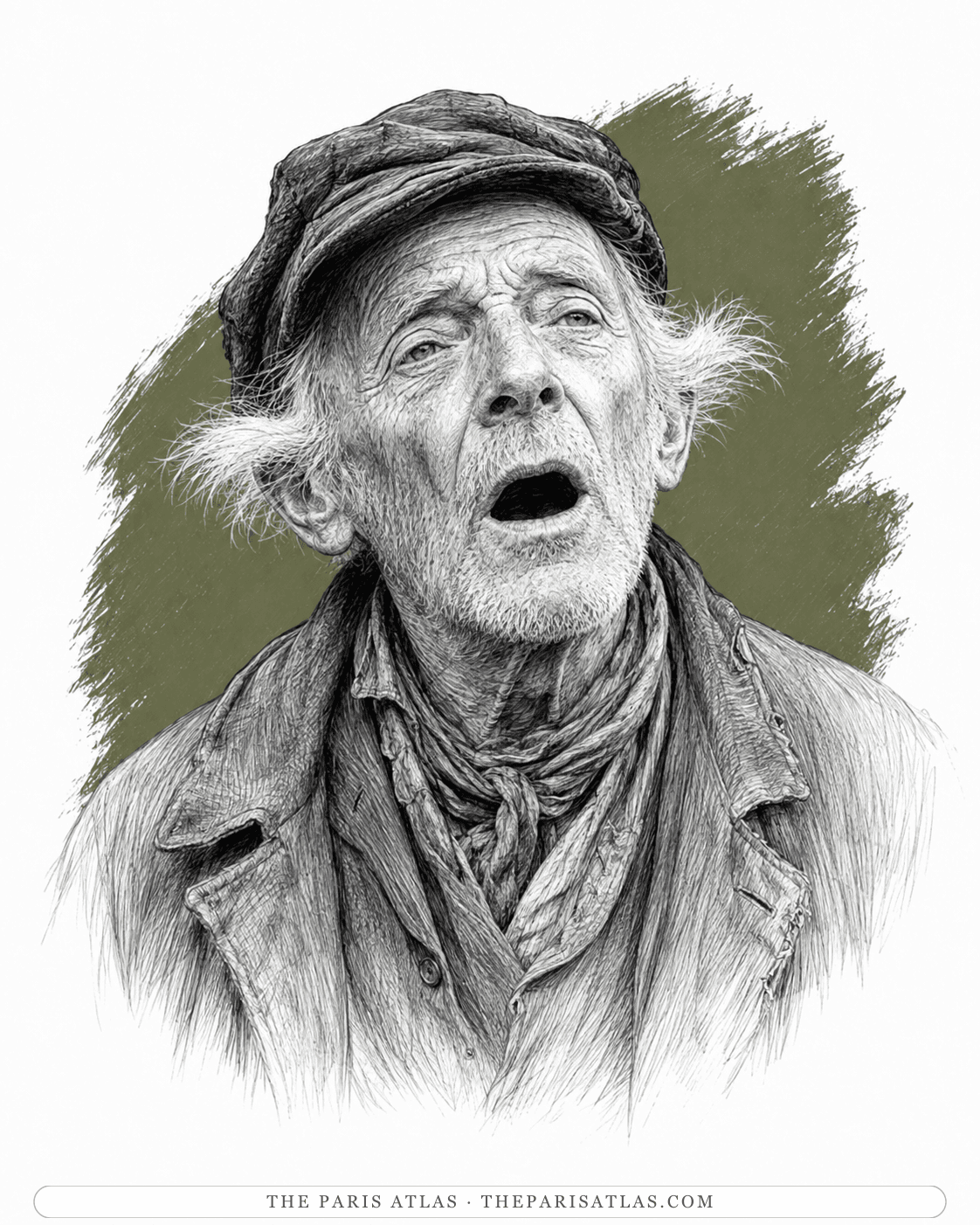
Deafie
A weazened old tramp, a ship's steward by profession and deaf as a post, who becomes Dorothy's bin-mate after Nobby goes. He sings one line over and over and turns up again on the benches in Trafalgar Square. Orwell met a Deafie on his own 1931 hop-picking trip and kept the name.
The book

At a glance
- Dorothy Hare's hop-picking bin-mate, and later one of the Trafalgar Square regulars
- A ship's steward in the P. & O., and a tramp of many years' standing
- Chapters 2 and 3
Who they are in the book
Spoiler-freeDeafie is an old tramp picking hops in Kent, and he becomes the bin-mate of Dorothy Hare, the clergyman's daughter of the title, after Nobby, the young thief she walked down from London with, is arrested. A ship's steward by profession and a tramp of many years' standing, he is deaf enough that conversation with him does not really happen; George Orwell's word for it is that he is something of a Mr F.'s aunt, after the Dickens character whose remarks connect to nothing anyone has said.
He is an excellent picker, which is what saves Dorothy. She is picking against starvation and doing it badly, and it is his example that gets her up to a fair share of the work. He is picking against time too. The hop money is the last he will earn until next year's season, and the two of them aim at thirty bushels a day between them and never quite reach it.
The whole of his year runs off that fortnight. Every season he comes to the same farm, saves a pound, and spends a paradisiac week in a lodging house in Newington Butts before going back to the road. It is the only week in the year when he sleeps in anything that can be called a bed, except by courtesy. He turns up again later among the people spending a freezing night on the benches in Trafalgar Square, still singing, still answering nobody.
How Deafie Is Portrayed
- How the book describes himA small, weazened old tramp. He has the hairiest ears Dorothy Hare has ever seen, with tufts growing out of each one like miniature side-whiskers.
- The songOne line, for hours together: "With my willy willy--WITH my willy willy." He cannot hear what he is singing, and it seems to give him some kind of pleasure. Orwell adds in a single clause, without elaborating, that he was an exhibitionist but quite harmless.
- What he talks aboutThe P. & O. He was a steward, and his contributions to the Trafalgar Square night are memories that answer nothing anyone has said: meeting Indians two days out at sea in the great canoes they call catamarans, catching sea-turtles the size of dinner tables, and flocks of green parakeets in the coconut palms.
- At the binAn excellent picker, and the reason Dorothy manages a fair afternoon's work on the day she is worst off. He is picking for the last money he will earn until the next hopping season.
- The week in Newington ButtsThe pound he saves from the harvest buys it, and it is the only week in the year he spends in a bed. Then he goes back on the road.
- In the pile on the benchThe group heaps itself together for warmth, someone sits on his diaphragm, and he lets out a sound the stage direction calls unreproducible. Charlie's explanation is that it sets up a kind of humming inside of him.
- How the others treat himGinger, who is in charge of the tea, takes the cup back off him -- "You've 'ad your 'alf!" -- and tells him not to breathe in his face. He does not appear to hear either remark.
- Small among themWhen the five largest men jam together on the bench and wrap the group in newspaper, Deafie sits across their knees with the four women. He is also one of the three men who do not roll cigarettes from picked-up fag-ends.
If you like A Clergyman's Daughter


If you like George Orwell
Explore authors with a similar voice, perspective, and influence.

Henry Miller
The Brooklyn dropout who arrived in Paris broke at thirty-eight and wrote the exuberant, banned books that ended American censorship.
View author
Louis-Ferdinand Céline
The doctor of the Paris slums who wrote the century's blackest, funniest novel — and changed the sound of French prose.
View author
Simone de Beauvoir
French writer and philosopher whose novels, memoirs, and social analysis examined freedom, gender, responsibility, aging, and the material conditions that shape a life.
View author