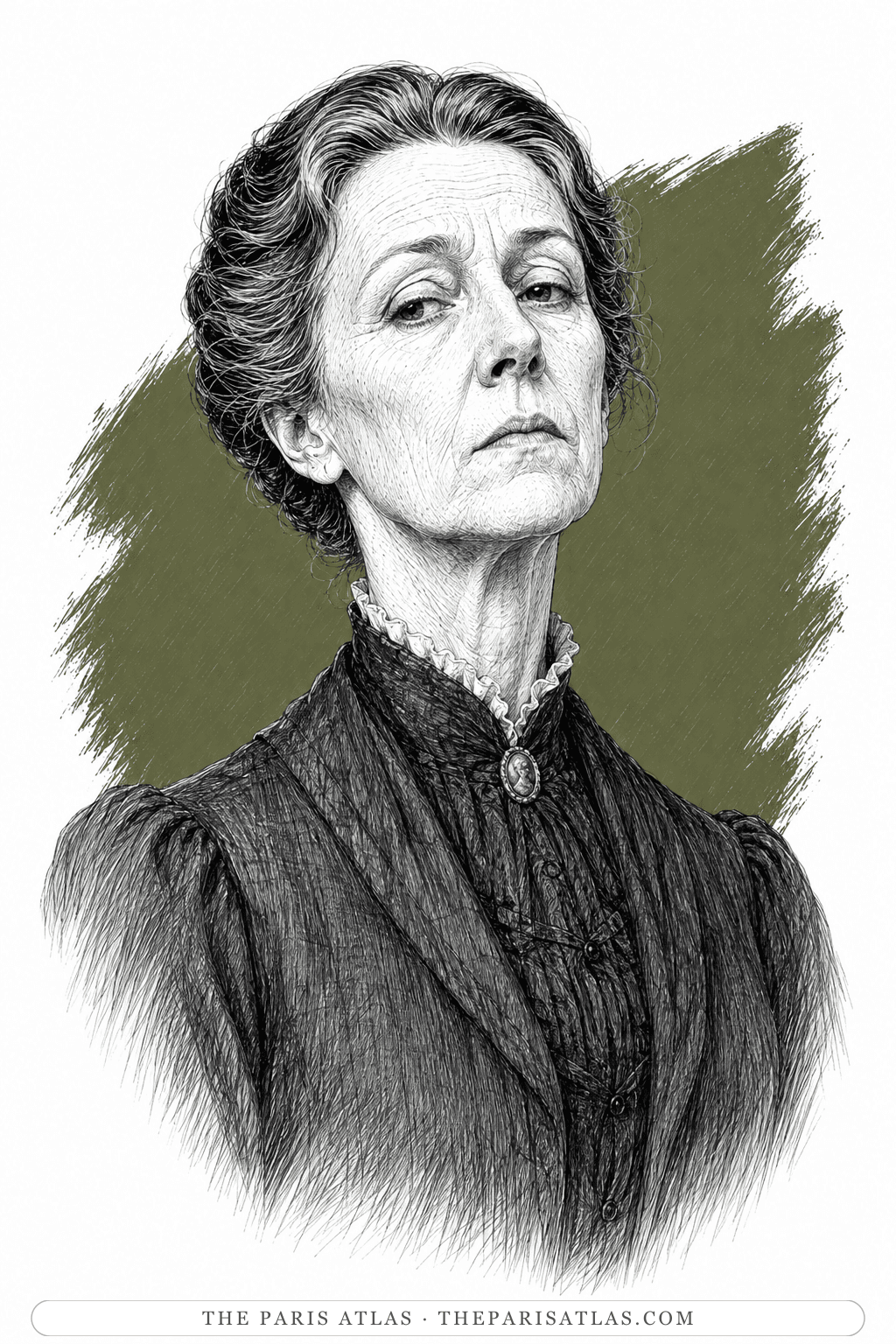
Mrs Semprill
Knype Hill's leading scandalmonger, and Mr Warburton's next-door neighbour. Everything that happens to Dorothy in the last four chapters of the book follows from what Mrs Semprill saw, or says she saw, from an upstairs window.
To be the one who knows first. She is genuinely astonished if you accuse her of looking for material, and protests that nothing pains her more than the spectacle of human wickedness, which is forced upon her unwilling eyes, and that only a stern sense of duty makes her publish it.
The book

At a glance
- The town scandalmonger of Knype Hill, and Mr Warburton's neighbour
- Forty
- A widow, given the first name Evelina in the newspaper report
- Not less than half a dozen broken engagements, and innumerable quarrels between husbands and wives
- Something worse than a slanderer: a bore
Who they are in the book
Spoiler-freeMrs Semprill is a slender woman of forty with a lank, sallow, distinguished face, glossy dark hair and an air of settled melancholy that gives her, George Orwell writes, something of the appearance of a Van Dyck portrait. She is a widow, she lives next door to Mr Warburton, and she is the most eminent of Knype Hill's many scandalmongers. Whenever you are doing something you would rather she did not see, you can trust her to be somewhere in the neighbourhood; Orwell says she seems able to materialize like an Arabian jinneeyeh at any place where she is not wanted.
Her method is a low, mournful, affectionate voice and a mouth brought steadily closer to your ear as the remarks grow more intimate. Her subject is the town, and there is hardly a soul in it about whom she cannot disclose some festering secret if you listen long enough: the bank manager spending his clients' money on the children of a bigamous second marriage, the music teacher with her gin bottle and her anonymous letters, the baker's daughter and her brother. Compared with the ordinary scandalmongers of a country town, Orwell writes, she was Freud to Boccaccio.
He then makes the observation the whole character rests on. Listen a little longer and the catalogue of obscenities becomes first monstrous and then unbearably dull, because in a town where everyone is a bigamist, a pederast or a drug-taker the worst scandal loses its sting. "In fact, Mrs Semprill was something worse than a slanderer; she was a bore." How much of it is believed varies. Sometimes the word goes round that she is a foul-mouthed old cat and everything she says is a pack of lies. Sometimes an accusation lands on somebody who needs years to live it down. She has broken off at least half a dozen engagements.
How Mrs Semprill Is Portrayed
- Where she watches fromEntrenched behind a pile of cretonnes near the window of the draper's shop, having observed Dorothy's entire conversation with Mr Warburton in the street outside. He compares her to the four beasts of the Apocalypse: "They are full of eyes, you remember, and they rest not night nor day."
- The approach"Dorothy DEAREST", murmured in the sorrowful voice of someone breaking bad news as gently as possible. She minces alongside with a delicate birdlike step, whispering, and does not stop when Dorothy crosses to the other side of the street.
- The perversionsOrwell notes that her stories are not merely dirty and libellous but nearly always carry some monstrous tinge of perversion. From listening to her you would gather that Knype Hill, with a thousand inhabitants, held more refinements of evil than Sodom, Gomorrah and Buenos Aires put together.
- What she cannot be forgiven forCutting her short. Any unwillingness to listen is taken as a sign of depravity, and produces fresh and worse scandals about you the moment you have left. Dorothy rides away without hearing her out, and the book treats that as a mistake.
- The window over the gateHer bedroom window looks down on Mr Warburton's front gate. It is the one consideration that makes him let go of Dorothy, and Dorothy hears a window shut as she walks away.
- The version that gets printedBy her account she happened by chance to look out of her window a little before midnight on 21 August, recognised Miss Hare in clear moonlight, watched the pair exchange embraces of a passionate nature, and saw them drive off half an hour later towards the Ipswich road, Miss Hare in scanty attire and appearing to be under the influence of alcohol. Pippin's Weekly prints it under the headline "PASSION DRAMA IN COUNTRY RECTORY".
- Whether she believes herselfDorothy works out, sitting in a hopfield, exactly what Mrs Semprill saw and exactly where the invention begins. What she cannot settle is the thing the book says nobody can settle about her: whether she tells her lies consciously and deliberately as lies, or somehow succeeds in believing them.
- CorneredMr Warburton, back from Europe and furious, tracks her down and gives her what he describes as a distinctly formidable piece of his mind. He reports that he could get nothing out of her except hypocritical snivellings about "poor, POOR Dorothy", and that the woman is simply sub-human.
If you like A Clergyman's Daughter


If you like George Orwell
Explore authors with a similar voice, perspective, and influence.

Henry Miller
The Brooklyn dropout who arrived in Paris broke at thirty-eight and wrote the exuberant, banned books that ended American censorship.
View author
Louis-Ferdinand Céline
The doctor of the Paris slums who wrote the century's blackest, funniest novel — and changed the sound of French prose.
View author
Simone de Beauvoir
French writer and philosopher whose novels, memoirs, and social analysis examined freedom, gender, responsibility, aging, and the material conditions that shape a life.
View author