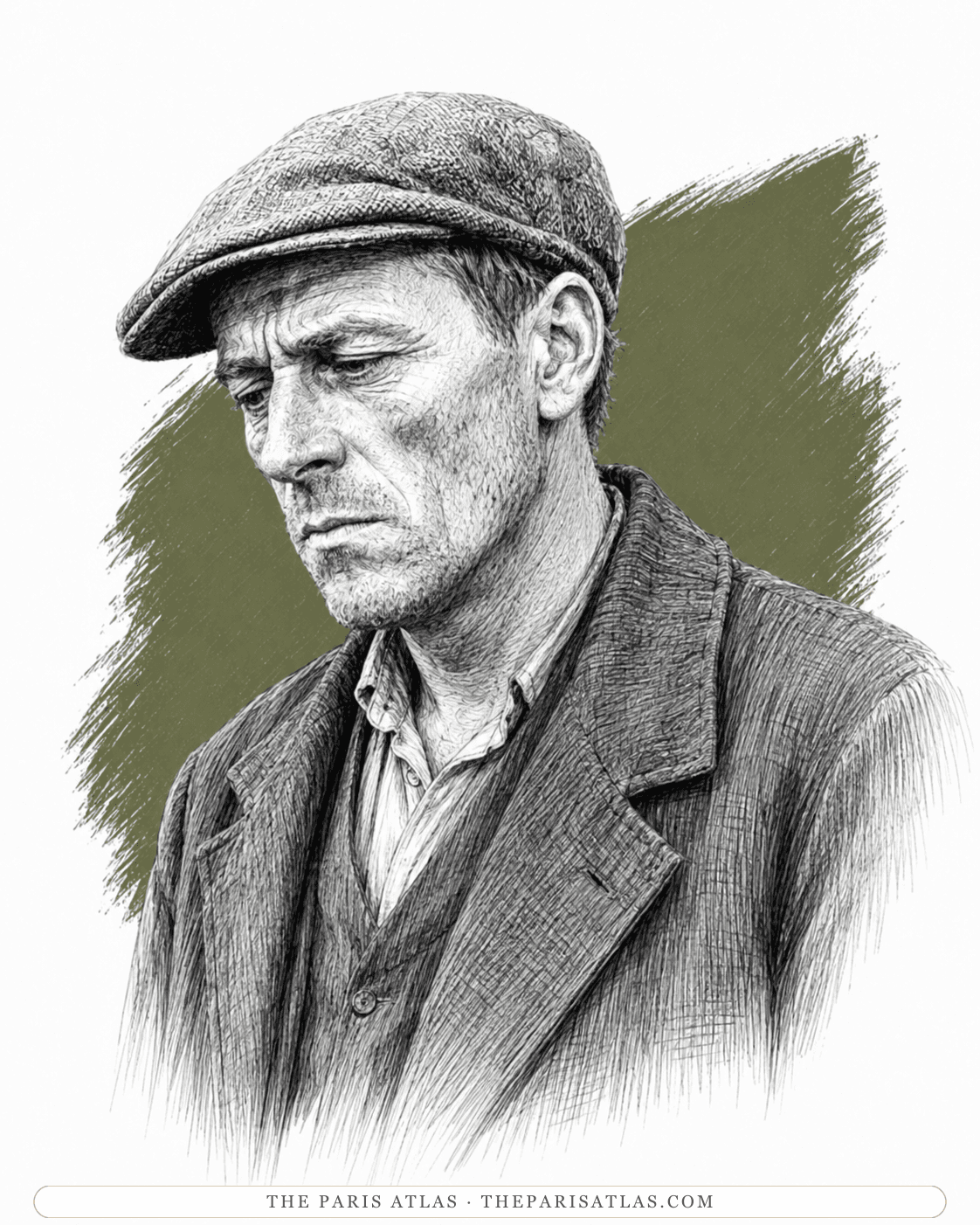
Nosy Watson
The bitterest of the Square regulars, muttering mostly to himself about a job he was blamed for and never did. He was narked by his own sister into prison at eighteen, and the first thing he bought when he came out was a hammer. He has fourteen convictions, an obsessive hatred of a detective he calls Smith of the Flying Squad, and a habit of composing verse in the back of the police van.
To get back at the people who informed on him. He has already done it once with a hammer, and he spends most of the night going over what he would like to do to the detective who caught him.
The book

At a glance
- One of the men around the bench in Trafalgar Square
- Housebreaking
- Fourteen
- At eighteen, on his sister's information
- Chapter 3
Who they are in the book
Spoiler-freeNosy Watson is a character in A Clergyman's Daughter, the 1935 novel by George Orwell. He is one of the group who spend the third chapter on and around a bench in Trafalgar Square in London through a freezing night. George Orwell writes that chapter as a play script, with each speaker named and their lines printed as dialogue, so almost everything the reader learns about him he says out loud.
He is a burglar, and he has just come out of prison again. Fourteen convictions, he tells the others, and with a record like that you do not stand a chance. Most of his speeches are about a detective he calls Smith of the Flying Squad, who he says supplied the plans of a house, had a van full of policemen waiting, and took the lot of them. Watson's complaint is that he was talked into the job and then jailed for it without ever doing it.
The other men on the bench treat all this as ordinary conversation. Charlie, who has nine convictions of his own and sang bass in the Dartmoor prison choir, asks him who caught him, and later the two of them go off and break a tobacconist's window together.
How Nosy Watson Is Portrayed
- How he talksMostly to himself, angrily, in broken pieces: "Sod! . . . Gee'd into it and then a stretch all round. . . . Never even done the bloody job. . . . Sod!" To gee someone into a job is to talk them into it.
- Smith of the Flying SquadThe detective he cannot leave alone. Asked whether Smith is crooked, he says a corkscrew would look like a bradawl beside him, and that there is not one man in the Flying Squad who would not sell his grandmother to the knackers for two pound ten and then sit on her gravestone eating potato crisps.
- The verse in the police vanHe composed a couplet in the back of the Black Maria on the way to court and wrote it up inside: "Detective Smith knows how to gee; / Tell him he's a ---- from me."
- Fourteen convictionsHe gives the number himself when Charlie asks, and adds the reason it matters: "You don't stand no chance with that lot against you."
- His sisterHe was informed on and sent to prison at eighteen by his own sister, who had married a man so religious that by now they have fifteen children, and who Watson says put her up to it. The first thing he did on release was buy a hammer, go round to her house and smash her piano to matchwood.
- What he compares things toPrison, every time. The tea brewed on the Square is bloody catlap, he says, though better than the cocoa in the stir. When he hears Charlie has been in Dartmoor, the first thing he wants to know is whether they give you jam there now.
- The tobacconist's windowAround one in the morning he and Charlie see a show-case full of fancy boxes of Gold Flake cigarettes. Watson wraps his scarf round his hand, they wait for a van big enough to drown the noise, and he puts the glass in. They run off with a dozen packets and find, round the corner, that the boxes are empty dummies.
- How he ranks his own troublesAbove everyone else's. "Some of you lot think you got a bloody lot to howl about, don't you? What about a poor sod like me? You wasn't narked into the stir when you was eighteen year old, was you?"
If you like A Clergyman's Daughter


If you like George Orwell
Explore authors with a similar voice, perspective, and influence.

Henry Miller
The Brooklyn dropout who arrived in Paris broke at thirty-eight and wrote the exuberant, banned books that ended American censorship.
View author
Louis-Ferdinand Céline
The doctor of the Paris slums who wrote the century's blackest, funniest novel — and changed the sound of French prose.
View author
Simone de Beauvoir
French writer and philosopher whose novels, memoirs, and social analysis examined freedom, gender, responsibility, aging, and the material conditions that shape a life.
View author