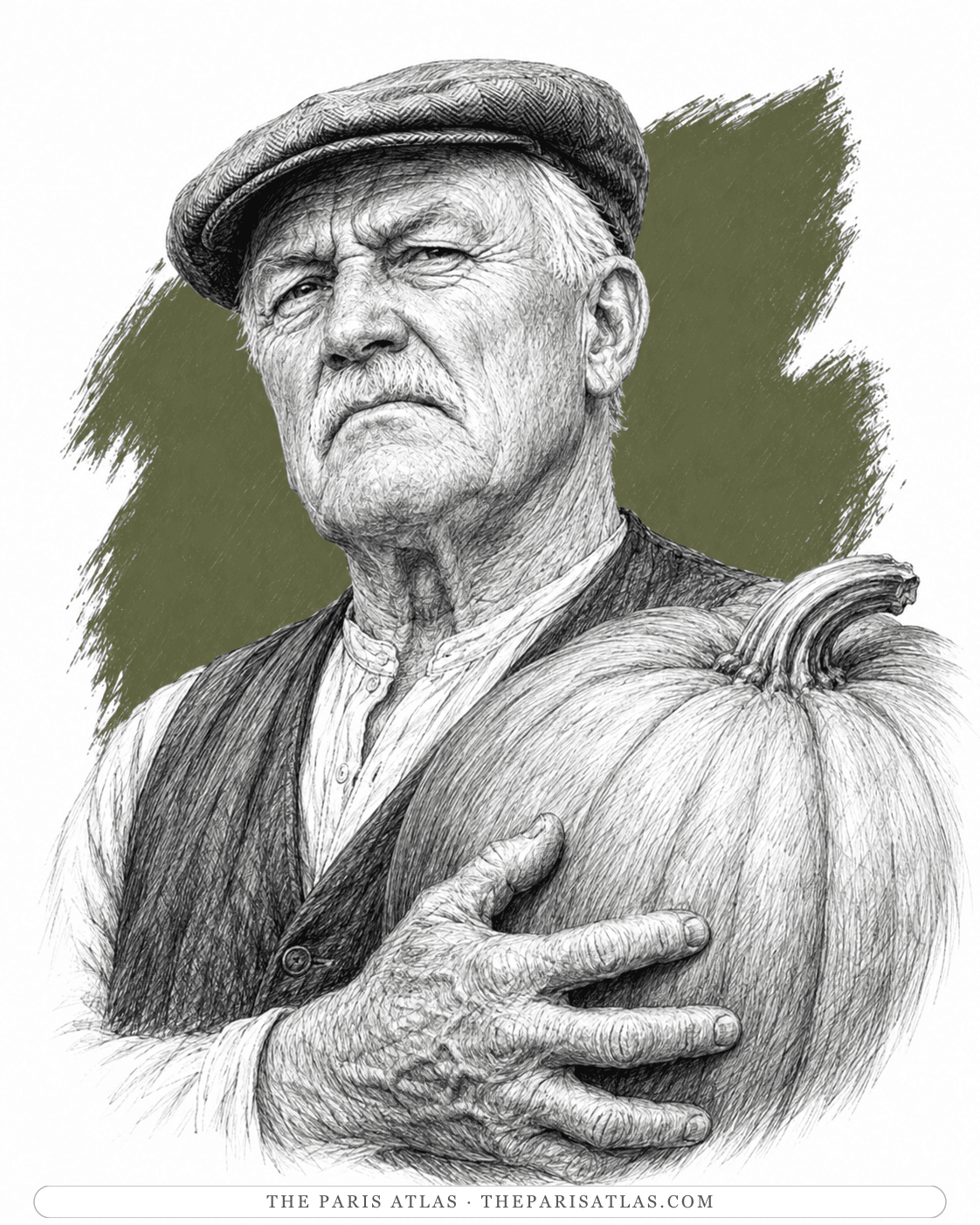
Mr Toagis
A surly retired market gardener whose attachment to the Church rested entirely on the privilege of decorating a window at the Harvest Festival. He grew a monstrous pumpkin for it, was in raptures over it, could not tear himself away and kept bringing friends to admire it, and when it was removed he went over to chapel, taking his heirs with him for ever.
To have his vegetables displayed in the church at Harvest Festival. It is the one thing that keeps him in the congregation, and he loses interest in the Church the moment it is taken away.
The book

At a glance
- A parishioner of St Athelstan's, Knype Hill
- Market gardener, retired
- Giant marrows, and one very large red pumpkin
- In one passage, after the fact; he never appears in a scene
- Chapter 1
Who they are in the book
Spoiler-freeMr Toagis is a character in A Clergyman's Daughter, the 1935 novel by George Orwell. He is a retired market gardener in Knype Hill, the small Suffolk town where the book opens, and he was a parishioner of St Athelstan's, the church run by the Reverend Charles Hare, father of the book's central character, Dorothy Hare.
He never appears on the page. The whole of his story is told in one short passage in the first chapter, as an example of the damage the Rector does by being unable to hide his contempt for parish life. Dorothy raises the Harvest Festival at breakfast, her father says he is not a greengrocer and does not enjoy preaching among festoons of runner beans, and the story of Mr Toagis follows as the thing that came of that attitude.
By instinct he belonged in a Nonconformist chapel, and George Orwell says as much in Latin -- anima naturaliter Nonconformistica, a naturally Nonconformist soul. What kept him in the Church of England was one annual privilege: at Harvest Festival he was allowed to dress the side altar with his own produce, which he did with a sort of Stonehenge of giant vegetable marrows.
How Mr Toagis Is Portrayed
- What he wasA retired market gardener, described in one word as surly, and counted by the Rector as a valuable parishioner -- meaning one who paid.
- What kept him in the churchThe right to decorate the side altar at Harvest Festival. He built a sort of Stonehenge out of gigantic vegetable marrows. Nothing else about the Church of England held him.
- The pumpkinThe previous summer he grew a fiery red pumpkin so enormous that it took two men to lift it. It was set down in the chancel, where it dwarfed the altar and took all the colour out of the east window. Wherever in the church you stood, it hit you in the eye.
- How he behaved about itHe was in raptures. He hung about the church at all hours, unable to tear himself away, and brought relays of friends in to admire it. George Orwell writes that from the look on his face you would have thought he was reciting Wordsworth's sonnet on Westminster Bridge, and prints three lines of it.
- What Dorothy hopedThat the pumpkin might be the way in. After it she had hopes of getting him to come to Holy Communion.
- What ended itThe Rector saw the pumpkin, was seriously angry, and ordered that revolting thing removed at once. Mr Toagis went chapel immediately, and he and his heirs were lost to the church for ever.
If you like A Clergyman's Daughter


If you like George Orwell
Explore authors with a similar voice, perspective, and influence.

Henry Miller
The Brooklyn dropout who arrived in Paris broke at thirty-eight and wrote the exuberant, banned books that ended American censorship.
View author
Louis-Ferdinand Céline
The doctor of the Paris slums who wrote the century's blackest, funniest novel — and changed the sound of French prose.
View author
Simone de Beauvoir
French writer and philosopher whose novels, memoirs, and social analysis examined freedom, gender, responsibility, aging, and the material conditions that shape a life.
View author