Mr Tallboys
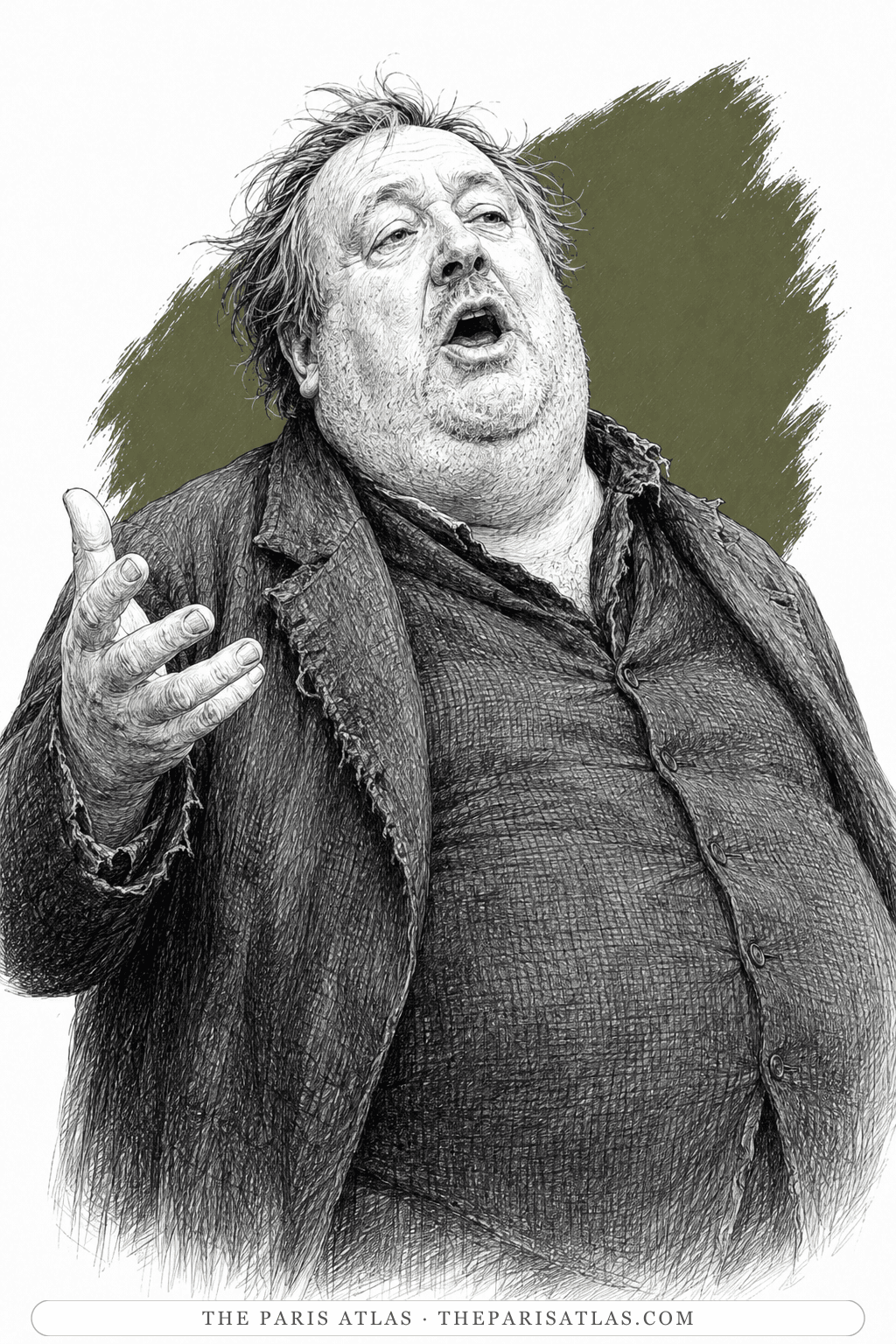
An unfrocked clergyman on the benches of Trafalgar Square, and the loudest voice in the chapter Orwell wrote as a play. He spends the night reciting the liturgy backwards and remembering his rectory.
To be heard performing again. He tells the bench that for preaching, chanting and intoning he was unrivalled, that his "Lift up your Hearts" was renowned throughout the diocese, and that he could do all styles: High Church, Low Church, Broad Church and No Church.
The book

At a glance
- Chapter 3 only, on the benches in Trafalgar Square
- Rector of Little Fawley-cum-Dewsbury; a Canon, and in Crockford
- Publicly, by the bishop of his diocese, after a newspaper scandal
Who they are in the book
Spoiler-freeMr Tallboys appears only in Chapter 3, the night in Trafalgar Square that George Orwell set out as a script. He was Rector of Little Fawley-cum-Dewsbury and a Canon marked out for preferment, and he lost it all in a scandal that reached the Sunday papers. He is a very fat man now, too fat to feel the cold according to Mrs Bendigo, and he is the only one on that stretch of pavement who never sits down.
What he does instead is talk, in two alternating registers. One is a litany of what he has lost, delivered to himself: the ivied church under the hillside, the red-tiled rectory, the cook and house-parlourmaid and groom-gardener, the cash in the bank, the name in Crockford, the twenty-one bottles of Clos St Jacques 1911 still in the cellar the night he left for London on the milk train. The other is the Book of Common Prayer turned inside out. He is the chapter's engine, and he is the reason the chapter is either the best or the worst thing in the novel, depending on the reader.
How Mr Tallboys Is Portrayed
- His bulkGeorge Orwell gives him a vast swag belly and marches him up and down behind it, pretending to carry a banner or a crozier in front of him. One of the others on the bench says he is too fat to feel the cold.
- How he speaksThe stage direction is that he speaks from the roof of his mouth, stage curate-wise. He strikes attitudes while he does it, and marches behind an imaginary drum when he sings.
- The clothes he remembersThe chapter never says what he is wearing in the Square. The black suit of irreproachable cut, the collar worn back to front and the watered silk cassock belong to the rectory he has lost; the grey flannel suit and the speckled straw hat belong to his days as a curate. He recites them all from the bench.
- Still a priestAsked whether he used to be a clergyman, he corrects the tense: after the order of Melchizedec, there is no question of used to be. Once a priest always a priest, even though unfrocked, or as he puts it un-Crocked, with the dog-collar publicly torn off by the bishop of the diocese.
- The Benedicite reversedAll night he chants the canticle backwards. "O all ye works of the Lord, curse ye the Lord, curse Him and vilify Him for ever!" Later he adds the marching hymn: "All things vile and damnable, all creatures great and small."
- How he came downAsked the usual question about choirgirls, he objects to the word girls. Only, he says, the usual flannel-bloomered hunters of the unmarried clergy: church hens, altar-dressers and brass-polishers. He notes that Pippin's Weekly made quite a feature of the case, under the headline "Missing Canon's Sub Rosa Romance", and that John Bull ran an open letter to a skunk in shepherd's clothing.
- The Black MassAt about half past one, with the others piled on the bench for warmth, he offers to work the miracle if somebody will hand him a chunk of bread: sulphur candles, the Lord's Prayer backwards, the crucifix upside down. He gets through most of it, and the chapter briefly stops being realistic at all.
- A title, a year earlyAmong the songs he throws out is "Keep the aspidistra flying", sung to the tune of "Deutschland, Deutschland uber alles". Orwell's next novel, published in 1936, took the line as its title.
- What he stops forOnly exhaustion. Towards three in the morning his monologue degenerates into a stream of nonsense and he drops his bulk on top of the others, almost suffocating them. By five he is singing "The roseate hu-ues of early da-awn" in the queue outside Wilkins's cafe.
- What Dorothy takes awayOn the last page of the book, working out that she cannot know God's purpose and might not like it if she did, she remembers him: "Therefore with Demons and Archdemons and with all the company of Hell." She is not sure whether she dreamed it.
Mr Tallboys quotes
Once a priest always a priest.
If you like A Clergyman's Daughter


If you like George Orwell
Explore authors with a similar voice, perspective, and influence.

Henry Miller
The Brooklyn dropout who arrived in Paris broke at thirty-eight and wrote the exuberant, banned books that ended American censorship.
View author
Louis-Ferdinand Céline
The doctor of the Paris slums who wrote the century's blackest, funniest novel — and changed the sound of French prose.
View author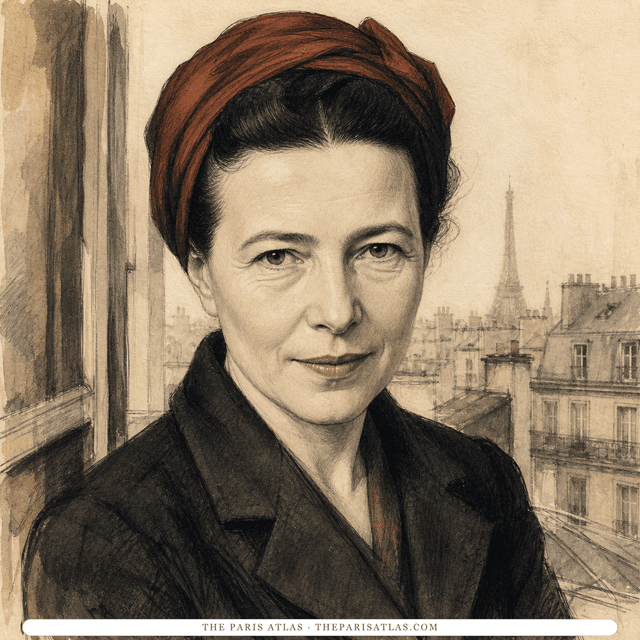
Simone de Beauvoir
French writer and philosopher whose novels, memoirs, and social analysis examined freedom, gender, responsibility, aging, and the material conditions that shape a life.
View author