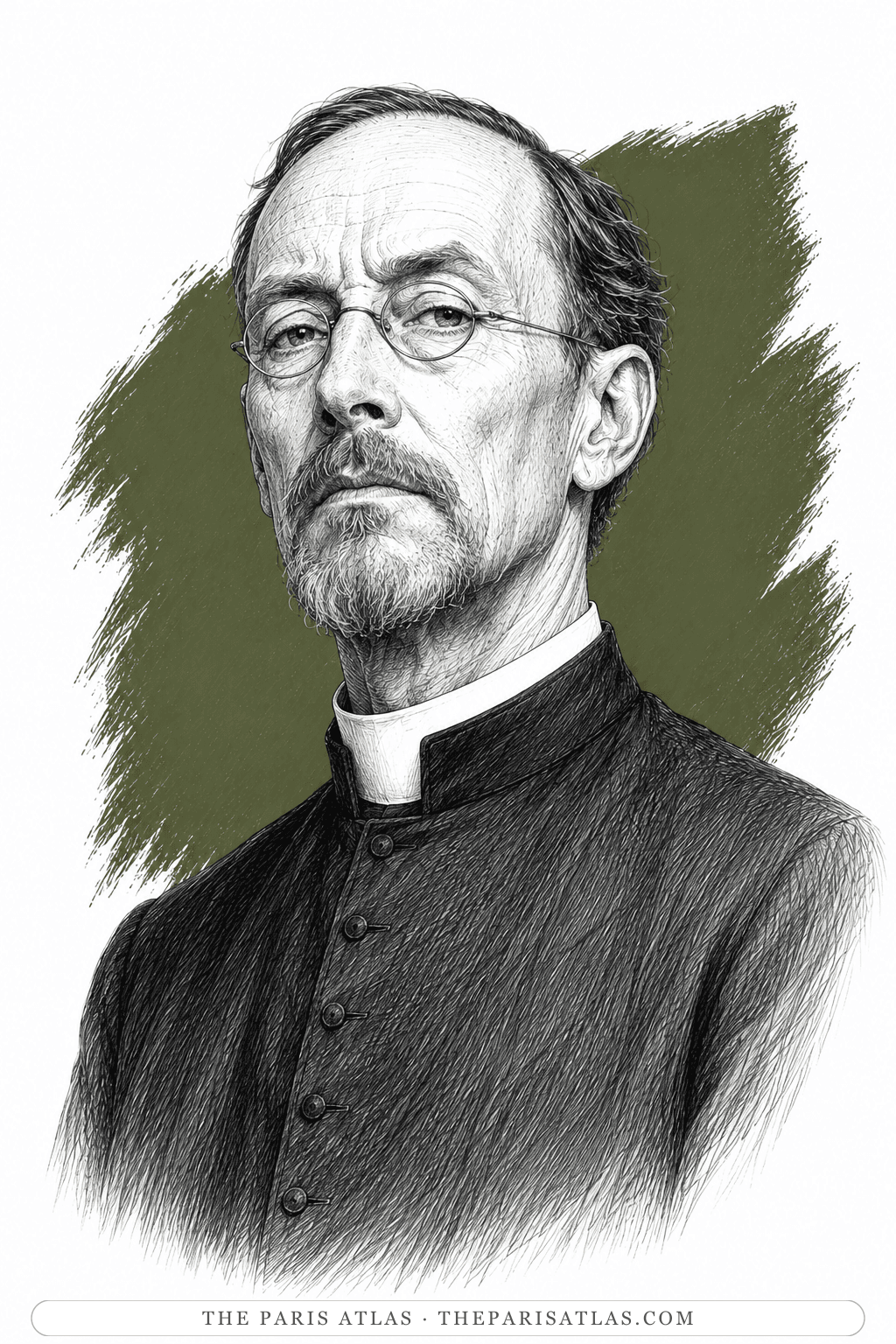
The Reverend Charles Hare
Rector of St Athelstan's, Knype Hill, and Dorothy's father. Scrupulous inside the church and entirely absent outside it. He loses money in shares he does not understand, ignores the bills, and has reduced his congregation from six hundred to under two hundred.
To be left alone in a golden past. Pressed about the debts he begins talking about his cousin Tom the baronet, who owed seven thousand before he came into his money, and about his own Oxford days, when a gentleman's bills could go thirty years unpaid.
The book

At a glance
- Rector of St Athelstan's, Knype Hill, Suffolk, and Dorothy's father
- 1871, younger son of the younger son of a baronet
- 1908, when he was thirty-seven
- 1921
- Six hundred when he arrived, under two hundred twenty-three years later
- Four thousand pounds inherited, about twelve hundred left
- His cousin Tom, Sir Thomas Hare, Bt, not spoken to for fifteen years
Who they are in the book
Spoiler-freeThe Reverend Charles Hare was born in 1871, the younger son of the younger son of a baronet, and went into the Church for the outmoded reason that the Church was the traditional profession for younger sons. His first cure was a slum parish in East London, which he remembers with loathing; then a village in Kent, where Dorothy was born and where the villagers still touched their hats. He married there, unhappily, and because clergymen must not quarrel with their wives the unhappiness stayed secret and got worse. He came to Knype Hill in 1908, aged thirty-seven, with a temper already soured. His wife died in 1921. In twenty-three years he has reduced the congregation of St Athelstan's from six hundred to something under two hundred.
George Orwell offers a single explanation for him and does not soften it: he is an anachronism. He ought never to have been born into the modern world, and a couple of centuries earlier he would have been perfectly happy as a pluralist writing poems or collecting fossils while curates at forty pounds a year ran his parishes for him. Living in past ages is expensive, though, and he cannot afford it, so he is tethered to the age of Lenin and the Daily Mail in a state of chronic exasperation which he works off on whoever is nearest. That is usually Dorothy.
As a priest, strictly speaking, he is beyond criticism. He conducts his services with perfect taste, preaches admirable sermons, gets up at uncomfortable hours to celebrate Holy Communion every Wednesday and Friday, and if a labourer's baby were dying he would walk twenty miles through snow to baptize it. What has never seriously occurred to him is that a clergyman has any duties outside the four walls of the church. Unable to afford a curate, he left the dirty work of the parish to his wife, and after her death to his daughter.
How The Reverend Charles Hare Is Portrayed
- His faceHis hair is as white and thick as thistledown, and the face under it is fastidious and aged, as pale as a silver coin, wearing an expression of aloofness and almost of contempt. One dark bright eye glances irritably over his shoulder at Dorothy. When he has decided to say nothing further, George Orwell compares him to an exceptionally aloof and unhelpful sphinx. Until his false teeth are in, his voice sounds muffled and senile.
- What he wearsCassock and short linen surplice at the seven o'clock service, and at breakfast afterwards a cassock of black watered silk, which Orwell says sets off his thick white hair and his pale, fine, none too amiable face. One other vestment reaches the book through the schoolmaster's complaints: a Gothic cope worn with a modern Italian lace alb on Easter Sunday.
- His handsShapely and aged. He holds the communion wafer out between finger and thumb, fastidiously and somehow distastefully, as though it were a spoonful of medicine.
- Twelve minutes lateHe draws out his gold watch and scrutinizes it as Dorothy comes in to breakfast, then repeats her apology back to her with delicate emphasis. Orwell describes one of those weary, cultivated voices that are never definitely angry and never anywhere near good humour.
- The investmentsHe inherited four thousand pounds on coming of age and has reduced it to about twelve hundred, feeding another fifty a year into the same machine. On the morning the book opens his Sumatra Tin has fallen from seven and fourpence to six and a penny, a loss of nearly sixty pounds, and his answer is to sell out at once and buy five hundred United Celanese. Orwell calls him an inveterate gambler who does not think of it as gambling.
- The baconThree minute rashers on squares of fried bread, turned over with a delicate movement as though he were playing at spillikins. He observes that bacon for breakfast is an English institution almost as old as parliamentary government, wonders aloud whether the Danes have killed more Englishmen with fire and sword or with their cheap bacon, and eats a fairly good breakfast off it.
- Luncheon, not dinnerHe corrects Dorothy sharply for what he calls the abominable lower-class habit of calling the midday meal dinner. Since the evening meal cannot honestly be called anything but supper, there is no such meal as dinner at the Rectory.
- The dying babyThe maid comes in to say that a bricklayer's baby is turning black and has not been baptized. The Rector's objection is to hearing disgusting details while he is eating his breakfast, and to Dorothy proposing to leave the table at the call of a common bricklayer. He sends word that he will be round at twelve, and he goes.
- The belfrySeven bells have lain on the belfry floor for three years, slowly splintering it, because reswinging or removing them would cost twenty-five pounds. Proggett the sexton reports on them roughly once a fortnight. The Rector's position: "Belfry's held up five hundred years; we can trust it to hold up a few years longer."
- On being owedHe is never so unmoved as when he is being reminded that he is up to his eyes in debt. Tradesmen expect to be kept waiting, he explains, and they like it, because it brings them more in the end. Told that the butcher is short with Dorothy in the shop, he calls the fellow's behaviour abominable and advises taking the account elsewhere.
- Roman FeverHis name for the Anglo-Catholic movement, for which he has the deepest contempt. He is simultaneously too High for his own congregation, whom he frightens by using the word Catholic from the pulpit, and too plain for the schoolmaster who wants processions and incense. Orwell's summary is that his brand of churchmanship annoyed every party in the parish about equally.
- The morning she vanishedHis first emotion on learning that Dorothy had gone was rage, and the outrage he could not get past was that he had to prepare his own breakfast, with a vulgar black kettle and rashers of Danish bacon, with his own sacerdotal hands. Orwell says his heart was hardened against her for ever after that.
If you like A Clergyman's Daughter


If you like George Orwell
Explore authors with a similar voice, perspective, and influence.

Henry Miller
The Brooklyn dropout who arrived in Paris broke at thirty-eight and wrote the exuberant, banned books that ended American censorship.
View author
Louis-Ferdinand Céline
The doctor of the Paris slums who wrote the century's blackest, funniest novel — and changed the sound of French prose.
View author
Simone de Beauvoir
French writer and philosopher whose novels, memoirs, and social analysis examined freedom, gender, responsibility, aging, and the material conditions that shape a life.
View author