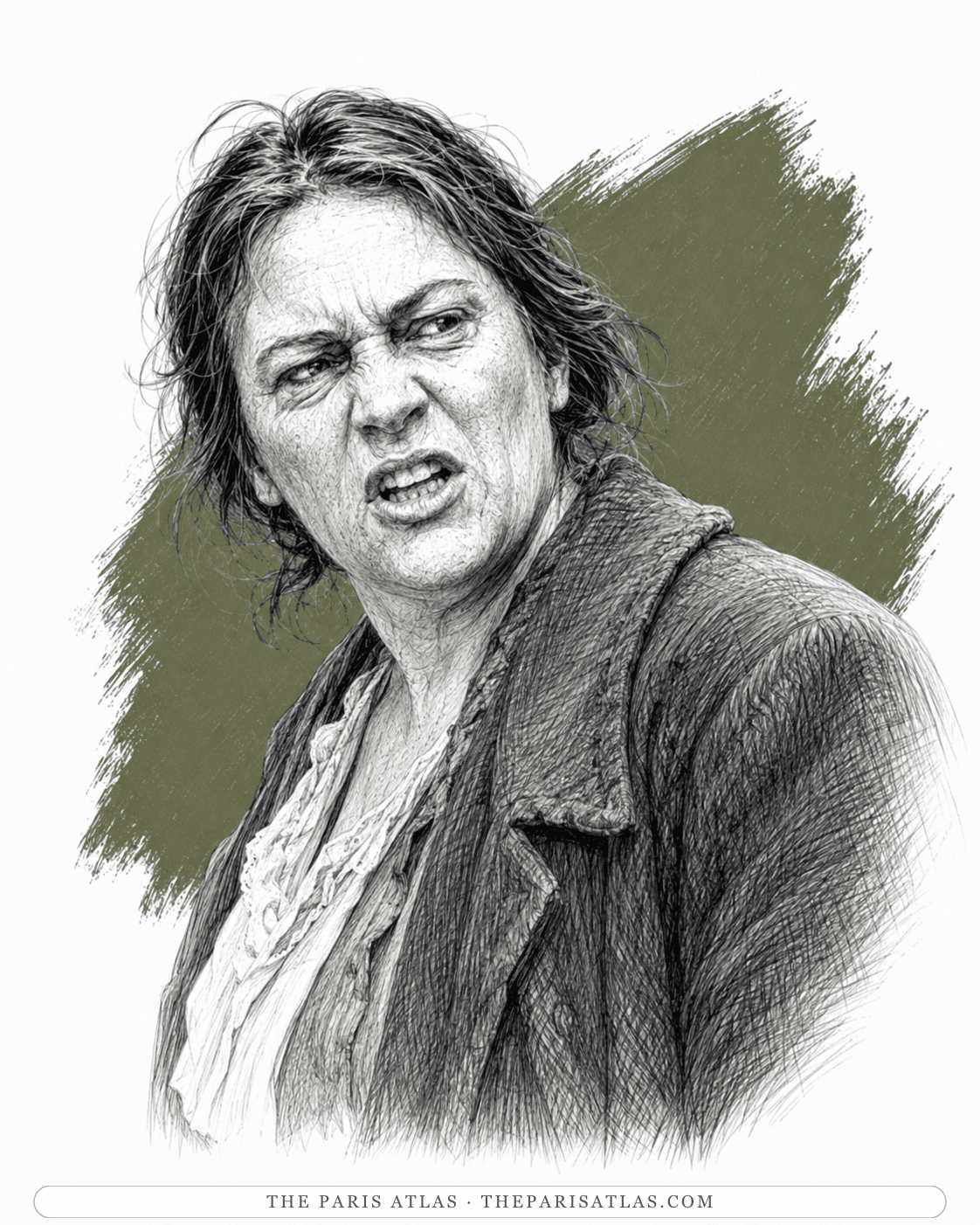
Mrs Bendigo
One of the women on the Square, and the angriest voice in the chapter. Her husband earns four pounds a week in Covent Garden and sleeps warm while she is out in the cold, and she swears at him in most of her sentences. She was put out in a hurry and has not even got her drawers on, complains about people sitting on her bad leg, and has no patience with the prostitutes or with Dorothy Hare. She will not go up to Covent Garden in the morning: one black eye in a week is enough for her.
The book

At a glance
- One of the women on Trafalgar Square through the night chapter
- To a Covent Garden porter earning four pounds a week
- He put her out for the night
- Chapter 3
Who they are in the book
Spoiler-freeMrs Bendigo is one of the four women on the benches in Trafalgar Square through the third chapter of the book, which George Orwell sets out as a play across a single freezing October night. She speaks more often than anyone in it except Charlie and the unfrocked clergyman Mr Tallboys, and she is the loudest voice on the bench.
She is the only person there who has a home. Her husband earns four pounds a week portering in Covent Garden and is asleep under four blankets a mile away. He put her out for the night in such a hurry that she has no drawers on, and she says so when the wind gets up. She is not tramping and not begging; she is out because he shut the door, and she expects to go back.
That gives her a standing she defends all night. She is a respectable married woman, and she says the words to a policeman's back. It is the ground she uses to keep the tramps off her shoulder, to sit in judgement on the young prostitutes who come over for the tea, and to tell Dorothy Hare -- who by this point in the book has lost her memory, her name and her money -- to drop her Buckingham Palace manners.
She also bought the sugar, which is more than most of the bench did, and she says so when it is passed around too freely.
How Mrs Bendigo Is Portrayed
- The word husbandShe uses it as a charge rather than a description, twice in the first minutes of the chapter and once on its own, which the edition prints in capitals. "Calls himself a bloody husband, does he? Four pound a week in Covent Garden and 'is wife doing a starry in the bloody Square!"
- The four blanketsWhat she says gets her down, and she names it as such: "to think of my bloody husband snoring under four blankets and me freezing in this bloody Square. That's what I can't stomach." At quarter to five she works out that he will be having haddock for his breakfast, and hopes it chokes him.
- What she says she will do about itShe has told him to his face what she thinks of him -- "Call yourself a man? I've seen things like you kep' in a bottle at the 'orspital" -- and believes he had another wife living when he married her. Her plan is to wait until he is drunk on Saturday night and cannot hit back, and then take the flat-iron to him. She adds that there are women who, if they had stood what she has stood, would have put spirits of salts in his tea.
- Her own limitGinger proposes that they all walk up to Covent Garden in the morning to beg fruit. Mrs Bendigo will not go, and gives the reason without any softening: "No fear! Not while my bloody husband's there. One black eye in a week's enough for me, thank you." Later she says that if she had her time over again she would marry for money.
- The benchShe polices it. Daddy, who is fifty years on the road, is told to shove up because she does not want his lousy old head on her shoulder, and told again when he sits on her packet of sugar. She has a bad leg and objects to people lying across it -- "What you think I am? Bloody drawing-room sofa?" -- and she suspects some people of having taken a mortgage on the seat.
- The policemanHe shakes her awake and calls her mother. "Mother? MOTHER, is it? Well, if I am a mother, thank God I ain't got a bloody son like you! And I'll tell you another little secret, constable. Next time I want a man's fat 'ands feeling round the back of my neck, I won't ask YOU to do it. I'll 'ave someone with a bit more sex-appeal." She shouts after him to go and find some cat burglars instead of nosing round a respectable married woman.
- A cut aboveThe same constable tells Dorothy Hare she can come to a bed at the Metropolitan Asylums Board, since anyone can see with half an eye that she is a cut above the others there. Mrs Bendigo thanks him for it in front of everyone and repeats the phrase back until it is unusable.
- What she makes of DorothyNothing, for most of the night. "Oh, cheese it! I 'ate these snivelling tarts." Told that the tin of milk says it is not fit for babies, she says Dorothy is not a baby and can drop her Buckingham Palace manners. At five in the morning, when Dorothy looks round at the state of them all, she gets the reply that she is no Greta Garbo herself, if Mrs Bendigo may mention it.
- The kippersHer last speech, delivered furiously with an accusing finger following the dish across the coffee shop. The girls who spent part of the night in bed are eating kippers as fast as they can be turned out of the pan, and her own table has one cup of tea between four and is lucky to get that.
- The oathIn nearly every sentence she speaks, and mostly the same one. It is the only thing about her the printed page insists on, since the chapter gives her no face, age or dress.
If you like A Clergyman's Daughter


If you like George Orwell
Explore authors with a similar voice, perspective, and influence.

Henry Miller
The Brooklyn dropout who arrived in Paris broke at thirty-eight and wrote the exuberant, banned books that ended American censorship.
View author
Louis-Ferdinand Céline
The doctor of the Paris slums who wrote the century's blackest, funniest novel — and changed the sound of French prose.
View author
Simone de Beauvoir
French writer and philosopher whose novels, memoirs, and social analysis examined freedom, gender, responsibility, aging, and the material conditions that shape a life.
View author