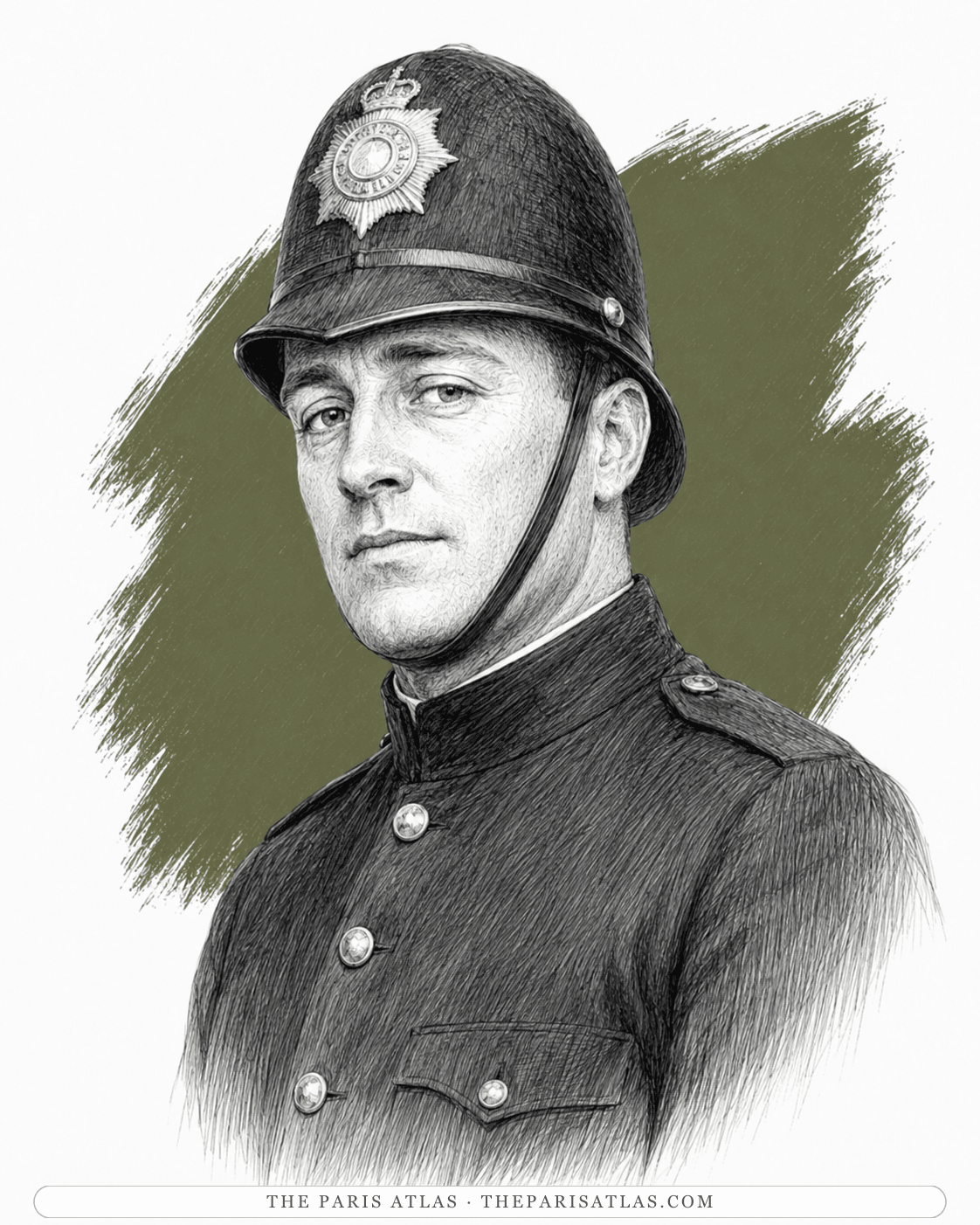
The policeman on the Square
A constable works along the benches until midnight, shaking people awake because sleeping on the Square is not allowed and Trafalgar Square is not a common lodging house. A new one comes on duty after that, and he is the one unexpectedly kind to Dorothy Hare, offering to take her down to the shelter run by the Metropolitan Asylums Board, which he calls the M.A.B., and telling her that anyone can see with half an eye that she is a cut above the others there.
The book

At a glance
- The constable working Trafalgar Square through the night chapter
- One until midnight, a second after it
- The rule against sleeping on the Square
- A bed at the Metropolitan Asylums Board
- Chapter 3
Who they are in the book
Spoiler-freeThe policeman is a character in A Clergyman's Daughter, the 1935 novel by George Orwell. He works the beat around Trafalgar Square in London through the night that makes up the book's third chapter, which George Orwell writes as a play script: a dozen homeless people are grouped around a bench, their lines are printed as stage dialogue, and the policeman comes and goes as one more speaking part. Dorothy Hare, the rector's daughter of the title, is one of the people on the bench.
His job that night is to keep anyone from actually sleeping. Sitting on the Square is legal and sleeping on it is not, so he walks the benches shaking people by the shoulder and telling them to go home, to people who have no home. Nobody argues the point with him. Mrs Bendigo swears at him, Snouter swears at his back, and the rest simply sit up until he has gone past and then lie down again.
The book is careful that this is not one man. A constable works the Square until midnight, when a new one comes on duty; and the tone changes with the shift. The first is the one Mrs Bendigo calls a nosy young sod who wants promotion. The second walks through every half hour, and it is he who wakes Dorothy at four in the morning and offers to take her somewhere she can sleep.
How The policeman on the Square Is Portrayed
- What he says down the row of benches"Now then, wake up, wake up! Rouse up, you! Got to go home if you want to sleep. This isn't a common lodging house." He says it to every bench in turn, and starts again at the far end.
- The hymnCharlie sings Jesu, lover of my soul to keep himself warm. The constable's response is "Now then, YOU! What you think THIS is? Baptist prayer meeting?" Charlie says he cannot help it, sergeant, it is his tuneful nature.
- How he answers abuseMrs Bendigo tells him that if she ever wants a man's fat hands round the back of her neck she will ask someone with more sex appeal. He replies, "Now then, now then! No call to get abusive, you know. We got our orders to carry out," and walks off. George Orwell's stage direction is that he exits majestically.
- The verdict on himMrs Bendigo's, delivered as soon as his back is turned: "It's that nosy young sod as wants promotion. Wouldn't let you bloody breathe if 'e 'ad 'is way." She then shouts after him to go and find some cat burglars instead.
- The midnight reliefA new policeman comes on duty at midnight and strolls through the Square every half hour, looking at the faces of the sleepers and leaving them alone once he has satisfied himself that they are asleep and not dead.
- Stopping the singingThe whole bench is stamping and clapping to a music-hall song when he appears at the eastern end of the Square and the noise stops dead. "D'you think this is the time of night to begin singing like a blooming bear garden? I shall have to send you back to your homes if you can't keep quiet."
- The offer to DorothyHe shakes her by the shoulder at four in the morning: "Wake up, now, wake up, wake up! Haven't you got an overcoat? You're as white as death." He tells her to come down to the Metropolitan Asylums Board with him for a bed, because anyone can see with half an eye that she is a cut above the others there. She refuses. "Well, please yourself. You looked real bad just now. I'll be along later and take a look at you," and he moves off doubtfully.
- The truce at threeBetween three and five in the morning the police customarily leave the Square sleepers alone, which is the only stretch of the night in which anyone gets more than a few minutes at a time.
- The fire in Chandos StreetGinger and Charlie fill two tins at the fountains and go off hoping to boil tea on a road gang's clinker fire. A policeman is already warming himself at it, and orders them away.
If you like A Clergyman's Daughter


If you like George Orwell
Explore authors with a similar voice, perspective, and influence.

Henry Miller
The Brooklyn dropout who arrived in Paris broke at thirty-eight and wrote the exuberant, banned books that ended American censorship.
View author
Louis-Ferdinand Céline
The doctor of the Paris slums who wrote the century's blackest, funniest novel — and changed the sound of French prose.
View author
Simone de Beauvoir
French writer and philosopher whose novels, memoirs, and social analysis examined freedom, gender, responsibility, aging, and the material conditions that shape a life.
View author