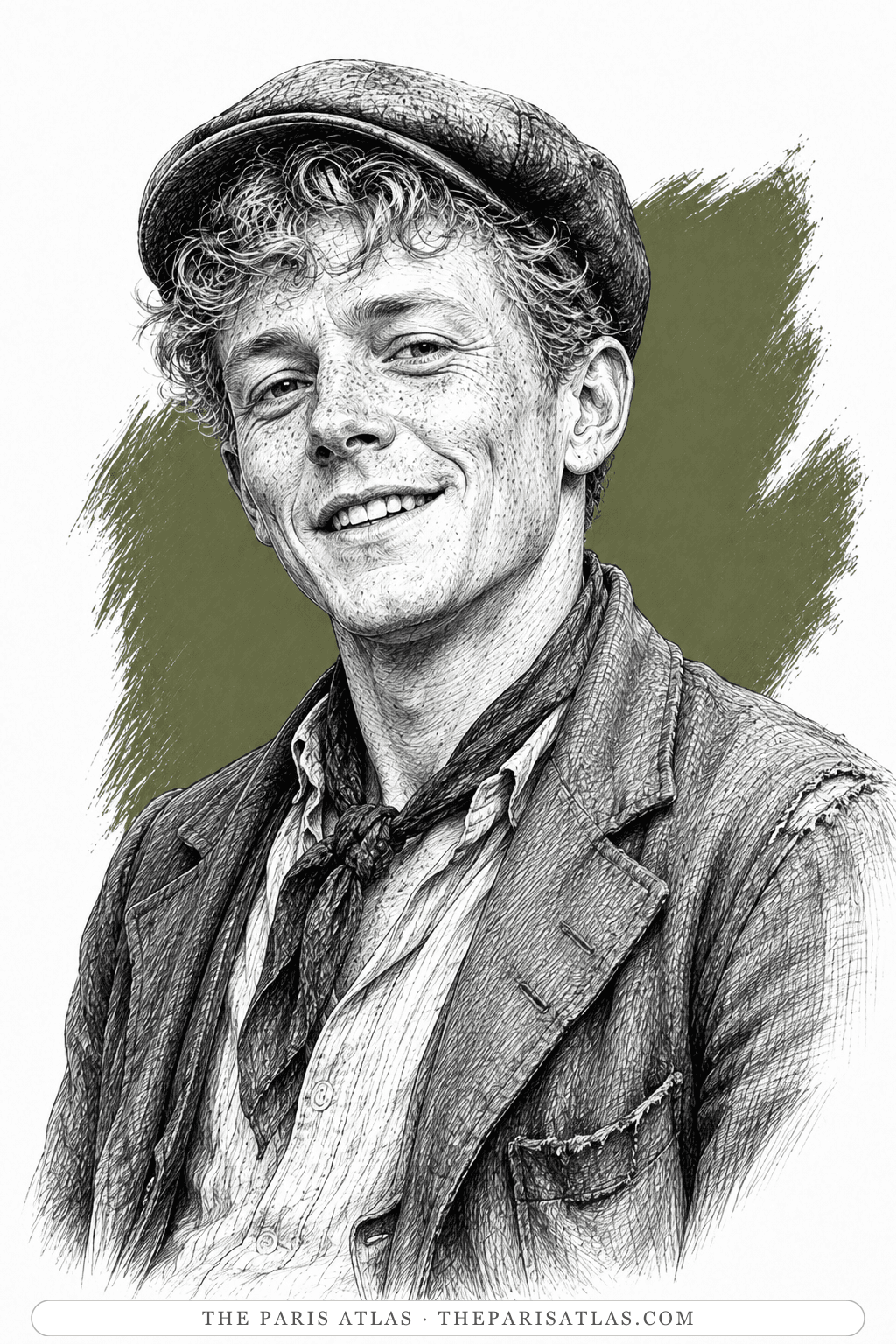
Nobby
The tramp who picks Dorothy up in the New Kent Road and takes her hop-picking. Twenty-six, orange-haired, a burglar with four convictions, and the most cheerful person in the book. He lies to her within a minute of meeting her and looks after her for six weeks.
To keep moving, and to eat. He is the only one of the four who never complains, and his answer to any setback is a can of tea, another orchard, and a round stone to hammer the nail in his boot back down with.
The book

At a glance
- Dorothy's companion from the New Kent Road to the hop camp
- Twenty-six
- The Deptford gutters
- Newspaper seller, petty thief, Borstal boy, soldier, burglar, tramp
- A widower; his wife died at eighteen in childbirth
- Four, by the time the hop camp hears about them
- About ten shillings a week, pooled with Dorothy's and split
Who they are in the book
Spoiler-freeNobby is twenty-six, squat, nimble and powerful, with a snub nose, a clear pink skin, huge lips and a mat of orange hair cropped short and growing low on his head, which George Orwell says gives him a startling resemblance to an orang-outang. He moves with a gambolling, apelike gait and grins so widely that it is impossible not to smile back. He is a widower; his wife died at eighteen in childbirth when he was twenty. He grew up in the Deptford gutters and has been in turn a seller of newspapers, a petty thief, a Borstal boy, a soldier, a burglar and a tramp. Six months in a line regiment ended with a damaged eye and a discharge. His best night's work was the safe at Woodward's boot and shoe factory, opened with nitro-glycerine, which brought him a hundred and twenty-five pounds; he spent it in three weeks.
None of this arrives as a life story. Orwell notes that Nobby was not equal to giving a consecutive account of himself, and that the facts have to be pieced together from casual picturesque memories dropped into conversation: the loathsomeness of the skilly in Holloway, the suppleness of the Borstal canes, the dull boom of the charge going off.
He is also the reason Dorothy survives her first weeks with no memory. He carries the bundles, does the stealing, does the shopping, gets a fire going and a can of tea boiled in any weather, and shares whatever he has. He tries to make love to her early on, and when she repulses him he bears her no grudge whatever, having the sort of temperament that cannot take its own reverses seriously. Everyone in the hop camp assumes he is her lover, which is why they are kind to her afterwards.
How Nobby Is Portrayed
- The face up closeThe huge coarse lips open on strong yellow teeth. Instead of stubble the chin carries barely a dozen red-gold hairs, glittering like snippings of copper wire. His hands are great and coarse, and they make him a clumsy picker once he gets to the hop garden.
- What he wears"He was frankly ragged" is the whole of the itemisation the book gives. One afternoon in the hop camp he walks about bare to the waist while his shirt dries.
- The lie that starts everythingHe tells Dorothy there is a job waiting for them at Blessington's farm, Lower Molesworth, thirty-five miles away, and that four to a bin is the best picking. There is no job and no promise. He confesses it quite light-heartedly a day or two later: he invented it to get her to come.
- The half-crownThe moment she agrees, he takes the coin gently out of her hand and slides it into his own pocket, explaining that it is in case she should lose it. It is gone within a few hours and they beg for everything after that.
- The nailA nail works up through the sole of his boot on the second day out. By the third it has worn a permanent hole in his foot and his sock is dark with blood, and he stops once a mile, squats in the ditch, finds a round stone and hammers it flat. "There! THAT b--'s in his grave!" Orwell notes that the epitaph should have been Resurgam.
- The teaThere was no weather so bad that Nobby could not produce a can of tea. He carries pieces of old motor tyre that will flare when the wood is wet, and possesses the art, known to only a few tramps, of getting water to boil over a candle.
- The cottage loafHe always buys a cottage loaf in preference to any other shape, on the grounds that it seems like two loaves when you tear it in half. He can also get fourpennyworth of meat out of a butcher for twopence.
- Thieving as a professionHis boast is that he will steal anything not tied down, and it nearly lands the whole party in prison more than once; a goose gets away from him only because it makes a noise. In the hop camp he collects a gang of youths who look up to him because he is a real burglar who has been in jail four times, and brings back as much as two hundredweight of fruit a night.
- The singingThree songs on rotation, in a lusty baritone: "Sonny Boy", "'Twas Christmas Day in the Workhouse" sung to the tune of "The Church's One Foundation", and a military number whose only recorded words are "And the same to you!", given with spirited imitations of a marching band.
- How he sleepsOn the bare ground with no sack, as peacefully as a child, while the others shiver. Orwell says his coarse, simian face never lost its warm pink colour, and that he was one of those red-haired people who seem to glow with an inner radiance that warms the surrounding air.
If you like A Clergyman's Daughter


If you like George Orwell
Explore authors with a similar voice, perspective, and influence.

Henry Miller
The Brooklyn dropout who arrived in Paris broke at thirty-eight and wrote the exuberant, banned books that ended American censorship.
View author
Louis-Ferdinand Céline
The doctor of the Paris slums who wrote the century's blackest, funniest novel — and changed the sound of French prose.
View author
Simone de Beauvoir
French writer and philosopher whose novels, memoirs, and social analysis examined freedom, gender, responsibility, aging, and the material conditions that shape a life.
View author