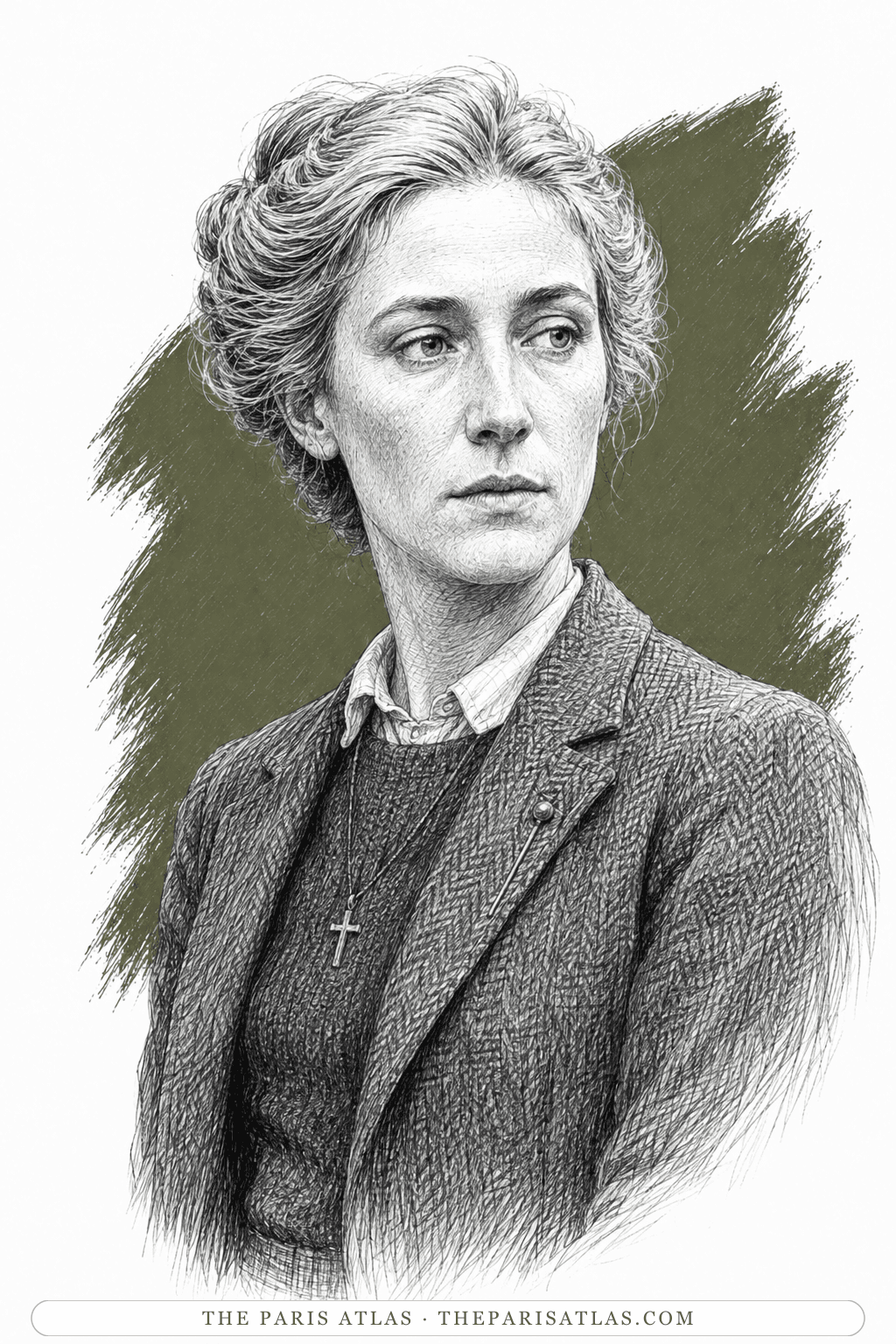
Dorothy Hare
The clergyman's daughter of the title. Twenty-eight, the only child of the Rector of St Athelstan's in Knype Hill, and effectively the unpaid curate of his parish. She keeps a memo list, takes cold baths on principle, and carries a pin in her lapel to punish herself with when her attention wanders at prayer.
To be of use, and to be able to pray. Both are on the list she writes out every night, and when the second one fails her on a Kentish road she carries on with the first because it is the only thing she knows how to do.
The book

At a glance
- The narrator's subject throughout; every chapter is hers
- Not quite twenty-eight
- Only child of the Reverend Charles Hare; her mother died in 1921. Born in Kent
- The Rectory, Knype Hill, Suffolk
- Unpaid parish worker: visiting, Girl Guides, three church leagues, the accounts, the costumes
- Eighteen pounds a month, including the maid's wages
- Ellen Millborough, after her father's maid and a town in Suffolk
- One pound and fourpence for the season, plus fivepence for adding up other pickers' tally books
- Ten shillings a week and her keep; six pounds for twelve weeks and five days
Who they are in the book
Spoiler-freeDorothy Hare is not quite twenty-eight when the book opens, and strangers take her for younger because of the childish earnestness in her eyes. George Orwell describes a girl of middle height, rather thin but strong, with thick, fine, exceedingly pale hair that her father has forbidden her to bob, a thin blonde face, pale eyes and a nose a shade too long. There are crow's feet already. Her left forearm is spotted with tiny red marks like insect bites, and the book explains them within a few pages.
She is the only child of the Reverend Charles Hare, Rector of St Athelstan's in Knype Hill, Suffolk, and she does everything in the parish that he does not regard as a clergyman's business, which is everything outside the four walls of the church. She visits between six and a dozen cottages a day on a bicycle, reads the Gospels aloud to housebound women and rubs embrocation into their legs, is captain of the Girl Guides and honorary secretary of three church leagues, types her father's sermons on a pre-Boer War machine, weeds the vegetable garden, and makes the costumes for the school plays out of glue and brown paper. She also runs the household on eighteen pounds a month and fields the tradesmen her father will not pay. Orwell calls it, in general, a seventeen-hour day.
The discipline she applies to herself is the thing the book keeps returning to. She takes all her baths cold from April to November precisely because she detests cold baths. She sets herself penances of no bacon for saying "Damn". She exhorts herself out loud in the second person with a scriptural reference attached: "Come on, Dorothy, up you get! No snoozing, please! Proverbs vi, 9." And she has made it a rule that whenever she catches herself not attending to her prayers she will drive a long glass-headed pin into her arm hard enough to draw blood. Nobody else in the book knows about the pin.
Then, on the night of 21 August, sitting up past midnight over the glue-pot, she stops being that person. She comes to eight days later in the New Kent Road with no memory, no money and no name, and the four chapters that follow put her in a hop camp, on the pavement in Trafalgar Square, in a police cell, and in a fourth-rate girls' school in a London suburb. Orwell is careful to say that she was already on the road to recovery when she was found, and that a photograph of her home or a few questions skilfully put would have brought her back within days. Nobody asked any.
How Dorothy Hare Is Portrayed
- Her hairThick, fine and exceedingly pale. Her father has forbidden her to bob it, and George Orwell says it is perhaps as well, because it is her only positive beauty. She twists it into a knot behind and sticks the hairpins in sketchily, and when they give way it falls over her collar-bones in two heavy strands.
- What she wears at Knype HillA grey jersey, a threadbare Irish tweed coat and skirt, stockings that do not quite match them, and much-worn brown shoes, thrown on in about three minutes with a plain gold cross round her neck. There is a tiny square of mirror in her room and she does not use it. After breakfast she changes into a sleeveless gingham frock for the parish round.
- The memo listShe reads it in the bath by candlelight, leaning over the side, waist deep in icy water. It runs from "7 oc. H.C." and "Mrs T baby? Must visit" through "BREAKFAST. Bacon. MUST ask father money. (P)" to "NB. to fork between peas bindweed awful". The (P) stands for penance.
- The pinA long glass-headed pin kept in her coat lapel. She drives it an eighth of an inch into her forearm whenever she catches herself not attending at prayer, and hardest of all when she finds herself hoping not to have to drink from the chalice after old Miss Mayfill. It is her one secret from everyone, and she decides at the end of the book to keep it that way.
- Cold bathsShe hates them, and takes all her baths cold from April to November for that reason. The alarm clock lives on the chest of drawers so that she has to get out of bed to silence it. The self-management is the point.
- Glue and brown paperShe makes the costumes for the church school plays herself, in a dilapidated conservatory that smells of glue and children. Breastplates from strips of brown paper pasted crosswise and painted with aluminium; a passable periwig from a paper skull-cap and dyed tow; and the pair of jackboots for Charles I that haunt her for days.
- What she calls "all that"Her horror of being touched by men, which she traces to scenes between her parents that she witnessed at nine and to some steel engravings of nymphs pursued by satyrs. She would gladly have married Francis Moon, a curate at St Wedekind's in Millborough who asked her more than once, and she refused him without ever telling him why. He died of pneumonia a year later.
- The clothes she wakes up inIn the New Kent Road she looks down at a shabby black satin dress, rather long, laddered and dirty flesh-coloured artificial silk stockings, and very shabby black satin shoes with high heels. None of it is hers, and the gold cross has gone. A jeweller's mirror shows her a thin, very blonde, youngish face with crow's feet, faintly smudged with dirt, under a black cloche hat stuck on carelessly. Her hands are smallish and hard-palmed, and strange to her mainly because they are so dirty.
- The walk to KentThree days of it leave her footsore and almost perpetually hungry, cold at night, and dazed by sleeplessness into what Orwell calls a blowsy, witless feeling. There are stretches of an hour when she seems almost to be sleeping as she walks. The string of the sack cuts into her shoulder like a saw and the sack chafes her hip until it bleeds.
- On the roadShe gives her name as Ellen, taken at random, and later invents the surname Millborough after a Suffolk town. She carries the sack of stolen potatoes because Flo refuses to carry anything, tears the heel off her second shoe so she can walk flat-footed, and begs alongside the others without shame, having no remembered past to be ashamed in front of.
- Her hands in the hopfieldsThe bine thorns cut them to pieces within three days, and mornings begin with fingers too stiff to bend and bleeding in a dozen places. The sulphurous juice stains them coal-black, and neither water nor soap will shift it; only mud and hop juice will.
- In the hop campThe sun bakes the pickers brown and the small green hop lice get into her hair and her ears. Her underclothes have been slept in for ten days or more, her stockings have hardly any feet left to them, and her shoes hold together only because of the mud caked on them. Under the dirt and the sunburn she is very pale, and her face looks haggard and much older than before. Her fingers are stiff enough that a pencil produces a large sprawling hand like a child's.
- The accentIt ruins her chances of work as a servant, because every suburban housewife hears it and assumes she has been in trouble. It doubles her takings as a beggar, which she only discovers by accident. She begs only from women, and only when hunger is past bearing.
- Destitute in LondonAfter the harvest she washes off five weeks of dirt at the Bermondsey public baths, darns and cleans her black clothes, and puts on a pair of shoes and woollen stockings another picker has given her. From the knees down she is passably respectable, and it is not enough. Landladies read her at a glance, and the women who interview her for work look from her face to her damaged hands and from those to the darns in her skirt. On the bench in Trafalgar Square her knees stiffen with the cold until she nearly falls, and the constable who wakes her tells her she is as white as death.
- In the schoolroomGiven twenty-one girls who have learned nothing, she divides them into three groups so she can work with one while the others read, spends half her own money on secondhand Shakespeares and an atlas, and gets them making a plasticine contour map of Europe and a wallpaper chart of English history. They clamour to be allowed to go on with the map. Both are destroyed within the term.
- The clothes she buys for the schoolFitted out in London on her cousin's money: a ready-made tweed coat and skirt with a jersey to go with them, a hat, a very cheap frock of printed artificial silk, a pair of passable brown shoes, three pairs of lisle stockings, a nasty cheap little handbag, and grey cotton gloves that would pass for suede at a little distance. Underclothes and nightdresses have to wait, on the reasoning that it is the clothes that show that matter.
- How her face changesBy the end of a term at Southbridge she is much thinner, and the girls who once thought her pretty now think her old and scraggy. Her eyes have lost the half-childish look that made strangers take her for younger, and her face has grown thin enough to make her nose seem longer. Orwell says it is now quite definitely a schoolmarm's face, and that you could imagine pince-nez on it. Mr Warburton, seeing her again, tells her she looks older and more completely grown up, and that he can feel all her ribs. The book never says what she is wearing in its final chapter.
Dorothy Hare quotes
You stick to the Christian scheme of things, but you leave Paradise out of it.
…it's the things that happen inside you that matter.
Her memory returns the night Nobby is arrested, and with it the newspaper story about her own supposed elopement.
The larger change is not the memory.
If you like A Clergyman's Daughter


If you like George Orwell
Explore authors with a similar voice, perspective, and influence.
Henry Miller
The Brooklyn dropout who arrived in Paris broke at thirty-eight and wrote the exuberant, banned books that ended American censorship.
View author
Louis-Ferdinand Céline
The doctor of the Paris slums who wrote the century's blackest, funniest novel — and changed the sound of French prose.
View author
Simone de Beauvoir
French writer and philosopher whose novels, memoirs, and social analysis examined freedom, gender, responsibility, aging, and the material conditions that shape a life.
View author