Boris
The Russian ex-waiter the narrator met in a hospital ward, laid up with arthritis in one leg. He knows how Paris hiring works, talks constantly about Napoleon and the regiment he served in, and is the reason the narrator ends up at the Auberge de Jehan Cottard.
To wear a tail coat again, and after that to be a maître d'hôtel, save fifty thousand francs, and open a small select restaurant on the Right Bank. He gives ten days of unpaid work to a restaurant that may never open for the chance of waiting a table in one.
The book

At a glance
- Russian refugee waiter in Paris, and Orwell's closest friend there
- About thirty-five
- Captain in the Second Siberian Rifles; his father a colonel, his parents killed in the Revolution
- Brush factory, Les Halles porter, dishwasher, waiter; at the Hôtel Scribe when he fell ill
- Arthritis in the left leg. He walks with a stick, and cannot hide the limp from an employer
- An attic off the rue du Marché des Blancs Manteaux, sleeping on the floor
- Maître d'hôtel, fifty thousand francs saved, a small restaurant on the Right Bank
- The Paris half, from Chapter IV onward
Who they are in the book
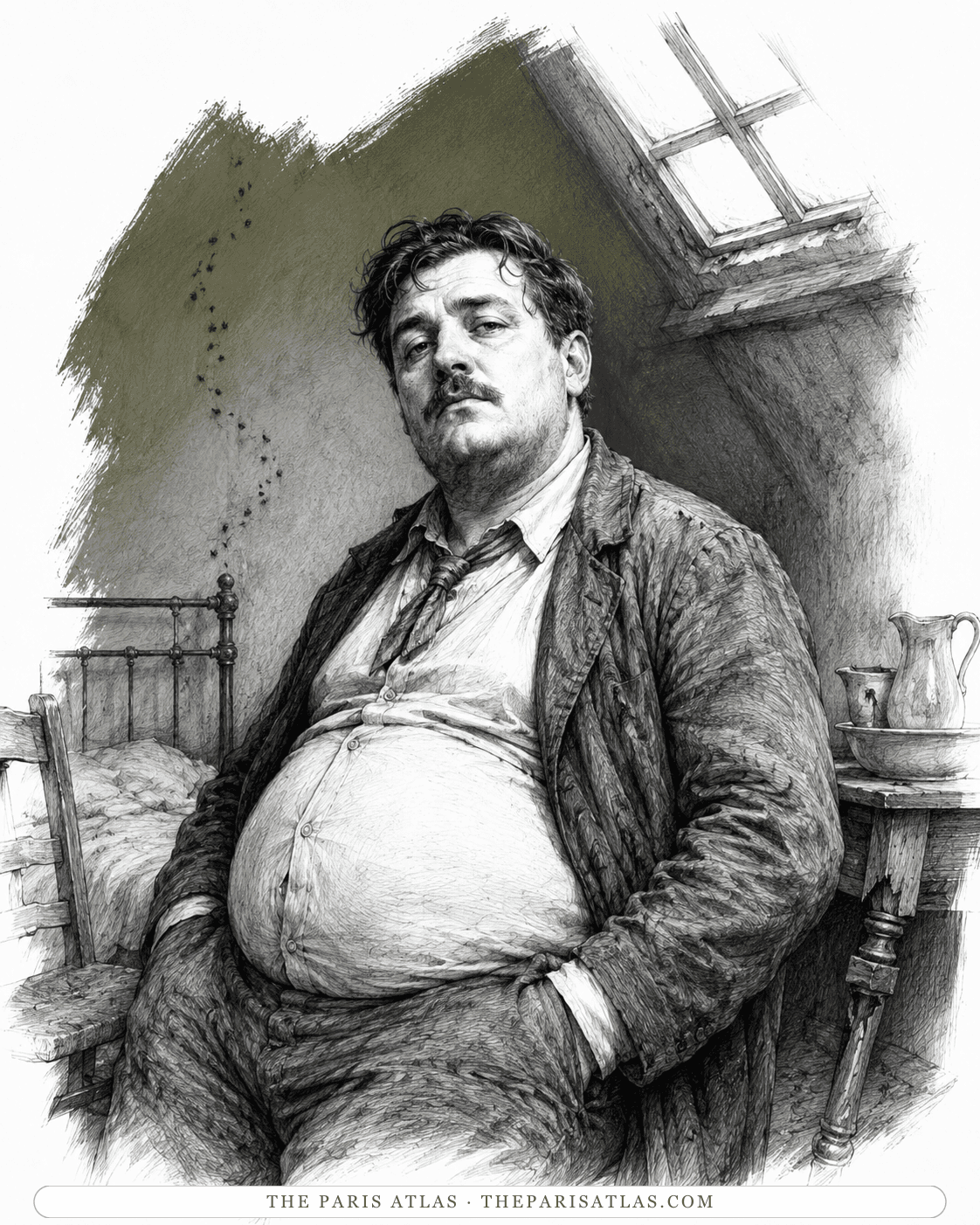
Spoiler-freeGeorge Orwell met Boris in the public ward of a Paris hospital, where the Russian was being treated for arthritis in his left leg and told the Englishman to come to him if he was ever in difficulties. Boris was about thirty-five, big and soldierly, and had grown fat from months in bed. His parents were rich people killed in the Revolution. He served through the war in the Second Siberian Rifles, which he held to be the best regiment in the Russian Army, and was a captain at twenty. In Paris he worked in a brush factory, then as a porter at Les Halles, then as a dishwasher, and climbed to waiter. When he fell ill he was at the Hôtel Scribe, taking a hundred francs a day in tips.
By the time Orwell went looking for him, none of that was left. Boris was in an attic ten feet square off the rue du Marché des Blancs Manteaux, sleeping on the floor under a skylight that let in the rain and living on two francs a day paid by the mechanic who rented the room and owed him three hundred francs. Before that he had slept a week on the quay under the Pont d'Austerlitz among empty wine barrels. Orwell, who had come for help and found a man worse off than himself, bought him a loaf. Boris ate half of it, sat up in bed, and announced that Orwell's remaining sixty francs were a fortune.
That is the pattern of nearly every scene he appears in. Fed, he plans; hungry, he collapses. Food acted on his system, Orwell writes, as rapidly as a cocktail. The two spent three weeks walking Paris for work, one day crossing the Seine eleven times, and were refused over and over because of the leg. Boris met all of it in military vocabulary. Leaving a lodging-house without paying was a ruse de guerre, and the maxim for a bad morning came from Foch: attack, attack, attack.
He is also what moves the Paris half along. Boris gets Orwell the job at the Hôtel X, then talks him out of it weeks later for the Auberge de Jehan Cottard, a restaurant so short of money it opened with two candles in the kitchen and brooms borrowed from the concierge. There he got what he had been working toward, his tail coat out of pawn and the title of head waiter, in exchange for eighteen-hour days, seven days a week.
How Boris Is Portrayed
- The look of himBig and soldierly, about thirty-five, and immensely fat since the illness that kept him months in bed. Orwell finds him asleep in the attic with his belly making a mound under the grimy sheet and his chest spotted with insect bites. The shoulders were broad enough to block an office doorway, and when good news came he took Orwell's hand in a grip that nearly broke the bones.
- Everything he had to wearOne suit, one shirt, a collar and tie, shoes almost worn through and socks all holes, plus an overcoat held back to be pawned in the last extremity. His waiter's tail coat stayed in the pawnshop until the Auberge job redeemed it.
- Standing straightWalking was agony on the bad leg, and restaurants turned him down for it. At one interview he stood upright the whole time without leaning on his stick, and the manager noticed nothing until he moved. "Ah," the manager said, "you limp."
- The photographsThe Revolution left him his medals and some photographs of his old regiment, and he kept those when everything else went to the pawnshop. Almost every day he spread them on the bed and narrated them: himself at the head of his company, a captain at twenty, his father a colonel.
- Napoleon and the restHe had read innumerable books of strategy and could talk about Napoleon, Kutuzof, Clausewitz, Moltke and Foch. His favourite café was the Closerie des Lilas, because the statue of Marshal Ney stands outside it, and he left the Métro at Cambronne rather than the nearer Commerce, for the sake of the general who answered a demand for surrender at Waterloo with a single word. Told he must abandon his suitcase, he cited Napoleon at the Beresina.
- Turned out for a job huntHe shaved without soap using a razor-blade two months old, tied his tie so the holes did not show, stuffed his shoe soles with newspaper, and inked the skin of his ankles where it showed through his socks. Before meeting the patron of the Auberge he smacked his cheeks at a jeweller's window to bring the blood into them, on the grounds that looking hungry makes people want to kick you.
- The suitcase of stonesHis scheme for leaving a lodging without paying: pawn both overcoats, fill the suitcase with stones from the Seine bank so the landlord who lifts it thinks it still packed, and carry the real possessions out wrapped as dirty laundry. He then held the landlord in loud conversation about bicycle racing while Orwell slipped past the office door with the bag.
- Two hundred mistressesHe once tried to compute how many mistresses he had had and made it over two hundred. In hopeful moods he spent fifty centimes on a stamp and wrote to one of them for money. Only one replied, a woman who also owed him two hundred francs, with a long affectionate letter full of memories and encouragement and no money. He went to bed and would not look for work again that day.
- The appetiteHunger tormented him, Orwell notes, without ever seeming to make him thinner. On one of the worst days the two of them wrote imaginary menus on the backs of envelopes, and Boris chose oysters, bortch, crayfish, chicken en casserole, beef with stewed plums, salad, suet pudding and Roquefort, with a litre of Burgundy and old brandy.
- The patron saintHe said, seriously, that a patron saint watched over him, and when things were bad he searched the gutter for the two-franc pieces the saint dropped there. Waiting to ask for work in the rue Royale he burned a fifty-centime candle to the saint in the Madeleine, then came out and put a match to a fifty-centime stamp as a sacrifice to the immortal gods, to be safe. They missed the job.
- What a plongeur can affordWhen Orwell told the Hôtel X honestly that he might leave in a fortnight, and lost the job for it, Boris called him a fool for the first time in their friendship. He took Orwell by the lapel and asked whether he thought a dishwasher could afford a sense of honour. Sign on for the month, ask to be paid by the day, walk out when the restaurant opens.
- The room in the Blancs ManteauxHe slept on the floor of a room rented by a Jewish mechanic who owed him three hundred francs and was repaying it at two francs a day. Boris called being in that position torture for a Russian of family, and Orwell records his long contemptuous monologues about Jews before breaking them off with 'etc. etc.'
- The three kilometresOn the day he got work in the cafeterie at the Hôtel X, after ten or twelve hours on his feet and with the bad leg, his first act was to walk three kilometres to Orwell's hotel and shout the news up at the window. For three days after that he met Orwell on a bench in the Tuileries with food stolen out of the hotel under his waistcoat.
The Auberge de Jehan Cottard opens ten days late, filthy and undercapitalised, and against Orwell's expectations it succeeds: once the first Frenchman comes in and brings two more the next night, the place has a name. Orwell leaves for a job in England and hears from Boris afterwards.
If you like Down and Out in Paris and London


If you like George Orwell
Explore authors with a similar voice, perspective, and influence.

Henry Miller
The Brooklyn dropout who arrived in Paris broke at thirty-eight and wrote the exuberant, banned books that ended American censorship.
View author
Louis-Ferdinand Céline
The doctor of the Paris slums who wrote the century's blackest, funniest novel — and changed the sound of French prose.
View author
Simone de Beauvoir
French writer and philosopher whose novels, memoirs, and social analysis examined freedom, gender, responsibility, aging, and the material conditions that shape a life.
View author