The patron
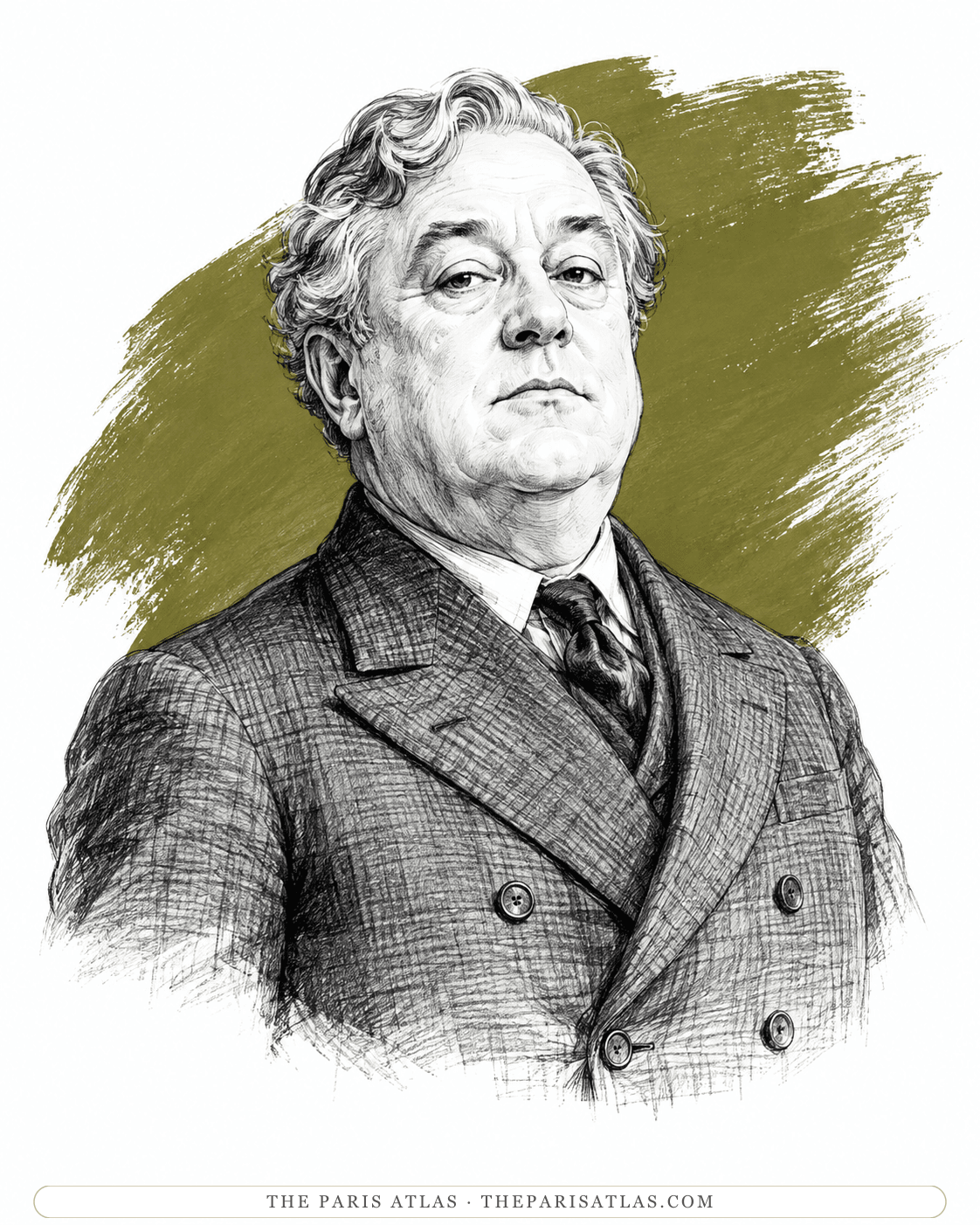
The owner of the Auberge de Jehan Cottard: an ex-colonel of the Russian Army in a double-breasted flannel suit, who opened a restaurant with no money, no saucepans, and a printed leaflet claiming Charlemagne had eaten on the site.
In Orwell's account the patron wants to be the proprietor of a chic Paris restaurant, and treats the financing as a detail that will arrange itself. He kept the same hours as the staff and spent them standing in the bar, smoking and looking gentlemanly, which Orwell says was his whole job apart from ordering the supplies.
The book

At a glance
- Owner of the Auberge de Jehan Cottard, in the rue du Commerce
- Never given; "the patron" throughout
- An ex-colonel of the Russian Army, according to Boris
- Short, fattish, dignified; wavy grey hair, double-breasted flannel, scent
- A French wife, who is the one really managing the restaurant
- Ordering the supplies, and standing in the bar looking gentlemanly
- Chapters IX, XVI, and XIX to XXI
Who they are in the book
Spoiler-freeGeorge Orwell went down to the rue du Commerce with Boris to ask for a job in a restaurant that did not yet exist, and met its owner. He describes a short, fattish, very dignified man with wavy grey hair, in a smart double-breasted flannel suit, smelling of scent. Boris said he had been a colonel in the Russian Army, as Boris himself had been an officer, and his wife, a Frenchwoman, was in the room too. The conversation that got Orwell hired never touched on washing dishes. The book calls him the patron from beginning to end and never gives him a name.
He was decorating the place in what he called le Normand: sham beams stuck on the plaster, electric lights made up as candlesticks, peasant pottery, a mounting block at the door. The bar was hung with indecent pictures by an artist from the Salon. He had a leaflet printed about the historical associations of the street, which claimed among other things that an inn on the site had once been frequented by Charlemagne, and he was very pleased with that touch. What he did not have was money. When baize for the tables turned out to be expensive he bought disused army blankets that smelled of sweat and covered them with check cloths. Orwell decided at the first meeting that the man was a cheat, and worse, an incompetent one. Two unmistakable duns were already waiting at the back door.
He announced that the restaurant would open exactly a fortnight from that day, then said the same thing again a fortnight later. He had hired the staff early in order to use them as unpaid workmen on the building, which Orwell reckons cost the four of them several hundred francs. Creditors were told he was at Fontainebleau or Saint Cloud. Promised advances did not arrive, and on one of those nights Orwell had nothing to eat, could not face his landlady over the rent, and slept on a bench on the boulevard. Through all of it the patron remained faultlessly polite. He is the only person in the restaurant that Orwell says never once forgot his manners.
How The patron Is Portrayed
- The look of himShort, fattish and very dignified, with wavy grey hair. He wore a smart double-breasted flannel suit and smelled of scent. Orwell adds nothing further about his face or his build.
- His wifeA Frenchwoman, in the room at the interview and, by Orwell's account, the one really running the restaurant. He describes her in a single line as a fat woman with a dead-white face and scarlet lips, which put him in mind of cold veal and tomatoes.
- The interviewHe established that Orwell was English, said he need not ask whether an Englishman played golf, and asked to be shown a few of the principal strokes. Orwell explained the difference between a driver and an iron, and was told the matter was settled: Boris would be maître d'hôtel and he would be plongeur, with a chance of rising to lavatory attendant if trade was good.
- The mannerHe had a way of waving one hand and flicking his cigarette ash at the same time, which Orwell says looked very grand. He handed out expensive cigarettes, greeted bad news with blandness, and delivered "exactly a fortnight from today" in the same grand voice on both occasions he used it.
- The five francsOn a visit when nothing at all had been done to the restaurant except the pictures in the bar, and there were three duns instead of two, he greeted Orwell with his usual warmth and then borrowed five francs from him. Orwell was his prospective dishwasher and was living on bread at the time.
- Where the money wentThree candles allowed in the kitchen when the light fused every evening. Eight copper saucepans obtained on credit, which the creditors came to seize at midnight before the opening and were bought off with half a bottle of brandy. A bribe, Orwell believes, to the inspector of labour who had noticed that the staff included no Frenchmen.
- Shiftiness and aristocratic mannersOrwell's own phrase for the combination that made him so hard to deal with. He never lost his temper and never raised his voice, kept the same seventeen-hour day as everyone else, and had nothing to do in it. His wife was the one actually running the restaurant.
- The nightly brandyAt half past twelve, as Orwell went out past the bar, the patron stopped him to say how tired he looked and to ask him to do him the favour of accepting a glass of brandy. Orwell says it was handed over as courteously as though he had been a Russian duke rather than a dishwasher, and that this was their compensation for a seventeen-hour day.
- Sharp knivesHe bought very sharp table knives, which Orwell calls the sole gleam of sense he showed in fitting the place out, and probably part of the reason the restaurant worked at all.
Orwell expected the restaurant to fail and says so repeatedly.
When Orwell gave a day's notice to take a job in England,
If you like Down and Out in Paris and London


If you like George Orwell
Explore authors with a similar voice, perspective, and influence.

Henry Miller
The Brooklyn dropout who arrived in Paris broke at thirty-eight and wrote the exuberant, banned books that ended American censorship.
View author
Louis-Ferdinand Céline
The doctor of the Paris slums who wrote the century's blackest, funniest novel — and changed the sound of French prose.
View author
Simone de Beauvoir
French writer and philosopher whose novels, memoirs, and social analysis examined freedom, gender, responsibility, aging, and the material conditions that shape a life.
View author