The white-bearded screever
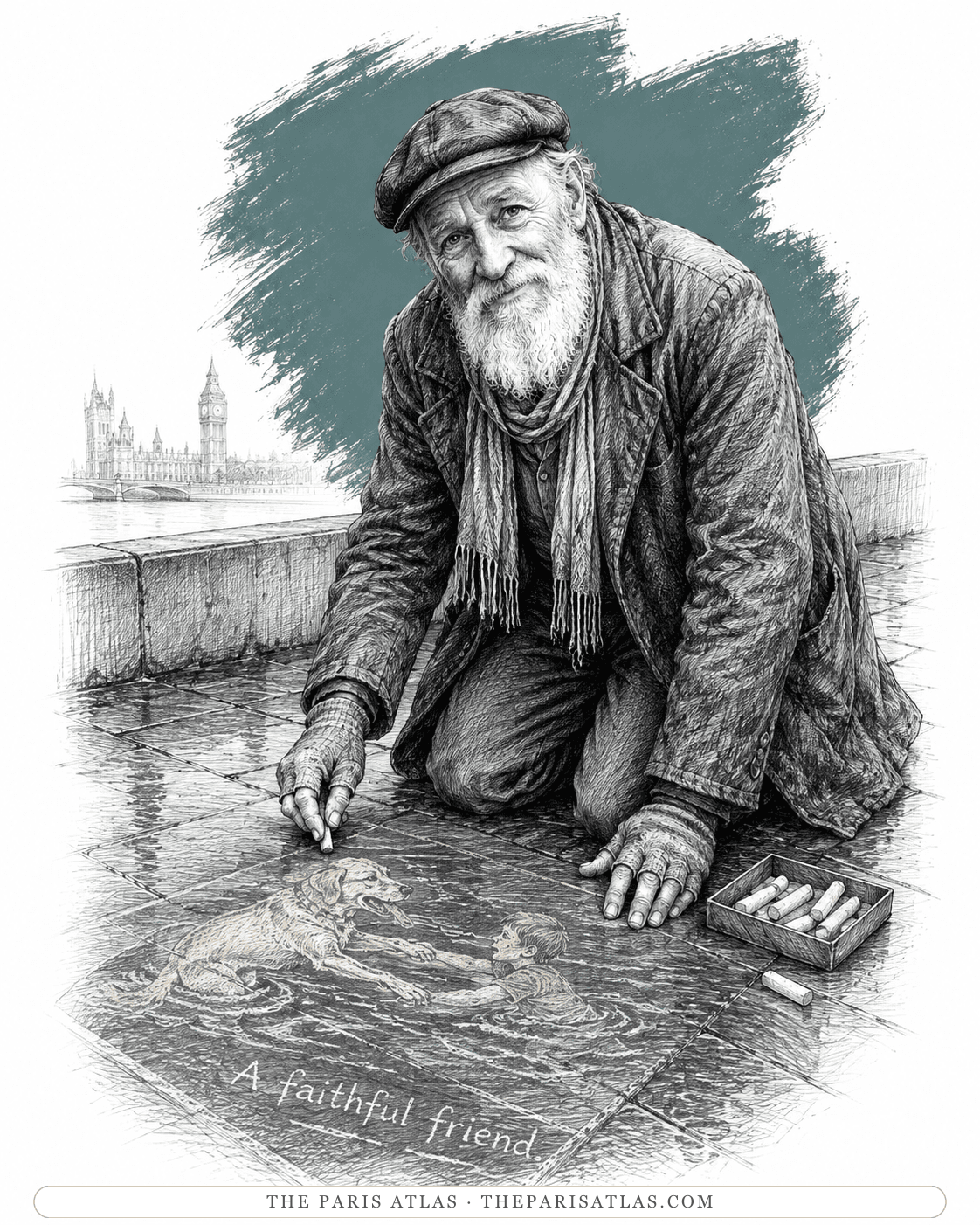
An old pavement artist fifty yards along the Embankment from Bozo's pitch, who had drawn the same picture every day for ten years: a dog pulling a child out of the water, captioned "A faithful friend". Bozo, who prided himself on a fresh cartoon daily, held him in complete contempt.
The book

At a glance
- One of the pavement artists working the Thames Embankment, pointed out to Orwell by Bozo
- Never given
- Ten years on the same picture, by Bozo's count
- Only from Bozo's pitch, fifty yards away; the two never speak
- Chapter XXX
Who they are in the book
Spoiler-freeGeorge Orwell's Down and Out in Paris and London, published in 1933, is his own account of washing dishes in Paris and then tramping in England. In the London half he falls in with a man called Bozo, who worked the Thames Embankment near Waterloo Bridge as a screever. Orwell explains the word the first time he uses it: a screever is a pavement artist. The work meant kneeling on the paving stones with a box of coloured chalks, drawing a picture there, and taking a hat round the people who stopped to watch.
Pitches were spaced out. At that time there was a screever roughly every twenty-five yards along the Embankment, twenty-five yards being the recognised minimum between one man and the next. Fifty yards from his own pitch, Bozo pointed out an old man with a white beard and told Orwell what he thought of him. The old man had been drawing the same picture every day for ten years: a dog pulling a child out of the water, with "A faithful friend" written underneath.
Bozo's contempt for him was a professional argument. Bozo used proper artists' colours rather than blackboard chalk, worked from a notebook of politicians copied out of the newspapers, and put up a new cartoon every day, because in his view the whole thing with cartoons is being up to date. He once heard that a child had got its head stuck in the railings of Chelsea Bridge and had the cartoon on the pavement before they had got the child out. By that standard the old man was not an artist at all. Bozo's line was that he could not draw any better than a child of ten and had learned his one picture by rule of thumb, the way you learn to put a puzzle together.
Everything the book says about the old man comes from Bozo, across fifty yards of pavement. Orwell never speaks to him and never gives his name. What Orwell adds himself is why a man in that position drew at all rather than asking outright. Under the English begging laws of the time, approaching a stranger for twopence could get you seven days, while chalking pictures on the pavement counted as following a legitimate trade.
How The white-bearded screever Is Portrayed
- The pictureA dog pulling a child out of the water, captioned "A faithful friend". The same one, drawn again on the pavement every day for ten years.
- How Bozo says he did itLearned by rule of thumb, like putting a puzzle together, rather than drawn from any training. Bozo's verdict was that the old man could not draw any better than a child of ten.
- Where he kneltFifty yards along the Embankment from Bozo's pitch. Screevers worked about twenty-five yards apart, that being the recognised minimum distance between pitches.
- What Bozo called himOne of "the salmon platers", Bozo's term for the other pavement artists on the Embankment. The book does not explain the phrase, only the contempt in it.
- Why the work was chalkOrwell notes that asking a stranger for twopence could bring seven days for begging, while drawing on the pavement counted in law as a legitimate trade.
If you like Down and Out in Paris and London


If you like George Orwell
Explore authors with a similar voice, perspective, and influence.
Henry Miller
The Brooklyn dropout who arrived in Paris broke at thirty-eight and wrote the exuberant, banned books that ended American censorship.
View author
Louis-Ferdinand Céline
The doctor of the Paris slums who wrote the century's blackest, funniest novel — and changed the sound of French prose.
View author
Simone de Beauvoir
French writer and philosopher whose novels, memoirs, and social analysis examined freedom, gender, responsibility, aging, and the material conditions that shape a life.
View author