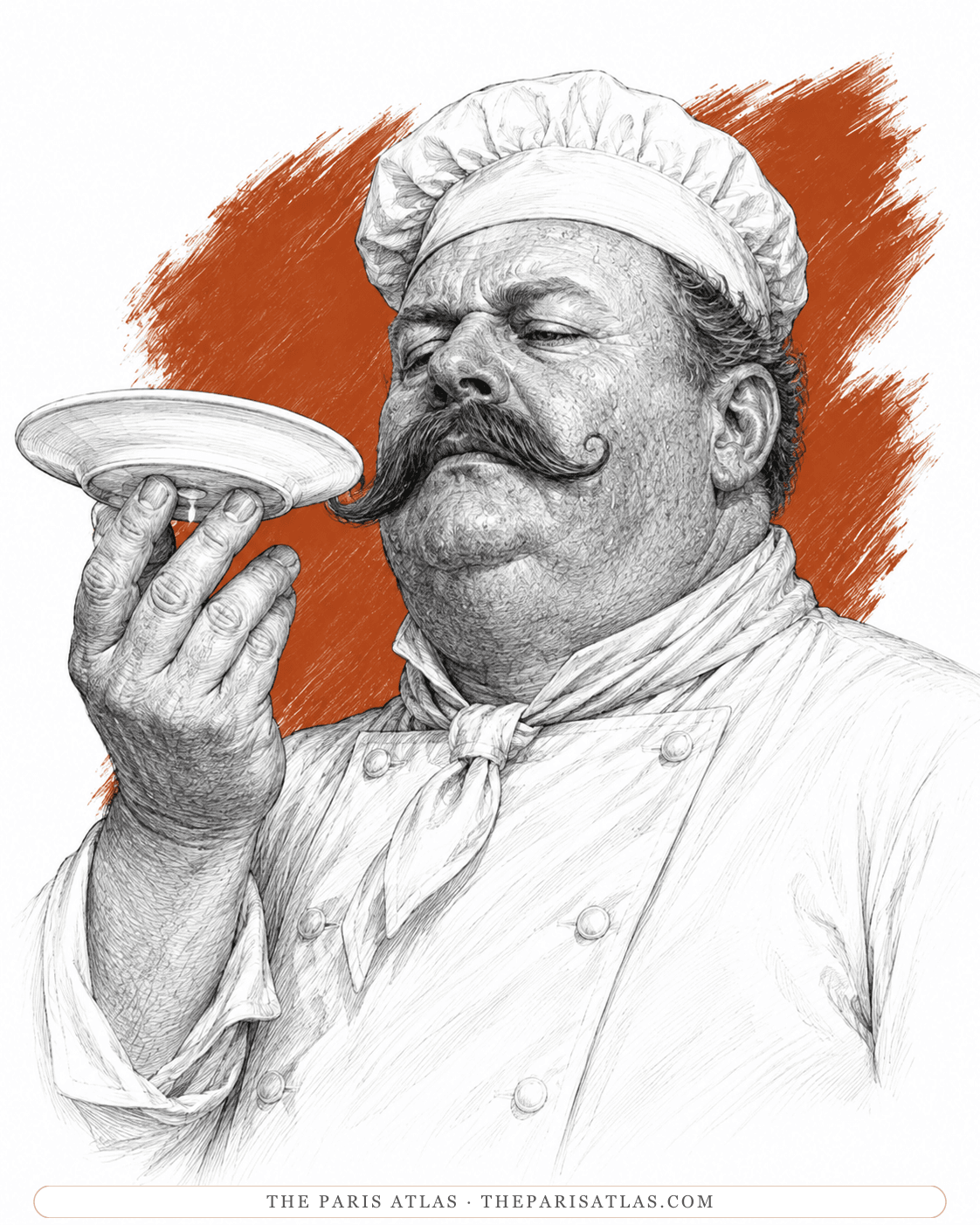
The head cook at the Hôtel X
The head cook of the grand hotel: a scarlet-faced man with big moustaches who stood in the middle of the kitchen calling out several hundred dishes a day from memory. Orwell calls him an insufferable bully and an artist in the same sentence. Not the cook at the Auberge de Jehan Cottard later in the book, who is a Baltic Russian woman.
In George Orwell's account, to have every dish leave his kitchen at the minute it falls due. He cooked few of them himself and inspected all of them, and made it a point of honour to insult everyone in the building below the head waiter.
The book

At a glance
- Head cook of the Hôtel X, near the Place de la Concorde
- Never given
- A fine, scarlet man with big moustaches
- About five thousand francs a month, against seven hundred and fifty for a plongeur
- Chapters X, XIII and XIV
Who they are in the book
Spoiler-freeThe kitchen of the Hôtel X was a low-ceilinged cellar lit red from the fires, so hot that every piece of metalwork except the stoves had to be kept covered with cloth. Twelve cooks worked the furnaces in the middle of it, sweating through their white caps, with waiters and plongeurs clamouring at three counters and scullions scouring copper saucepans with sand. George Orwell went down there several times a day to fetch meals, and the head cook stood in the middle of the room booming orders without a break.
Orwell took his tray to the wrong counter the first time. The head cook walked over, twisted his moustaches, looked him up and down, then beckoned the breakfast cook and pointed: this was the type of plongeur they were sent nowadays. He asked whether Orwell came from Charenton, where the lunatic asylum is, and on being told England said he might have guessed. Orwell got a version of that reception on every trip, since he always made some mistake and was expected to know the work. Out of curiosity he counted the number of times he was called maquereau in one day. It was thirty-nine.
The abuse and the skill were the same man. Between breakfast and lunch the head cook took orders for several hundred dishes, all due at different times. He cooked few of them, gave instructions on all of them, and inspected each one before it went up. The vouchers were pinned to a board he seldom looked at. Everything was in his head, and exactly to the minute, as each dish fell due, he called for it. Orwell rates him the most workmanlike type in the hotel and the least servile, and writes that he was an insufferable bully and also an artist.
How The head cook at the Hôtel X Is Portrayed
- The face and the handsA fine, scarlet man with big moustaches, which he twisted while he looked a new plongeur up and down. The other note Orwell keeps is for his fingers: fat and pink, and licked a hundred times over the course of a morning's tasting.
- In the middle of the roomStanding among twelve cooks skipping to and fro at the furnaces, booming out the orders continuously, and breaking off only to curse at a plongeur.
- The receptionA tray brought to the wrong counter got Orwell held up as an exhibit to the breakfast cook, and a question about whether he had come from the asylum at Charenton.
- Thirty-nineThe number of times Orwell was called maquereau in a single day at the kitchen counters. He counted out of curiosity.
- The board he did not readSeveral hundred dishes a day, all due at different moments, with the vouchers pinned up and ignored. He called each one at its minute from memory, and Orwell says he never missed.
- Inspecting a steakHe picked it up in his fingers, slapped it down, ran his thumb round the dish and licked it to taste the gravy, then did it again. He stepped back and looked at the meat the way a painter looks at a picture, pressed it into place, and wiped his fingerprints off the dish before handing it over.
- RankAbout five thousand francs a month, a table of his own in the kitchen, and an apprentice cook to wait on him. Cooks were the only men in the hotel allowed moustaches, and wore them, Orwell was told, to show their contempt for the waiters.
If you like Down and Out in Paris and London


If you like George Orwell
Explore authors with a similar voice, perspective, and influence.

Henry Miller
The Brooklyn dropout who arrived in Paris broke at thirty-eight and wrote the exuberant, banned books that ended American censorship.
View author
Louis-Ferdinand Céline
The doctor of the Paris slums who wrote the century's blackest, funniest novel — and changed the sound of French prose.
View author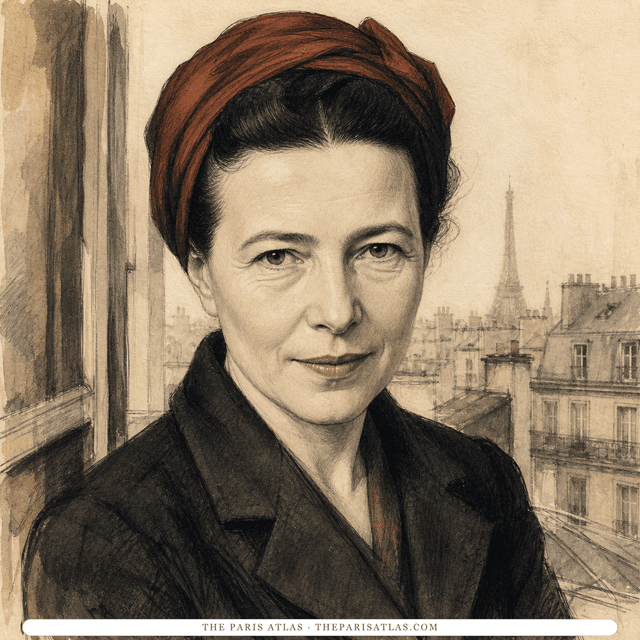
Simone de Beauvoir
French writer and philosopher whose novels, memoirs, and social analysis examined freedom, gender, responsibility, aging, and the material conditions that shape a life.
View author