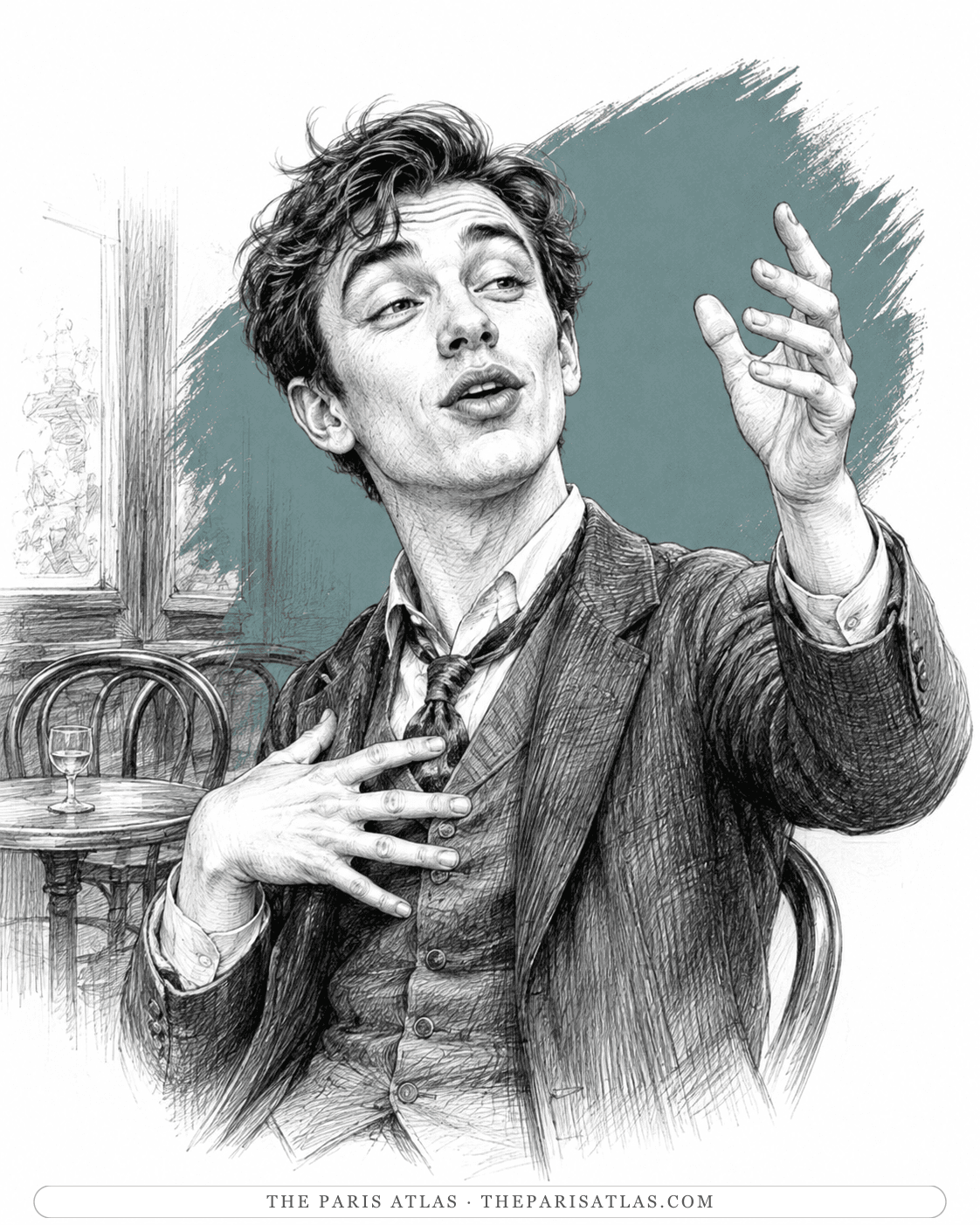
Charlie
A young man of family and education who ran away from home and lives in the quarter on occasional remittances. He drinks in the bistro under the hotel and talks, mostly about himself. Two chapters are given over to monologues of his, taken down at length.
To be taken for a connoisseur of pleasure. At twenty-two he tells the room he is worn out and finished, that he has plumbed abysses of wisdom, and that he will now expound the higher, more refined pleasure known to civilized men alone.
The book

At a glance
- A regular in the bistro under the narrator's hotel, in the Paris chapters
- Twenty-two
- Family and education; ran away from home
- Occasional remittances, and whatever he can get without working
- A brother in Paris who is a lawyer, and parents who told the brother to feed him
- Chapters II and XVIII in full, the Saturday night in XVII, and the Roucolle story in XXIII
Who they are in the book
Spoiler-freeCharlie is one of the regulars in the bistro beneath the Hôtel des Trois Moineaux, and George Orwell introduces him not as a friend but as a sample of the conversation there, one of the local curiosities: a youth of family and education who had run away from home and lived on occasional remittances. He is twenty-two. Orwell draws him as physically boyish, pink and young, with the fresh cheeks and soft brown hair of a nice little boy, tiny feet, very short arms, hands dimpled like a baby's, and lips excessively red and wet. He capers while he talks, declaims like an orator on a barricade, and will talk to anyone in the room so long as the subject is himself. Orwell's verdict on the sight of him is one line: he is, somehow, profoundly disgusting to see.
Chapter II is one of his performances, transcribed whole. He announces that he will explain the true meaning of love, and then tells the story of what he calls the happiest day of his life. Two years earlier his brother, a lawyer, was in Paris and took him to dinner on their parents' instructions. Charlie let him get drunk at dinner, made him swallow a tumbler of brandy on the pretext that it would sober him up, went through his pockets while he lay unconscious, and left with eleven hundred francs. He spent the night looking for something he considered worth the money. A young man he fell in with took him to a shuttered house in a dark street, where a woman demanded a thousand francs at the door, took it, led him to the head of a flight of stone steps and told him to go down into the cellar and do what he liked, because she would see nothing, hear nothing and know nothing. The cellar was a bedroom lit red from floor to ceiling, and a girl of about twenty was on the bed. Charlie describes taking her by the throat, throwing her on the floor and raping her while she screamed for mercy, laughing at her, and telling her he had not paid a thousand francs in order to show mercy. He says that if the law had allowed it he would have killed her. He guesses aloud that she was a peasant girl her parents had sold.
He tells this at three in the afternoon to a bistro containing Madame F., the patronne, and one or two men out of work, and ends by telling them that this is love. Orwell prints the speech in Charlie's voice, adds two sentences about what a curious specimen he was and what diverse characters the quarter held, and moves on. Chapter XVIII is a second monologue, delivered drunk. Broke, and refusing on principle to work, Charlie had padded his girlfriend Yvonne with a borrowed cushion and sent her to a government maternity hospital to claim the free meals given to pregnant women. She ate there daily and smuggled bread and cheese back to him until his money came. A year later the nurse recognised her in the street and asked after the baby; Yvonne panicked and said it had been neither a boy nor a girl, and Charlie saved the situation by saying it was twins.
How Charlie Is Portrayed
- The look of himPink and young, with the fresh cheeks and soft brown hair of a nice little boy, and lips excessively red and wet. His feet are tiny, his arms abnormally short, his hands dimpled like a baby's. The one detail added later comes on a Saturday night, when he is drunk and holding a glass of sham absinthe in one fat hand.
- How he is introducedNot as a companion but as an exhibit. Orwell offers him as a sample of the queer conversations one heard in the bistro, and closes the chapter by saying he describes him to show what characters could be found in the quarter.
- The performanceHe gestures with his short arms, dances while he speaks, and does not need much of an audience. An almost empty bistro at three in the afternoon serves as well as a full one on a Saturday night. His small piggy eyes glitter once he gets going.
- What he claims to beA civilized man who has acquired the true wisdom and become, in the words the book leaves in French, refined and vicious. He dates his own exhaustion to the age of twenty-two.
- The story in Chapter IIHis account of the happiest day of his life: robbing his drunk brother of eleven hundred francs, and spending a thousand of it to rape a girl of about twenty in a red-lit basement room. He offers it to the bistro as an explanation of what love really is.
- How he describes the minutes afterCold and languid, full of vain regrets, and feeling, he says, a kind of pity for the weeping girl on the floor. He then complains of being prey to such mean emotions. His money was gone, so he walked home.
- What he will not doWork. Opening the second monologue, he says that with everything pawned there was nothing left open to him except work, which is a thing he will not do. He offers what he did instead as a souvenir of a refined and civilized life, and its moral as the triumph of his own intelligence.
- Saturday nightsDrunk by the middle of the evening, staggering about with a glass of sham absinthe, pinching the women in the room and reciting poetry. Sober again in the small hours, he takes the floor to talk about his soul for five minutes. He borrows thirty francs from Madame F. and is gone by half past one.
- A source Orwell does not trustThe long story of Roucolle, an old miser who paid six thousand francs for what turned out to be face powder and died within a fortnight of the police raid that followed, comes from Charlie on the narrator's last day in the quarter. Orwell prints it with the note that Charlie was very likely lying, as usual.
- A face that turns up againIn the London half, a shy, chubby clergyman handing out sixpenny meal tickets to a queue of tramps is described as curiously like Charlie, and is the one man in the queue the tramps are genuinely grateful to.
If you like Down and Out in Paris and London


If you like George Orwell
Explore authors with a similar voice, perspective, and influence.

Henry Miller
The Brooklyn dropout who arrived in Paris broke at thirty-eight and wrote the exuberant, banned books that ended American censorship.
View author
Louis-Ferdinand Céline
The doctor of the Paris slums who wrote the century's blackest, funniest novel — and changed the sound of French prose.
View author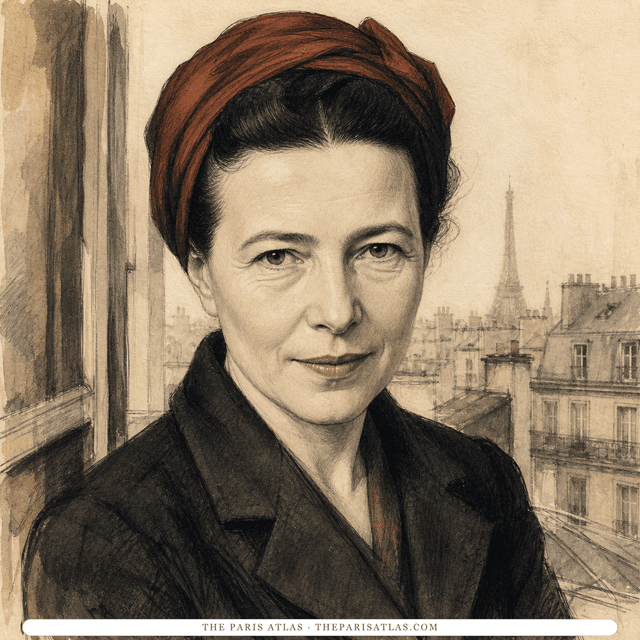
Simone de Beauvoir
French writer and philosopher whose novels, memoirs, and social analysis examined freedom, gender, responsibility, aging, and the material conditions that shape a life.
View author