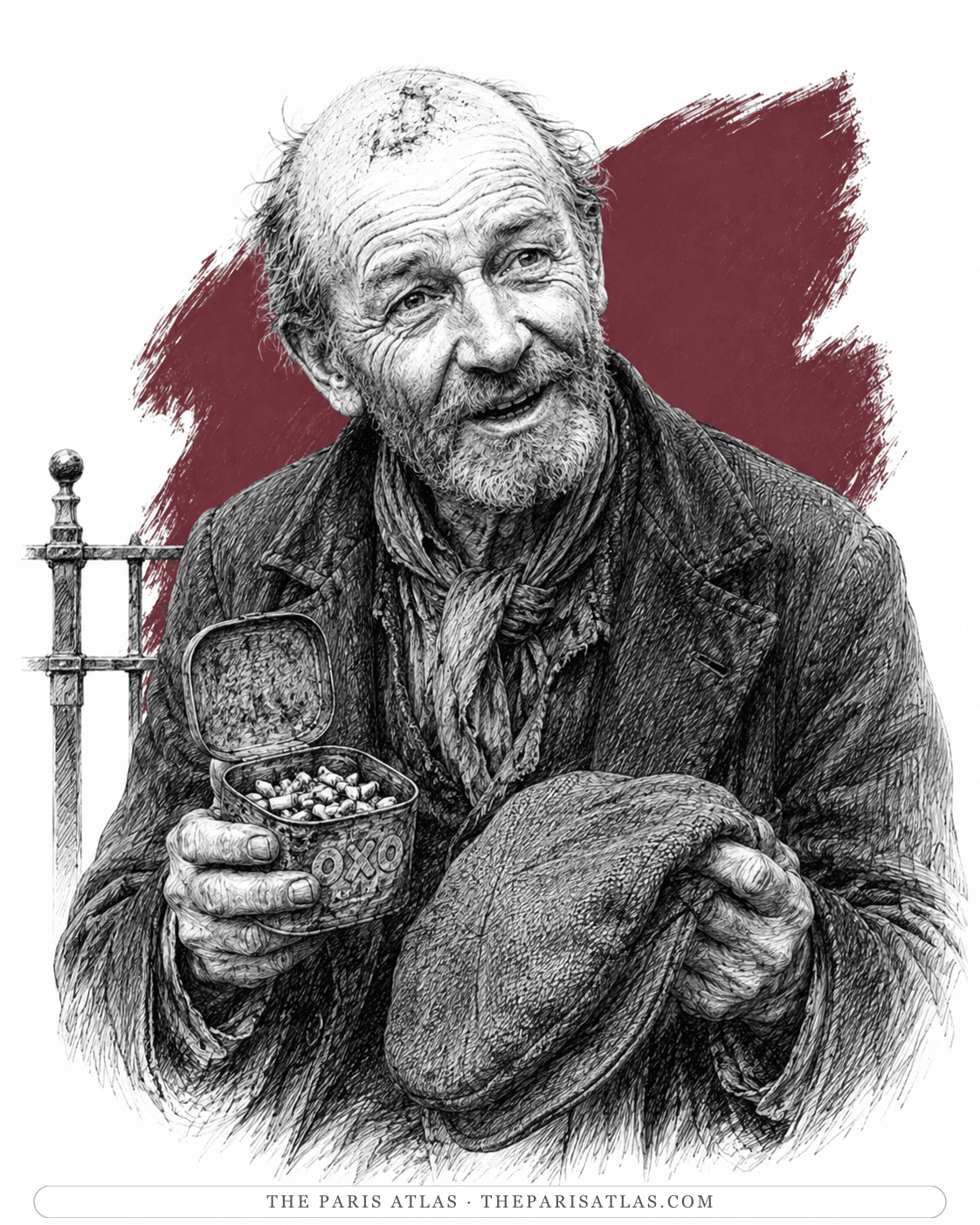
The Irishman at Romton
The old tramp leaning against the pigpens in Romton market-place who teaches the narrator the vocabulary of the road, takes him to a free tea, and walks him to the gate of his first casual ward.
In George Orwell's account, to get the day passed. He rates a cup of tea worth half an hour of prayers on exactly that ground, and fills an Oxo tin off the pavement rather than go without a smoke.
The book

At a glance
- The first tramp Orwell speaks to in England
- Never given
- Fifteen years
- Cigarette ends off the pavement, kept in an Oxo tin
- Chapters XXVI and XXVII
Who they are in the book
Spoiler-freeGeorge Orwell arrived at Romton in the afternoon with a halfpenny in his pocket and no idea how a casual ward worked. A wizened old Irishman was leaning against the pigpens in the market-place. Orwell went and leaned beside him and offered his tobacco box, and the Irishman opened it and stared: there was sixpennyworth of good tobacco in it, which was proof enough that the younger man had not been on the road long. He produced his own supply, a rusty tin that had once held Oxo cubes, with twenty or thirty cigarette ends in it picked off the pavement. With care, he said, you could collect two ounces a day in London.
He then explained the spikes, which is the tramps' word for casual wards. There are tea spikes, cocoa spikes and skilly spikes. Skilly is a can of hot water with some oatmeal at the bottom, and the skilly spikes are the worst. Romton was a cocoa spike the last time he was there, which he counted as a mercy; he had been up to York and round Wales since. His health was the other subject. He described his symptoms in full, and they came to eczema on a bald crown, shortsightedness with no glasses, chronic bronchitis, an undiagnosed pain in the back, dyspepsia, urethritis, varicose veins, bunions and flat feet. With that assemblage he had tramped the roads for fifteen years.
At about five he asked whether Orwell could do with a cup of tea, and led him to a tin-roofed shed in a side street, rather like a village cricket pavilion, where a lady gave out tea and buns and then kept the room for half an hour of prayers. He warned about the prayers in advance and dismissed them in the same breath: they passed the time. At a quarter to six he took Orwell to the spike itself, a smoky yellow cube of brick in the corner of the workhouse grounds, behind a high wall and iron gates. Orwell says he was a friendly old man and that he smelled very unpleasant, which was not surprising once one had heard the list.
How The Irishman at Romton Is Portrayed
- How the book describes himA wizened old man leaning against the pigpens in the market-place, obviously a tramp. Orwell calls him friendly and says he smelled very unpleasant, which he found unsurprising given the list of ailments the old man was carrying.
- The Oxo tinTwenty or thirty cigarette ends picked up off London pavements, which was nearly all the tobacco he ever had. Two ounces a day was the yield, with care.
- Three kinds of spikeTea spikes, cocoa spikes and skilly spikes. Skilly is hot water with oatmeal at the bottom of the can, and he thanked God Romton did not serve it.
- The catalogueEczema, no glasses for his shortsight, chronic bronchitis, a pain in the back nobody had diagnosed, dyspepsia, urethritis, varicose veins, bunions and flat feet, described from top to bottom on request.
- Fifteen yearsHow long he had been walking between casual wards with that list, going as far as York and round Wales between visits to the same spike.
- The free teaHe knew the shed where a cup and a bun could be had, and told Orwell straight out what it cost: a lot of prayers afterwards, which passed the time away.
If you like Down and Out in Paris and London


If you like George Orwell
Explore authors with a similar voice, perspective, and influence.

Henry Miller
The Brooklyn dropout who arrived in Paris broke at thirty-eight and wrote the exuberant, banned books that ended American censorship.
View author
Louis-Ferdinand Céline
The doctor of the Paris slums who wrote the century's blackest, funniest novel — and changed the sound of French prose.
View author
Simone de Beauvoir
French writer and philosopher whose novels, memoirs, and social analysis examined freedom, gender, responsibility, aging, and the material conditions that shape a life.
View author