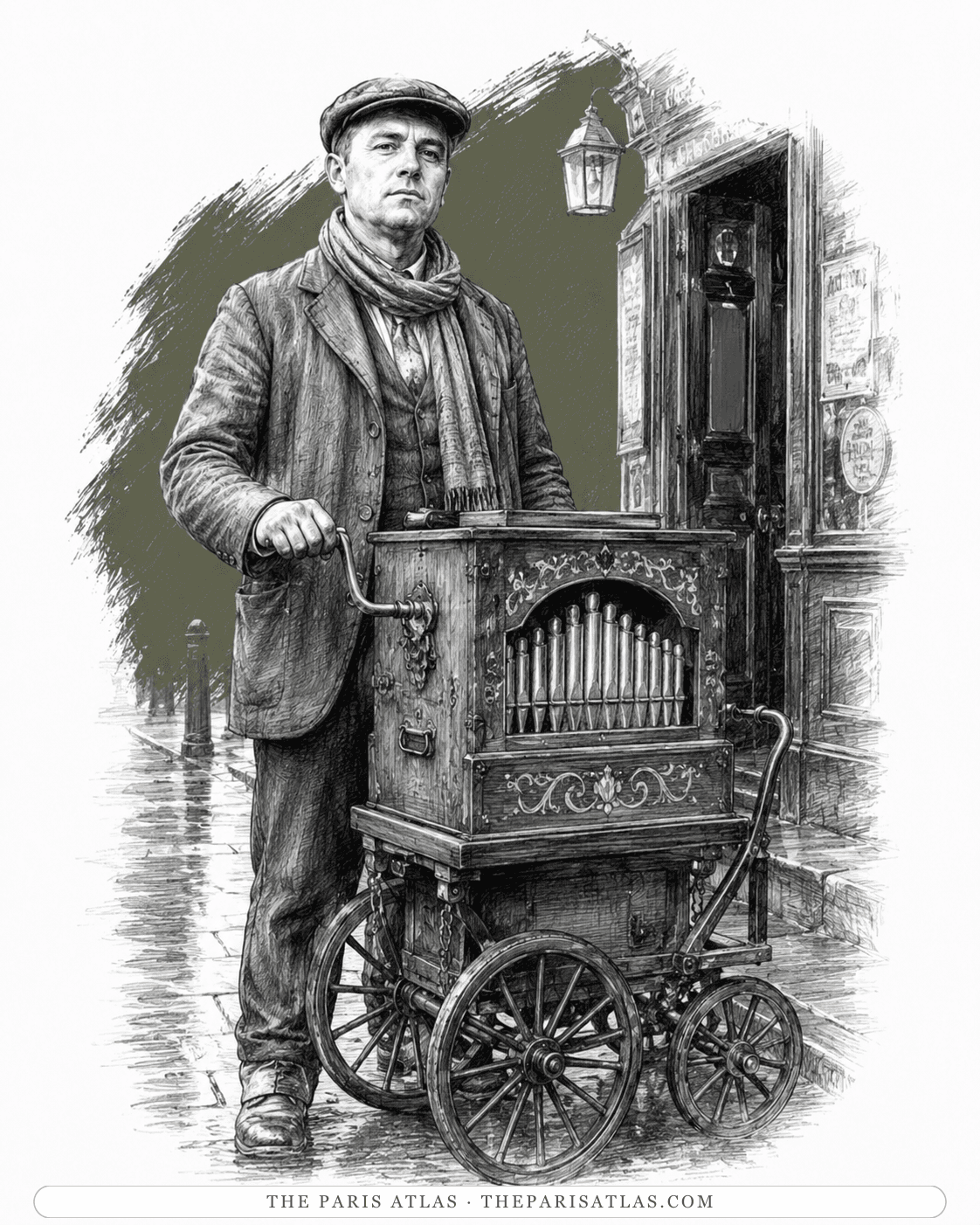
Shorty
An organ-grinder who worked the cheap pubs and coffee-shops round Whitechapel with a mate who had a wooden leg, and always played a second tune once the hat had come round.
In George Orwell's account, to be taken for an entertainer rather than a beggar. He plays a second tune after the money has been collected, on the grounds that a man paid to go away would not bother.
The book

At a glance
- An organ-grinder, and a friend of Bozo's
- Whitechapel and the Commercial Road
- About a pound a week each after the organ is paid for
- Chapter XXXI
Who they are in the book
Spoiler-freeShorty was a friend of Bozo's, and George Orwell got the trade from him directly. Organ-grinders, like street acrobats, are counted as artists rather than beggars, and it is a mistake to think they earn their living in the street: nine-tenths of the money is taken indoors, in coffee-shops and public houses, and only the cheap public houses, because the good-class ones will not let them in. He and his mate worked the houses round Whitechapel and the Commercial Road.
Their method had two parts. Shorty stopped outside a pub and played one tune. His mate, who had a wooden leg and could excite compassion, went inside and passed the hat. Then Shorty played a second tune. He would not leave that out, and treated it as a point of honour: the idea was that he was a genuine entertainer and not a man being paid to go away.
The books were thin. Between them they took two or three pounds a week, but the organ was hired at fifteen shillings a week, so they averaged about a pound each. They were on the streets from eight in the morning until ten at night, and later on Saturdays.
How Shorty Is Portrayed
- The pitchCoffee-shops and cheap public houses round Whitechapel and the Commercial Road. Nine-tenths of the take comes from indoors, and the good pubs bar them.
- The mateA man with a wooden leg, who went in with the hat while Shorty played outside, on the reasoning that he could excite compassion.
- The encoreA second tune after the drop, every time, which Shorty described as a point of honour rather than a way of earning more.
- The booksTwo or three pounds a week for the pair, fifteen shillings of it to hire the organ, and about a pound a week each left. Eight in the morning to ten at night, later on Saturdays.
If you like Down and Out in Paris and London


If you like George Orwell
Explore authors with a similar voice, perspective, and influence.

Henry Miller
The Brooklyn dropout who arrived in Paris broke at thirty-eight and wrote the exuberant, banned books that ended American censorship.
View author
Louis-Ferdinand Céline
The doctor of the Paris slums who wrote the century's blackest, funniest novel — and changed the sound of French prose.
View author
Simone de Beauvoir
French writer and philosopher whose novels, memoirs, and social analysis examined freedom, gender, responsibility, aging, and the material conditions that shape a life.
View author