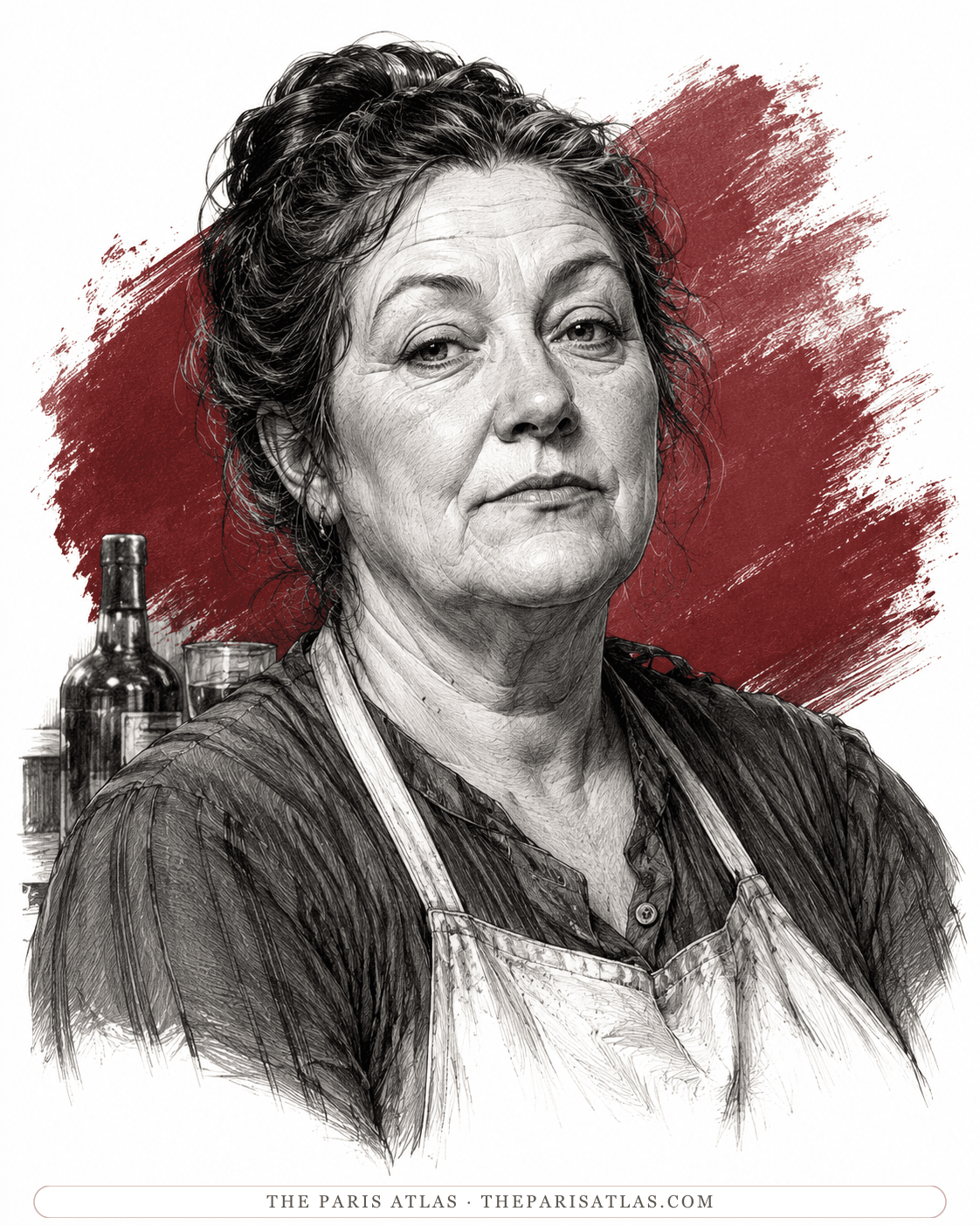
Madame F.
The patronne of the Hôtel des Trois Moineaux, where the narrator lodges, and of the bistro in its cellar. She sets the rent, judges the lodgers, pours the wine on Saturday nights, and takes a drunk stonemason's wages off him before he can spend them.
To keep the house paid for and its people intact. Every Saturday at about five she tells someone to catch Furex, a stonemason who drinks himself insensible each weekend, before he can spend his wages, and holds the money back, leaving him enough for one good drink.
The book

At a glance
- Patronne of the Hôtel des Trois Moineaux and of the bistro below it
- The Auvergne, by Orwell's description
- Five storeys, forty partitioned rooms, thirty to fifty francs a week
- Malaga, all day, for her stomach
- Runs the place with her husband, who is never named or described
- Chapters I to IV, and the bistro chapters XVII and XIX
Who they are in the book
Spoiler-freeMadame F. keeps the house George Orwell lives in for the Paris half of the book. The Hôtel des Trois Moineaux is a five-storey warren cut by wooden partitions into forty rooms, in a slum quarter Orwell calls the rue du Coq d'Or; he in fact lodged at 6 rue du Pot de Fer, off the rue Mouffetard. Rooms let at thirty to fifty francs a week to a floating population of cobblers, bricklayers, stonemasons, students, prostitutes and rag-pickers, most of whom arrive without luggage and are gone in a week. There is no maid and no time for sweeping, so the rooms are filthy and the walls are full of bugs. Orwell's summary is that it was a dirty place but homelike, because Madame F. and her husband were good sorts.
She also runs the bistro at the foot of the hotel, a brick-floored room half underground, fifteen feet square, with a photograph of a funeral on the wall captioned “Crédit est mort”. Half the hotel drinks there in the evenings. Orwell describes her as a splendid Auvergnat peasant woman with the face of a strong-minded cow, drinking Malaga all day for her stomach. On a Saturday night, with twenty people in the room, she is behind the bar filling measures through a pewter funnel and keeping a wet dishcloth within reach, because every man in the room tries to make love to her.
The narrator's dealings with her are almost entirely about money he does not have. He cannot take his own clothes out of the building to pawn them without asking her leave, and she is surprised that he asks rather than removing them on the sly, which is the usual trick in the quarter. She meets him on the bistro steps when he comes back, uneasy about the rent; he tells her the clothes fetched two hundred francs when they fetched seventy, and she is impressed by the price of English tailoring. Later, with the rent days overdue and no wages coming from the restaurant he is working in, he sleeps on a boulevard bench rather than face her about it.
How Madame F. Is Portrayed
- The house she keepsForty rooms behind wooden partitions, layers of pink paper hiding the cracks, and enough bugs that lodgers burn sulphur to drive them into each other's rooms. She has no maid and no time to sweep.
- How she is drawnA splendid Auvergnat peasant woman with the face of a strong-minded cow, drinking Malaga all day for her stomach. That is the whole of her physical description in the book.
- Behind the barPouring measures of wine through a pewter funnel for a room of twenty, with a wet dishcloth always to hand, because every man in the room tries to make love to her.
- The judge of lodgersShe does not like the look of a young Italian who turns up calling himself a compositor, and makes him pay a week in advance. He pays, stays six nights, cuts duplicate keys and robs a dozen rooms, the narrator's included. That theft is what starts the poverty the book is about.
- Looking after FurexFurex is a Limousin stonemason who works steadily all week and drinks himself into a paroxysm on Saturdays. Orwell says he would have gone to pieces without her. The week he got away from her he was run over in the Place Monge. When he is sick on a bistro table she hoists him like a sack and carries him up to bed.
- The rentThe one subject she cannot be talked round on for long. She meets the narrator on the bistro steps after his trip to the pawnshop with the question already in her eye, and he lies about what he got.
- What she knowsShe is the book's source on what goes on upstairs. It is on her authority that Orwell reports neither of the Rougiers, an elderly couple who sold photographs of Loire chateaux as pornography, had taken their clothes off in four years.
- Closing timeAfter one in the morning she waters the wine and the evening goes flat. She also lends Charlie thirty francs at that hour, and he leaves.
If you like Down and Out in Paris and London


If you like George Orwell
Explore authors with a similar voice, perspective, and influence.

Henry Miller
The Brooklyn dropout who arrived in Paris broke at thirty-eight and wrote the exuberant, banned books that ended American censorship.
View author
Louis-Ferdinand Céline
The doctor of the Paris slums who wrote the century's blackest, funniest novel — and changed the sound of French prose.
View author
Simone de Beauvoir
French writer and philosopher whose novels, memoirs, and social analysis examined freedom, gender, responsibility, aging, and the material conditions that shape a life.
View author